EU Architecture Roles: Use TOGAF, ArchiMate, EIRA Well

EU architecture work is not a generic enterprise architecture assignment
An enterprise architect at EU institutions is not hired simply to produce a target architecture or maintain a repository. The work sits where public-service design, cross-border interoperability, architecture governance and reusable digital building blocks meet. The common mistake is to arrive with a strong TOGAF certificate, polished ArchiMate diagrams and no working understanding of the European Interoperability Reference Architecture (EIRA).
That combination is not enough because the frameworks do different jobs. TOGAF supplies an enterprise architecture vocabulary and approach. ArchiMate supplies a modelling notation. The European Interoperability Framework (EIF) establishes the interoperability policy perspective. EIRA turns that perspective into an architecture content structure built around Architecture Building Blocks, or ABBs.
The right preparation is therefore EIRA-first, not certification-first. Start by learning how EIRA organises interoperable digital public services, then show that you can use TOGAF concepts and ArchiMate notation within that structure. This is not a prescribed institutional procedure; it is the most reliable way to make your architecture background relevant to assignments with an interoperability focus.
TL;DR
- EU-institution architecture work is centred on interoperability for digital public services, not generic enterprise modelling alone.
- EIF is the policy and interoperability baseline; EIRA is the reference architecture that operationalises it.
- TOGAF helps with architecture method and concepts; ArchiMate helps express the model; neither replaces EIRA.
- Enterprise architects usually work closer to standards, governance and reuse; solution architects work closer to service design and implementation choices.
- The strongest profile shows direct EIRA and EIF relevance, not just certifications.
The framework stack: know the job each component does
Most weak applications blur four distinct layers into one claim: “I know TOGAF and ArchiMate.” That statement says little about whether you can design an interoperable public service. A stronger profile shows how the four components connect without treating any one of them as a substitute for the others.
| Component | Its role in EU-institution architecture work | What it should change in your work | Common mistake |
|---|---|---|---|
| TOGAF | Provides architecture concepts and terminology, including architecture patterns, building blocks and views. | Use it to structure architecture thinking, governance and the relationship between business, application, data and technology concerns. | Assuming TOGAF alone tells you which interoperability building blocks to use. |
| ArchiMate | Provides the modelling notation used by EIRA. | Express architecture consistently and make relationships between services, capabilities, information and technology visible. | Delivering a technically correct model with no EIRA-specific content semantics. |
| EIRA | Provides a reference architecture organised into views aligned with EIF interoperability levels, plus an ABB-based content model for interoperable digital public services. | Select, classify and justify reusable architecture building blocks in an interoperability context. | Treating EIRA as a diagram template rather than a reference architecture. |
| EIF | Provides the interoperability policy and conceptual baseline. | Address legal, organisational, semantic and technical interoperability as connected architecture concerns. | Confusing policy-level interoperability principles with the architecture model itself. |
EIRA is technology- and product-neutral and follows a service-oriented architecture style. That matters. The assignment is not only about placing applications and integrations on a landscape. It is about designing services and interfaces that can work across organisational, sectoral and national boundaries. Reusable services, clear responsibilities and interoperable information exchanges belong in the architecture discussion from the beginning.
This is also where many otherwise capable architects miss the real stack. EIF tells you what kind of interoperability must be addressed. EIRA turns that into architecture content and views. TOGAF gives you familiar architecture concepts for structuring the work. ArchiMate makes the result readable and consistent. Once you see the stack that way, the role becomes much clearer.
Read the EIRA overview on the Interoperable Europe Portal before relying on older presentation material or previous-project conventions. The portal also provides EIRA v6.1.0 online documentation, which is the sensible starting point when an assignment pack does not specify another version.
Prepare the right evidence before discussing tools or certificates
For an enterprise architect or solution architect considering EU-institution assignments, the useful prerequisite is not a long list of platforms. It is evidence that your work connects strategy, service design, information, integration and governance. Build that evidence around the kind of architecture decisions the role is likely to require.
- Architecture governance: examples of how architecture principles, target states, patterns or reusable components guided decisions.
- Interoperability: work involving multiple organisations, shared services, common information exchanges or standards-based interfaces.
- Layer alignment: proof that you can connect business needs to application, data and technology architecture rather than modelling each layer in isolation.
- Public-service relevance: experience in public administration architecture or system-development environments where common terminology, accountability and reuse matter.
- Modelling discipline: models that explain a decision and its dependencies, not diagrams produced merely to document a tool.
Do not pad this evidence with every framework you have encountered. A short, traceable account of how you used architecture building blocks, maintained consistency across layers or supported a reusable service decision is more credible than a broad inventory of methods.

That traceability is especially important in EIRA-based work. If you say you improved interoperability, be ready to show whether the issue was legal, organisational, semantic or technical, how that concern affected the architecture, and which building blocks or views made the decision explicit. Generic framework language is weaker than a simple, disciplined chain from requirement to architecture consequence.
Enterprise architect and solution architect: the practical boundary
EU contracts do not use a single universal job taxonomy, so the assignment description always takes priority over the title. In practice, however, the distinction is usually clear once you look at the decisions the architect will own. Enterprise architecture operates nearer to the target state and the rules that keep multiple initiatives coherent. Solution architecture operates nearer to the design of a particular digital public service and its implementation choices.
| Area | Enterprise architect focus | Solution architect focus |
|---|---|---|
| Primary concern | Architecture direction, interoperability governance and consistency across the wider landscape. | Designing a specific digital public service so it is interoperable by design. |
| EIRA use | Establishes reusable ABBs, common architecture terminology and guardrails for initiatives. | Selects and applies appropriate ABBs to the service design and its interfaces. |
| EIF use | Ensures target-state decisions account for legal, organisational, semantic and technical interoperability. | Tests whether the proposed service design addresses those interoperability concerns in practice. |
| TOGAF and ArchiMate use | Frames architecture governance, views, patterns and cross-domain alignment. | Models the solution, dependencies and service relationships using the required architecture semantics. |
The overlap is significant. Both roles need the EIRA vocabulary because EIRA supports architecture and system-development work across public administrations. The useful dividing line is this: the enterprise architect decides how architecture should remain coherent and reusable across change; the solution architect makes those principles real in a service design.
Do not describe a solution architect role as purely technical. EIRA’s view structure makes that framing too narrow. A service can have a clean integration design and still fail as an interoperable public service if organisational responsibilities, legal constraints or semantic meaning have not been addressed.
This is also why public-sector architecture experience carries real weight. EU digital public services are not designed as isolated internal systems. They sit in an environment where multiple administrations, shared terminology, governance rules and reusable capabilities all matter at the same time.
Use EIRA as the bridge from interoperability intent to architecture work
The practical discipline is to move from an interoperability concern to a defensible architecture decision. EIRA is valuable because it prevents the work from becoming either an abstract policy discussion or a set of disconnected technical diagrams.
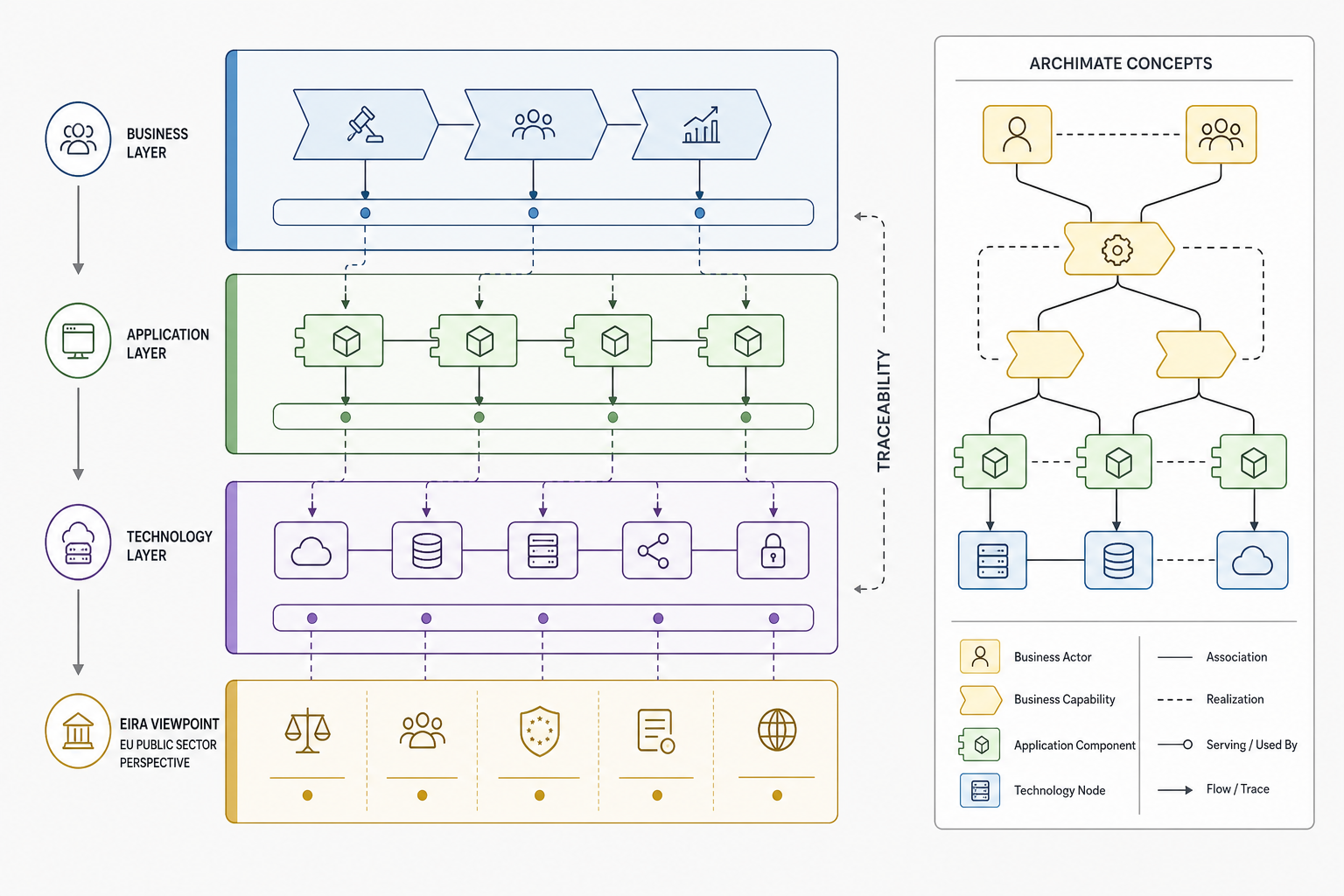
Requirement → EIF concern → EIRA ABBs → ArchiMate view → architecture decision
- Read the assignment for the service outcome, not just the technology vocabulary. Identify the public service, the organisations involved, the information that must be understood consistently and the interfaces that must remain reusable. This protects against starting with a preferred platform or integration pattern.
- Map the interoperability concerns to the EIF perspective. EIRA’s views align with the EIF interoperability levels: legal, organisational, semantic and technical. Treat these as connected design concerns. A technical interface does not resolve semantic ambiguity, and a common data representation does not establish organisational responsibility.
- Work with EIRA Architecture Building Blocks. ABBs are the content-level mechanism for analysing and designing interoperable services. The point is not to force every service into a stock diagram. It is to make the building blocks, their role and their relationships explicit enough to support reuse and consistent governance.
- Model with ArchiMate, but model EIRA meaning. ArchiMate is the notation layer; EIRA is the reference-architecture content layer. A model should therefore use ArchiMate to express architecture clearly while respecting the EIRA ABB taxonomy and viewpoints. This distinction separates useful EIRA work from generic enterprise modelling.
- Make the decision traceable across layers. Connect the service need to the relevant business, application, data and technology consequences. This is where an enterprise architect shows governance value and a solution architect shows design maturity.
The detailed explanation of EIRA concepts and its ArchiMate relationship is available in the portal’s chapter on key concepts and ArchiMate notation. Use it to sharpen the language in your portfolio and discussions. It is better to say that you can apply EIRA ABBs in ArchiMate models than to claim that ArchiMate knowledge alone makes you EIRA-ready.
Understand the building-block split: reference content first, solution content second
This is the part many candidates leave implicit. In TOGAF terms, EIRA sits on the reference-architecture side of the work. EIRA ABBs are specialisations of TOGAF Architecture Building Blocks. They describe the reusable architecture content and structure you use to analyse and shape interoperable digital public services. Solution building blocks sit closer to implementation.
That distinction helps in interviews and deliverables. If you present a product selection, interface pattern or implementation design too early, you are talking solution before you have made the interoperability architecture explicit. Stronger work starts by clarifying the ABB-level structure, then shows how solution choices realise that structure. The discipline is simple: first define what must exist in the architecture, then show how a specific solution realises it.
EIRA also supports this requirement flow. Interoperability requirements can be expressed across the EIF levels, grouped into interoperability aspects, and then realised through specifications and solution choices. That gives enterprise architects a governance logic and gives solution architects a clean path from requirement to design.
Certifications that carry weight — and the evidence that matters more
TOGAF certification is directly relevant because EIRA reuses TOGAF paradigms and terminology. It signals that you understand concepts such as architecture building blocks, architecture patterns and architecture views. ArchiMate certification is also valuable because EIRA uses ArchiMate as its modelling notation and extends its concepts for its own reference-architecture purpose.
Those credentials are useful, but neither is a complete answer to an EIRA-based assignment. The stronger profile demonstrates four things together:
- TOGAF fluency for architecture method, governance and structured decision-making.
- ArchiMate fluency for producing readable, consistent architecture models.
- Direct EIRA experience, or a well-evidenced ability to use EIRA ABBs for interoperable public-service design.
- EIF familiarity, especially where cross-border or cross-sector interoperability is central to the work.
There is no universal formal certification mandate or universal minimum experience requirement established by the EIRA material. Do not present one as if it exists. Instead, make the relevance of each credential explicit: TOGAF helps you work with EIRA’s architectural concepts; ArchiMate helps you express the architecture; EIRA and EIF knowledge demonstrate that you understand the interoperability context in which those skills will be used.

If you already hold TOGAF and ArchiMate certifications, position them as enablers, not endpoints. The message should be: I can use familiar enterprise architecture concepts and a standard notation inside an EIRA- and EIF-driven interoperability context. That is stronger than presenting the certificates as stand-alone proof of fit.
Troubleshoot the gaps that weaken otherwise strong profiles
- Your profile is TOGAF-heavy but EIRA-light. Fix this by showing how TOGAF Architecture Building Blocks translate into EIRA ABB-based work. Do not imply that a TOGAF credential automatically covers EIRA.
- Your ArchiMate models are visually strong but generic. Fix this by explaining the EIRA semantics behind the model: which ABBs are relevant, how they support interoperable services and which EIF concerns they address.
- You describe EIF as though it were an architecture notation. Fix the framework layering. EIF is the interoperability framework; EIRA operationalises those interoperability levels through a reference architecture; ArchiMate expresses the model.
- Your materials mix EIRA versions carelessly. The online documentation is identified as v6.1.0, while older material remains accessible. Check the assignment pack, use its version-specific terminology and avoid combining historical wording with current framework language without explanation.
- You claim enterprise architecture when the evidence is solution delivery. Fix the positioning rather than overstating the role. Show how your service-level work applied reusable building blocks and interoperability principles, then explain how that experience can scale into broader governance work.
One extra caution is worth keeping in mind. Older EIRA material and newer portal documentation do not always present the framework in exactly the same way. Where version-specific language matters, use the terminology in the assignment pack rather than forcing one universal phrasing onto every bid or interview answer.
The advanced move: build a framework-to-evidence narrative
A CV or interview answer becomes much stronger when it follows the same logic as the architecture work. Start with the interoperability or service-design problem. Identify the relevant EIF concern. Explain the EIRA building-block reasoning. Then show how you used TOGAF thinking and ArchiMate modelling to support a decision.
This approach avoids the usual certificate dump and demonstrates the judgment EU-institution architecture work demands: knowing when a model is only notation, when a framework is only policy, and when both must become an implementable architecture for an interoperable digital public service.
It also gives you a cleaner way to explain mixed experience. If most of your background is solution delivery, frame it in terms of reusable service decisions, shared information exchanges, standards-based interfaces and cross-organisation dependencies. If your background is enterprise architecture, frame it in terms of target-state coherence, governance, reusable building blocks and interoperability guardrails. In both cases, EIRA is the common language that makes the experience legible.
Key moves to remember
- Lead with EIRA and EIF understanding, then position TOGAF and ArchiMate as the method and notation that support the work.
- Separate enterprise architecture governance from solution architecture delivery, while showing that both use the same interoperability vocabulary.
- Use EIRA ABBs to connect reusable architecture content to the design of interoperable public services.
- Never confuse EIF policy guidance, EIRA content, TOGAF architecture method and ArchiMate notation.
- Make certifications credible by linking them to direct evidence of public-sector, interoperability and architecture-governance work.
Conclusion
EU-institution architecture roles reward architects who can translate interoperability intent into structured architecture work, not architects who only list familiar certifications and tools. EIF, EIRA, TOGAF and ArchiMate each have a distinct job, and the strongest candidates show that they understand the stack rather than collapsing it into generic enterprise architecture language. If you can explain reusable building blocks, cross-border service design and traceable architecture decisions in that framework, your profile becomes far more relevant to these assignments.