EU Interpretation Systems: A Technician’s Practical Guide
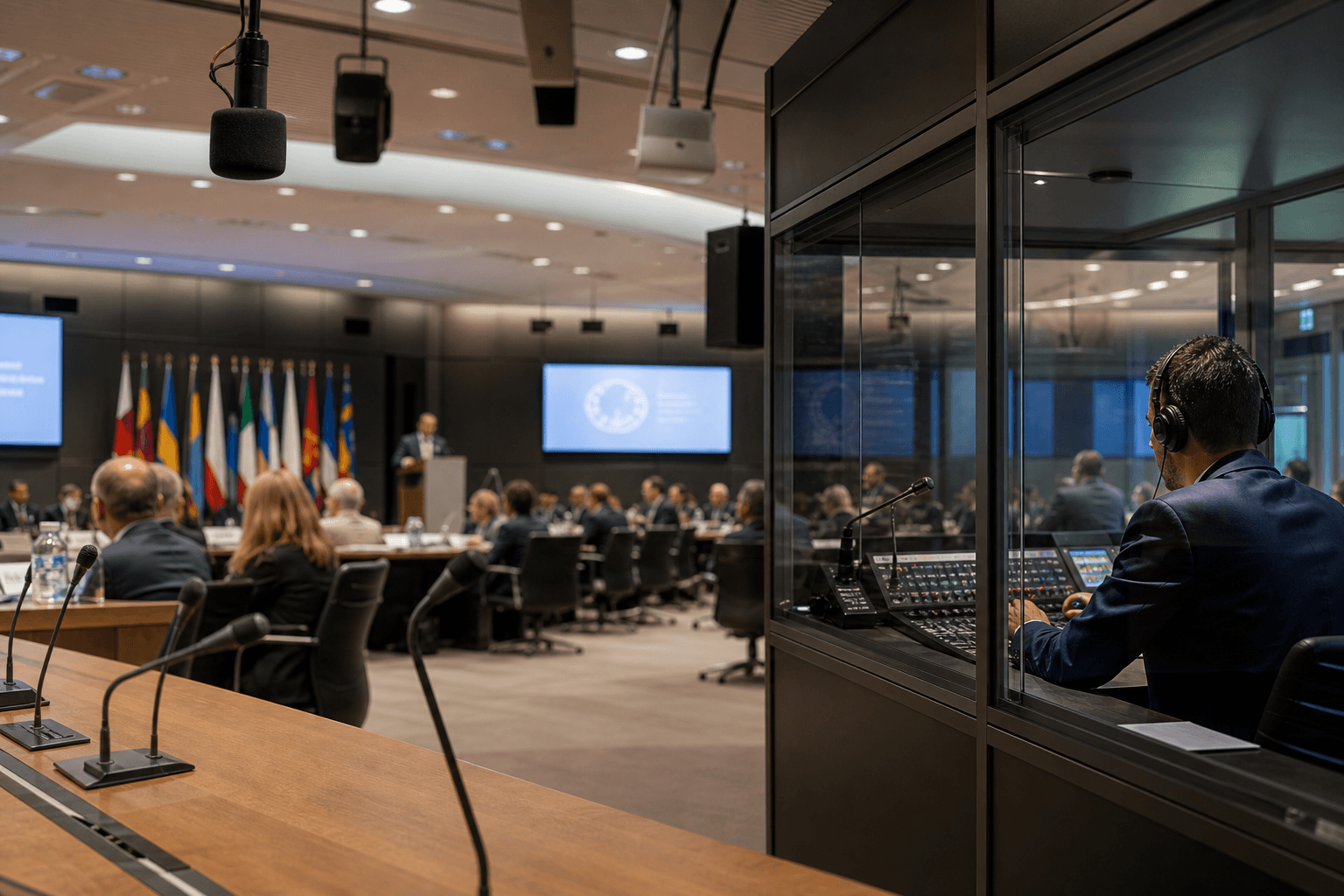
EU-institution conference work is not commercial AV with extra headsets. It is a multilingual operating environment in which a single weak return feed, an incorrectly routed relay channel or an unsuitable booth can prevent interpretation from happening at all. The equipment may look familiar — microphones, displays, conferencing endpoints, consoles and audio distribution — but the design priority is different: interpreters must receive intelligible sound and usable images, select the right source language, deliver into the correct outgoing channel and continue working without channel instability.
The mistake commercial integrators make most often is treating interpretation as an add-on to the main room system. That approach produces a room with clear speech at the lectern and a polished video-conferencing experience, yet leaves the language-routing chain under-designed. In an EU-institution setting, the interpretation chain is the room’s operational core. The right approach is to design, commission and troubleshoot from the interpreter’s workstation outward — not from the front-of-room display inward.
TL;DR
- Use the interpreter workflow as the design centre, not the lectern or the main display.
- Recognise the distinct roles of ISO 20109:2025 for simultaneous interpreting equipment, ISO 2603:2016 for permanent booths and ISO 4043:2016 for mobile booths.
- Plan and verify language paths, including floor audio, relay choices, outgoing channels and audience distribution, before calling a room ready.
- Treat booth conditions — acoustics, ventilation, lighting, sightlines and per-interpreter equipment — as part of the technical system.
- In hybrid rooms, remote audio and video still have to fit the same multilingual channel architecture.
What changes when you move from commercial AV work
An interpretation systems EU institutions technician works across the same disciplines as an AV technician — audio, video, control, networked conferencing and user support — but applies them to a more demanding workflow. Several languages can be active simultaneously. Each language needs a dependable path from speaker to interpreter and from interpreter to audience. Relay interpretation is a normal operating condition, not an exception to solve at the last minute.
Commercial rooms are commonly built around one programme feed and one principal audience path. EU interpretation rooms have several parallel audio paths, interpreter-specific controls and language channels that must remain correct throughout the meeting. A good installation is not simply one where every device powers on. It is one where every participant hears the intended language, every interpreter can select the intended source, and the system maintains intelligibility and channel integrity under real multilingual use.
| System area | What the technician needs to verify | Why it matters in an EU-institution room | Common failure if missed |
|---|---|---|---|
| Audio distribution | Map the floor feed, interpreted outputs and audience language channels as separate but related paths. | These rooms run parallel language services, not one main programme path. | All channels carry audio, but the wrong language reaches the booth or the listener. |
| Interpreter controls | Confirm that each interpreter has an individual console with outgoing-channel switching, relay selection and the required relay pre-selections. | Interpreters must be able to move quickly between direct and relay sources while staying on the correct outgoing language. | The booth has audio, but the interpreter cannot select the right source or sends to the wrong destination. |
| Booth environment | Check acoustics, task lighting, seating, work surface, microphones, headphones and, for mobile booths, CO2 monitoring. | The booth is a working position, not a furniture add-on. If the environment fails, interpretation fails. | Noise, fatigue, poor intelligibility or an unusable booth despite technically functioning electronics. |
| Image and sightlines | Verify that interpreters receive usable images and have a direct, unobstructed view of proceedings and other booths where required. | ISO 20109 covers sound and image transmission to interpreters; visual access is part of workable interpretation conditions. | Audio is present, but interpreters still cannot work effectively because visual information is inadequate. |
| Hybrid integration | Make sure remote speakers, remote participants and any interpreted returns enter the same language-routing design as in-room sources. | Hybrid meetings add endpoints, but they do not remove the need for disciplined channel integrity. | A remote workaround bypasses the language architecture and breaks interpreted return paths. |
| Documentation and room support | Check which ISO 20109 version the project is using, record legacy-document differences and confirm meeting-time technical cover. | Room papers may still use 2016 wording even where the institutional reference now points to 2025. | Acceptance disputes, rework or live support confusion caused by version drift and unclear handover records. |
That comparison matters only if it changes what you do on site. For audio distribution, the task is to verify language identity, not just signal presence. For consoles, the task is to test operating logic under likely relay conditions, not simply confirm button illumination. For booth environment and image, the task is to decide whether interpreters can work continuously, because a technically powered booth can still be operationally unusable.
The same applies to hybrid and documentation work. A remote contribution is not successful merely because it enters the platform; it must land in the correct floor or interpreted path. And a room file is not complete merely because drawings exist; the technician needs a current language-routing record that reflects the standard reference actually being used.
The practical judgment: do not begin by asking whether the conferencing platform works. Begin by establishing whether the language architecture works. A flawless camera switch cannot compensate for a relay path that sends the wrong language to a booth.
The standards framework technicians need to recognise
Three standards define the essential technical landscape. They are related, but they do not do the same job. Treating them as interchangeable is a quick route to a room that is compliant in one area and unsuitable in another.
- ISO 20109:2025 is the current core reference for simultaneous interpreting equipment. It covers equipment used to transmit sound and images between speakers, interpreters and the audience, irrespective of where those users are physically located. For technicians, that means the standard concerns the whole interpretation path, not only the booth console.
- ISO 2603:2016 applies to permanent interpreter booths. It is relevant when fixed booths are being built, renovated or incorporated into a conference-room refit. It addresses the requirements and recommendations for permanent booths, including accessibility and usability for interpreters with special needs.
- ISO 4043:2016 applies to mobile interpreter booths. These are transportable or temporary booths, and the standard reflects the additional realities of handling, transport and temporary installation while preserving the conditions needed for interpretation.
Older room documentation may still refer to EN ISO 20109:2016. The current institutional standards reference is ISO 20109:2025. This version difference matters during refurbishment, maintenance and acceptance work. Do not assume that an older document is the final word simply because it was supplied with the room. Establish the current applicable reference before deciding what is being checked, retained or replaced.
Standards review → identify the booth type and equipment reference → assess the complete interpreter workflow
This distinction also helps prevent a common planning error. ISO 20109 is not a substitute for booth design standards, and booth standards are not a substitute for channel-routing discipline. The room works only when the physical booth, the interpreter workstation and the language distribution chain are treated as one system.
Prepare properly before touching the routing
The best preparation is a written system map that follows languages rather than devices. A conventional AV signal flow might show microphone, DSP, amplifier and loudspeaker. That is necessary, but it is incomplete here. Your map must show which source language reaches each booth, which outgoing language each interpreter sends, which relay sources can be selected and which audience channel receives every interpreted output.
Before commissioning or supporting an interpreted meeting, establish the following baseline:
- The languages into which interpretation will be provided, because the institutional room baseline is at least one booth for each of those languages.
- Whether the booths are permanent or mobile, since ISO 2603:2016 and ISO 4043:2016 apply to different physical installations.
- The current ISO 20109 reference used for the project, and whether legacy drawings or room specifications still use 2016 wording.
- The relationship between floor audio, interpreter inputs, outgoing language channels, audience distribution channels and remote participants.
- The number of active interpretation languages, because relay pre-selection requirements change when interpretation is provided from more than six languages.
- Whether remote speakers, remote interpreters or remote participants are included, since each must fit cleanly into the language-routing plan.
This preparation looks administrative until the meeting becomes multilingual. Then it is the difference between isolating a fault quickly and tracing channels under pressure while interpreters are waiting. The advanced move is to keep the signal map understandable to both technical and operational colleagues. A channel plan nobody outside engineering can read will not help when a language change is requested during a live session.
A practical language-path planning template
By channel matrix here, think of a technician’s planning table rather than a named ISO document. The useful version lists, for each active language path, the source heard by the interpreter, any relay option, the outgoing language assignment and the audience destination. It can also include spare channels and hybrid links where the room design allows them.
At minimum, that planning view should let you answer a few operational questions at a glance: what the floor channel is carrying; which booths can work directly from that floor channel; which booths are expected to work from relay; what outgoing channel each booth position is allowed to use; and how remote participants receive or contribute to the same language architecture. If those answers are scattered across separate drawings, labels and software screens, the room is harder to support than it needs to be.
Step 1: Treat every booth as an active workstation
A booth is not simply an acoustically separated space containing a console. It is a working position from which an interpreter listens, selects sources, delivers interpretation and monitors the session continuously. The Commission’s conference-room specifications require one individual console per interpreter. Each console includes outgoing-channel switching and relay selection.
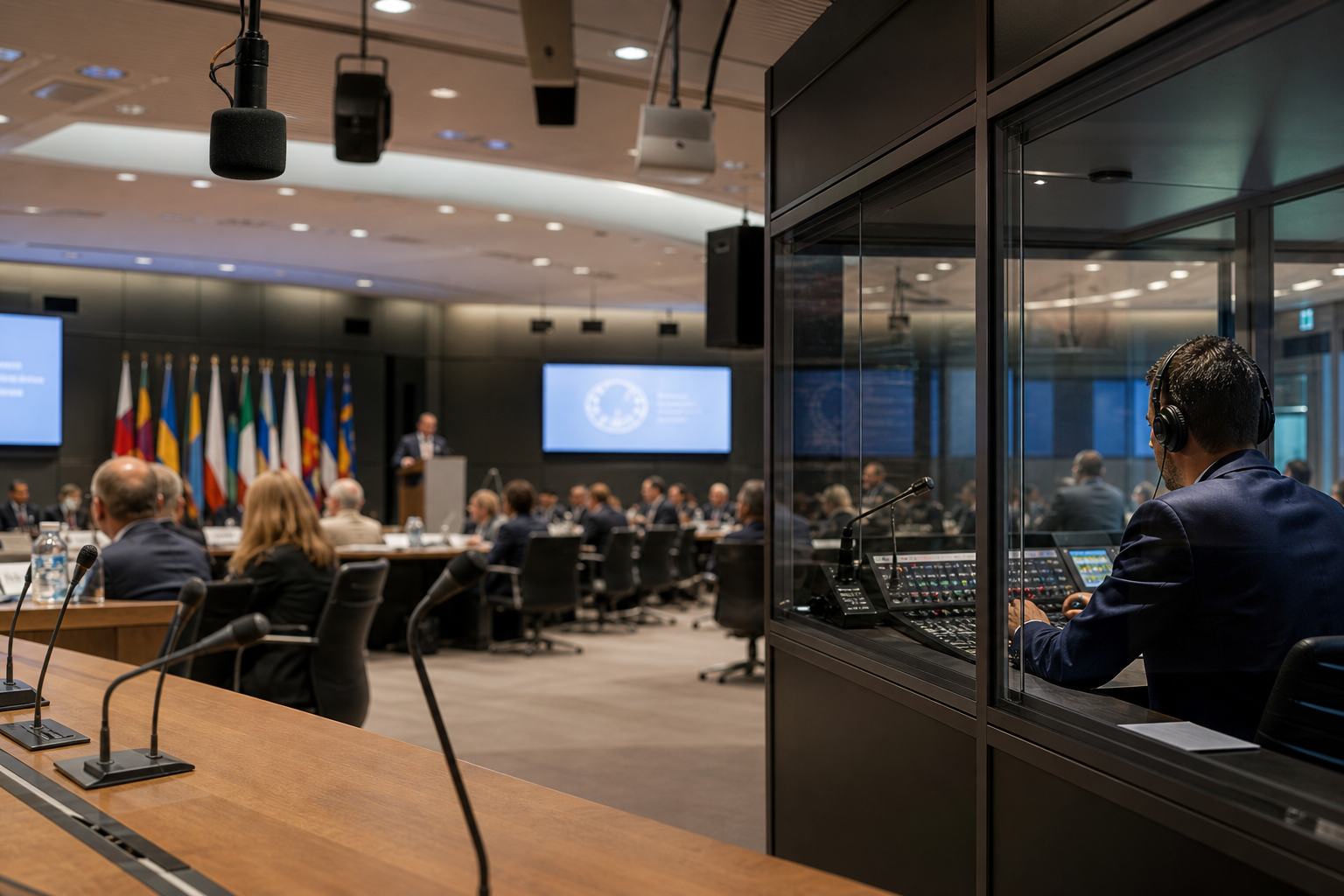
The relay requirement deserves special attention. Interpreters do not always work directly from the floor language. They may need to interpret from another interpreted channel. That is why each console must provide at least three single-button relay pre-selections. Where interpretation is provided from more than six languages, the requirement rises to five pre-selections.
Console controls → direct and relay source selection → continuous multilingual interpretation
What goes wrong: a technician confirms that a console receives audio, then signs off the booth. That is not enough. The relevant test is whether the interpreter can select the intended relay source quickly, send to the intended outgoing channel and hear a stable, intelligible feed throughout. Physical connectivity proves only that a cable path exists. It does not prove that the operating logic is correct.
Booth console workflow overview
The core booth workflow is simple to describe and easy to underestimate: listen to the floor or a relay source, choose the correct incoming language, speak into the assigned microphone and send that interpretation to the intended outgoing channel. Every interruption in that chain becomes a live operational problem. That is why per-interpreter console provision matters, and why the console specification is more than a list of features.
Each booth position also requires one microphone and one set of headphones, with the room specifications giving AKG K15 or similar as an example for headphones. Silent controls matter here as well. If a control is awkward or intrusive in use, the defect shows up not in a bench test but in sustained interpreting conditions. One practical point for technicians is that switching a microphone on must switch off any other microphone on the same outgoing A or B channel. That behavior prevents two microphones colliding on the same output path and is exactly the kind of operating rule that gets missed when a system is tested only as generic audio.
Step 2: Verify the full interpreter input, not audio alone
ISO 20109 covers the quality of both sound and images transmitted to interpreters and from interpreters to the audience. That scope is important in hybrid rooms. Commercial AV teams often concentrate on what the audience sees on the main display and what remote attendees hear in the conferencing platform. The interpreter’s input must be assessed separately.
Interpreters need usable source audio and usable visual information. A technically present video feed is not automatically a useful one. Likewise, a floor-audio feed can be present yet operationally poor if it is unstable, unintelligible or mapped to the wrong source. In hybrid meetings, remote speaker audio and video must enter the interpretation workflow without breaking the routes required by in-room participants, other booths and remote attendees.
- Confirm that each booth receives the intended floor or relay audio.
- Confirm that visual information made available to interpreters is delivered through the system’s intended image path.
- Confirm that outgoing interpreted channels reach the correct audience distribution paths.
- Confirm that remote participants are not treated as a separate audio universe outside the language-channel design.
The judgement call is simple: camera switching and conferencing software remain important, but they are not the centre of the technical design. In an interpreted hybrid meeting, they are inputs to a language-routing system. Configure and test them accordingly.
This is also where sightlines become a technical issue rather than a facilities note. Institutional specifications require a direct and unobstructed view of all proceedings in the room and of the other interpreting booths. Where that view is compromised, the loss is not cosmetic; it reduces the quality of visual cues available to interpreters and makes the booth harder to use even if the monitors and audio feeds are functioning.
Step 3: Commission channel logic before polishing the room experience
Channel management is where commercial habits are most likely to fail. An AV technician may be accustomed to proving that a microphone reaches the far end of a call, the loudspeakers reproduce programme audio and local reinforcement is free from obvious problems. Those checks remain necessary. They are just not sufficient.
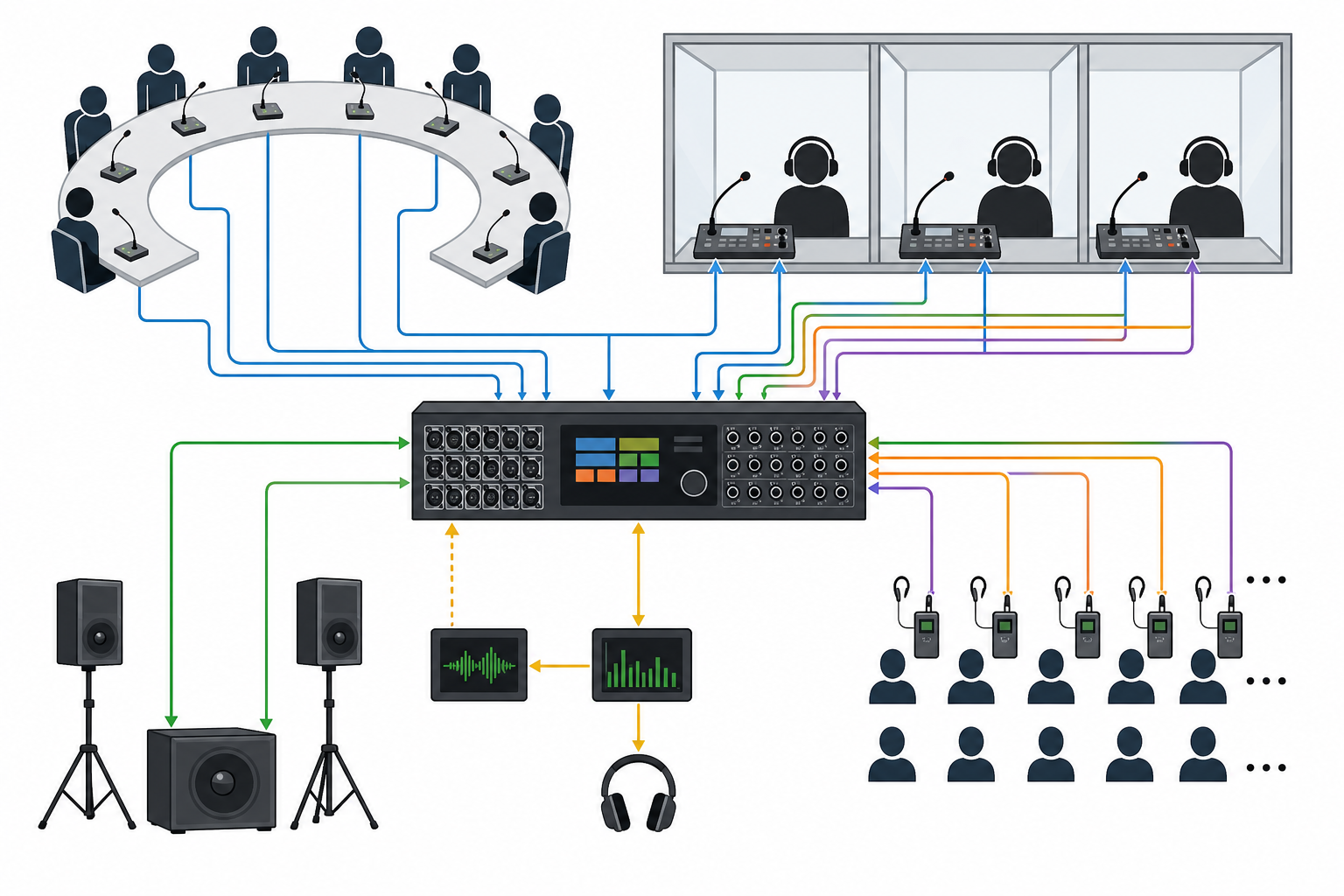
EU interpretation systems require the technician to validate a matrix of relationships: speaker input to floor channel; floor channel to every relevant booth; booth relay selection to interpreter headset; interpreter microphone to outgoing language channel; and outgoing language channel to audience distribution. The value of a written matrix is that it exposes missing routes and incorrect labels before they become live operational faults.
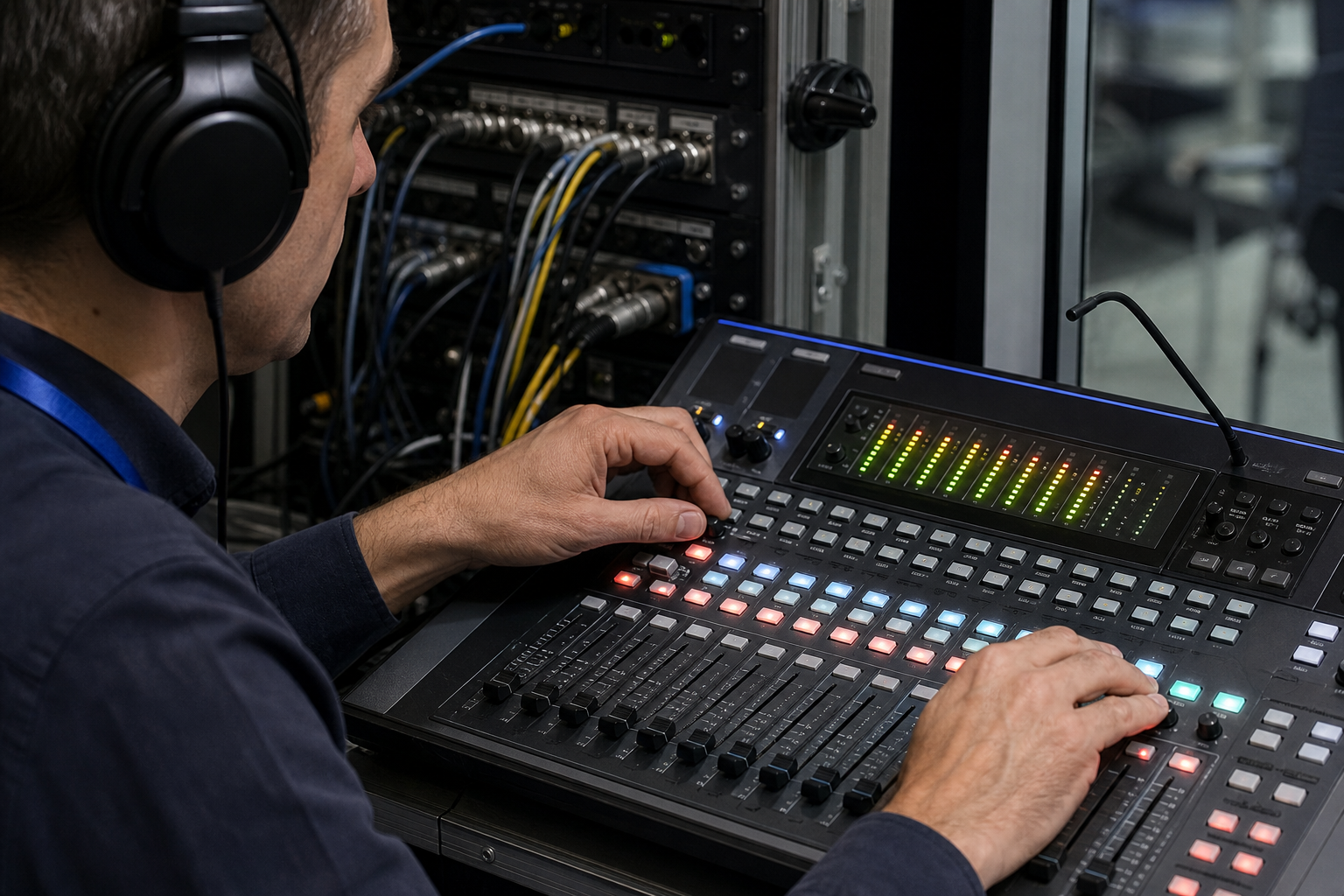
Channel matrix → verify source, relay and outgoing paths → protect language integrity
Do not accept a generic “all channels working” result. That phrase hides the most damaging kind of error: all channels carry audio, but not the intended audio. The right acceptance mindset is language-specific. Identify each path by source language, relay language and destination language, then verify the relationship at the booth and at the audience side.
Language-path commissioning checks
Without turning commissioning into a rigid step-by-step script, there are a few categories that deserve explicit sign-off in any multilingual room:
- Floor identity: confirm what the floor channel carries in normal room use and in hybrid use.
- Relay availability: confirm that the required relay pre-selections are available and correspond to the expected working languages.
- Outgoing exclusivity: confirm that interpreted outputs are tied to the intended outgoing language channels and that microphone behavior on shared A or B channel logic is understood.
- Audience distribution: confirm that delegate listening positions, headsets or distribution receivers access the intended interpreted channels.
- Image support: confirm that interpreters receive the visual information intended for their work, not just whatever is convenient on the room display system.
- Hybrid mapping: confirm that remote contributions and interpreted returns fit the same language plan as in-room contributions.
- Version and documentation control: confirm which standards reference and room documents are being used for the current acceptance or support activity.
Taken together, these checks change commissioning from a device exercise into a language-path exercise. That is the shift that most often separates a room that looks complete from a room that can survive a demanding multilingual meeting.
Step 4: Give booth conditions the same weight as electronics
In commercial integration, furniture, task lighting and seating are often passed to the facilities or fit-out team. In interpretation work, that division can be misleading. Booth conditions directly affect whether interpreters can work effectively, so they belong in the technical acceptance conversation.
The institutional specifications set out practical booth requirements: a firm working surface covered with shock-absorbent material; an individual adjustable compact table light for each interpreter; a dimmable overhead light source; and comfortable, height-adjustable chairs with five legs on wheels. Each booth position requires one microphone and one set of headphones. The cited example for headphones is AKG K15 or similar.
These details are not decorative. A poorly arranged surface creates handling noise. Inadequate task lighting affects sustained work at the console. Shared accessories may look efficient in a storeroom but do not match the per-interpreter provision in the room specification. This is one of the clearest differences between a standard corporate room and a professional interpretation environment: the workstation is part of the technical system.
For mobile booths, add the requirement that is easy to overlook in a conventional AV checklist: a CO2 detector or measurement sensor. Temporary installation does not remove the duty to consider the booth as an occupied working environment. It adds a practical operational check that is rarely central to ordinary meeting-room commissioning.
Room-readiness checks that technicians should not outsource mentally
Institutional booth requirements extend beyond the obvious electronics. A silent door with satisfactory acoustic insulation matters because the booth is meant to provide acoustic separation between simultaneous languages. Ventilation matters because the booth must support sustained concentration, not just short occupancy. The published room requirements specify soundless and independent ventilation, with at least seven complete air renewals per hour for permanent booths and at least eight for mobile booths.
Physical layout matters too. For two interpreters, a booth minimum of 2.50 m wide by 2.40 m deep by 2.30 m high is part of the practical design picture, while 3.20 m width is required where booths serve three or four interpreters or where there are more than six booths in a hall. For mobile booths, the installation condition includes a non-noise-producing carpeted platform about 30 cm high and a minimum 1.30 m passage behind the booths. These are not abstract design notes; they directly affect accessibility, noise control and supportability.
One more institutional habit is worth noting during planning and acceptance. Booth positioning is expected to support direct views of proceedings and the other booths, and booth-position drawings may need approval within the institutional process before final room use. During live meetings, one fully qualified simultaneous-interpreting technician should remain in the room. That expectation reinforces the central point of this guide: interpretation support is treated as an active operational function, not a one-time install activity.
Step 5: Handle permanent and mobile booths as different projects
Permanent booths and mobile booths may support the same interpretation workflow, but they should not be approached as identical physical solutions. ISO 2603:2016 is the standard for permanent booths in new builds and renovations. It is the relevant framework when a conference room is being designed or refitted around integrated interpreter facilities.
ISO 4043:2016 is the mobile-booth counterpart. It addresses the manufacturing requirements for transportable booths, reflecting the fact that mobile units must be handled, transported and installed temporarily while continuing to support sound isolation and interpreter work.
- Permanent booth work: connect booth design to the wider building and conference-room refurbishment scope, including accessibility and usable working conditions.
- Mobile booth work: focus equally on the installed operating condition and the practical constraints introduced by transport and temporary placement.
- Both: assess the booth together with ISO 20109 equipment paths. A suitable booth without dependable audio and image delivery is not a functioning interpretation position.
The shortcut to avoid is describing mobile booths as “temporary” and stopping there. Their temporary status changes the installation context; it does not lower the importance of sound isolation, equipment function, interpreter ergonomics or air-quality monitoring.
Troubleshoot the faults that matter in live multilingual rooms
Interpretation faults are often misunderstood because the visible symptom is simple — an interpreter cannot work, or a participant cannot hear a language — while the cause sits elsewhere in the system. Start troubleshooting from the affected language path, not from the nearest device. The standards framework helps here: ISO 20109 points you toward the full sound-and-image chain, while ISO 2603 and ISO 4043 remind you that booth conditions can be part of the fault picture as well.
Audio is present, but the interpreter has the wrong source
This is a routing problem, not an audio-level problem. Likely causes include incorrect floor-source assignment, wrong relay selection, mislabeled relay pre-selections or documentation that no longer matches the current channel plan. The console must give the interpreter access to the intended direct or relay language, not merely any active audio feed.
The booth works locally, but the audience cannot hear the interpreted language
That symptom usually points to a break between the interpreter microphone path and the audience distribution path. Common causes include the outgoing channel being assigned incorrectly, the distribution side listening to the wrong destination channel or a handover record that identifies channels by number but not by language. A successful booth headset check does not prove audience delivery.
The audience hears a language, but it is the wrong one
This is the classic false-positive system result: channels are active, meters move and nobody notices the error until a delegate selects the service. The underlying cause is usually language identity failure rather than transport failure — swapped channel labels, an incorrect outgoing assignment or a relay path landing on the wrong audience destination. It is precisely why language-specific commissioning matters more than a generic audio pass.
The interpreter microphone seems dead or intermittent
Before treating this as a hardware fault, consider outgoing-channel logic. Where microphone activation on one outgoing A or B channel switches off another microphone on that same output path, a collision in channel use can look like an intermittent fault. The symptom is local to the interpreter, but the cause may be channel assignment discipline rather than capsule or cable failure.
Interpreters complain even though the meters look normal
Meters do not show everything that matters. Poor sightlines, intrusive ventilation noise, inadequate task lighting, handling noise from the work surface or an unsuitable booth environment can all reduce working usability while leaving the main audio path apparently healthy. This is where ISO 2603 and ISO 4043 stop being background paperwork and become part of troubleshooting logic.
Hybrid participants disrupt the interpretation workflow
Check where remote-speaker audio enters the floor or language-routing architecture and where interpreted returns leave it. The likely causes are usually architectural: a remote endpoint has been treated as a separate programme source, the interpreted return has bypassed the normal language distribution chain, or remote video has not been made available in a way that supports the interpreters’ working view. The fix is not to create an isolated remote-audio workaround. The remote endpoint must be incorporated into the same disciplined channel plan used by the room.
Legacy documentation conflicts with the current reference
Separate the older ISO 20109:2016 wording in room documents from the current ISO 20109:2025 reference. Record the version issue clearly during maintenance, refurbishment or acceptance discussions. Silent assumptions create avoidable rework, particularly when an installation is being evaluated against documents produced at different times.
The better way to approach EU interpretation work
The strongest technicians in this environment do not define success as “the AV system is on.” They define it as “each language workflow is intact.” That means thinking like an operator as well as an integrator: which language is the source, which language is the relay, which channel is being sent, where does it arrive, and can the interpreter work continuously from the booth?
For staffing and handover, build competence around that workflow. A technician should be comfortable with booth consoles, individual interpreter accessories, relay routing, parallel channel distribution, audio and image delivery to booths, and the distinction between ISO 2603 permanent booths and ISO 4043 mobile booths. Familiarity with ordinary conferencing equipment is valuable, but it is not a substitute for multilingual signal discipline.
The practical handover document is a language-routing record, not just an equipment inventory. It should make clear which booths support which interpreted languages, how relay is selected, which channels reach the audience, whether the room uses permanent or mobile booths, and which ISO 20109 version is relevant to the current work. That is the document that protects continuity when support shifts change or a room moves from routine use into a complex multilingual meeting.
Key moves to carry into your next installation
- Design and test from the interpreter workstation outward, not from the main display inward.
- Use ISO 20109:2025 as the current equipment reference while recognising that legacy room documents may cite ISO 20109:2016.
- Apply ISO 2603:2016 to permanent booths and ISO 4043:2016 to mobile booths; do not treat the distinction as paperwork.
- Plan at least one booth per language into which interpretation is provided.
- Verify outgoing-channel switching, relay selection and the required relay pre-selections as operating functions, not just console features.
- Check every language path from source audio and image through the booth to audience distribution, including remote participants in hybrid meetings.
- Include booth furniture, lighting, per-interpreter microphones and headphones, and mobile-booth CO2 monitoring in the technical readiness check.
- Record version drift, channel identity and support expectations in a handover document that operational teams can actually use.
Conclusion
Done properly, an EU-institution interpretation room feels uneventful during the meeting: interpreters receive what they need, channels remain stable, delegates select their language and hybrid participants fit into the same multilingual workflow. That smooth result is not accidental. It comes from treating interpretation as a complete system of people, booths, controls, audio, images and language routes — not as a standard conference room with a few additional channels. For technicians moving in from commercial AV, that shift in priorities is the real job.