Key Personnel Replacement on EU Framework Contracts

A replacement is a contract-control event, not a recruitment task
On an EU framework contract, replacing a named key person is not simply a matter of finding a capable consultant and arranging a handover. The replacement may need contracting-authority approval before the person can take over. That distinction matters because the authority evaluated the original delivery team as part of the technical offer. A substitute who looks strong in general may still fail to meet the exact commitment made in the bid.
Here, key personnel means the named or contract-critical individuals used to support award or delivery commitments. A call-off, sometimes called a specific contract, is the order placed under the framework. Both levels can matter, because the framework may set the broad substitution rule while the call-off adds role-specific conditions.
The operational mistake is waiting until a resignation, extended absence or delivery issue forces action. By then, the delivery manager is trying to recruit, validate credentials, prepare a substitution file and preserve service continuity at the same time. That is how teams submit incomplete CVs, vague justifications and candidates who cannot withstand a comparison with the original nominee.
The right approach is to build an approval-ready replacement dossier for every contract-critical role before a change is needed. It should show, in the contracting authority’s own terms, why the proposed individual has an equivalent or better profile and can perform the same responsibilities without weakening the delivery commitment.
This is buyer-facing contract management. It protects delivery, preserves trust and avoids treating formal approval as an administrative formality that can be completed after the replacement has already started.
- TL;DR: On many EU framework and call-off contracts, a key-person replacement is subject to written approval, not just supplier notification.
- The approval test is usually framed as equivalent qualifications and experience, and sometimes as equal or better standing.
- The fastest files to assess contain a justified request, a complete CV, direct role mapping, availability confirmation and any evidence needed for interview or additional review.
- The practical win is to keep a replacement dossier updated in advance at both framework and specific-contract level.
Why written approval is central to a key-personnel replacement
Published EU tender and call-off documentation is clear on the principle: nominated key personnel cannot simply be substituted at the supplier’s discretion. The approval requirement exists because the contracting authority must retain control over whether the changed team still delivers the capability that won the contract.
PRAG guidance for EU external actions requires the contractor to substantiate a replacement request and first obtain the Contracting Authority’s written approval. Other published framework and call-off terms use similarly direct language, such as changes being subject to the written approval of the Contracting Authority or no substitution being made without prior written consent. BlueLight Commercial call-off terms similarly treat the replacement of key personnel as a matter requiring prior written approval. Published Irish tender documents also require changes in nominated personnel to be notified in writing as soon as possible and made subject to written approval.
The phrase changes from document to document, but the commercial meaning is consistent: notification is not approval. Telling the buyer that an expert has left does not entitle the supplier to install a replacement. A complete request must be made, the authority must be able to assess it, and written acceptance must be received where the governing clause requires it.
| Contract feature | What the authority is protecting | What the supplier needs to demonstrate |
|---|---|---|
| Prior written approval | The integrity of the evaluated technical offer | The supplier has not made an unapproved change to the committed team |
| Equivalent qualifications and experience | The capability promised at tender stage | The replacement meets the original role profile, not merely a broad job title |
| Equal or better standing | Delivery quality where the bid relied heavily on a named expert | The substitute is at least as credible in the relevant qualifications and experience |
| Interview and approval provisions | Practical fit, communication and role-specific competence | The proposed person can explain and evidence their ability directly |
Some published clauses raise the bar beyond a CV comparison. Greek tender documentation for a request for quotation provides for replacement personnel to be interviewed and approved before substitution is accepted in writing. In that situation, a polished CV is necessary but not sufficient. The authority may validate whether the proposed expert genuinely understands the assignment and can carry the responsibilities attached to the key role.
Important: do not assume that a framework-level rule is the entire answer. Check the framework agreement, the tender specifications, the call-off or specific contract, the order form and any approved mobilisation documentation. The applicable approval route and standard may sit in more than one document.
That is also why the safest reading is always clause-first. One document may say equivalent qualifications and experience; another may add skills, training, status and full competence for the same responsibilities; another may use the higher phrase equal or better standing. Those are not stylistic variations. They shape the evidence the supplier has to put in front of the authority.
Before you need it: build the file while the original nominee is still in place
The most effective time to prepare a substitution file is when nobody is asking for one. If the original key person is still active, the supplier can assemble a calm, accurate benchmark instead of reconstructing the role under pressure.
At framework level, keep a master role dossier for each contract-critical post. That dossier should include the governing substitution clause, the original tender CV, the role description used in the bid, and the mandatory profile elements that would have to be matched later. At specific-contract level, add a live supplement showing the actual workstream, delivery scope, geography, language, clearance, reporting line and any assignment-specific responsibilities that make the role harder to replace than it looked on paper.
A practical readiness pack usually contains five working documents:
- Role dossier template: role title, contract reference, clause wording, original nominee details and the exact approval route.
- Evidence list: copies or references for qualifications, certifications, role-specific experience, language capability, clearance status where relevant and availability status.
- Mapping matrix: a side-by-side comparison of the original approved profile and a possible substitute against the tender criteria.
- Interview readiness package: short brief on the assignment, core responsibilities, likely competence areas to be tested and the evidence supporting the candidate’s claims.
- Approval request pack: draft notice of unavailability, justified substitution request, CV pack, competence statement and placeholders for any additional information the authority may request.
Keep these records continuously updated. For the framework, review them after award, after any contract amendment and whenever a critical CV, certification or availability assumption changes. For each call-off or specific contract, update the same file when scope changes, milestones move, language needs shift or the authority places additional weight on a particular workstream. A stale bench is not a bench. It is just a folder of old CVs.

The recommended operating model: prepare role dossiers before disruption
A strong key personnel replacement EU framework contract process starts with a simple discipline: treat every named key role as a controlled commitment. The delivery team should be able to retrieve the original person’s approved profile and compare it with a credible substitute immediately. That does not mean pre-approving a person who has not been proposed. It means preparing the evidence that will make a properly triggered request easier for the authority to assess.
Prerequisites: establish the baseline you are replacing
- The governing clause: identify the exact wording on notification, written approval, equivalence and any interview requirement.
- The original key-person profile: retain the CV, role description, qualifications, experience and technical commitments used in the tender response.
- The delivery context: document the workstream, responsibilities, domain expertise, geography, language and clearance conditions relevant to the role.
- The approval route: record who receives the notice, who reviews the request and whether the contracting authority, another authority or both have a defined role.
- A controlled candidate pool: maintain potential substitutes against the actual tender criteria, rather than against a generic internal job description.
The original bid profile is the benchmark. This is where otherwise competent suppliers go wrong: they assess a potential replacement against current operational need, while the authority assesses them against the contractual promise. Those are often similar, but they are not automatically the same.
A practical working sequence for substitution of key experts
There is no universal procedural timetable across EU frameworks and specific contracts. The contract documents govern. The sequence below is a sound operating pattern because it reflects the approval, substantiation and equivalence requirements found in published tender documentation.
Step 1 — Confirm that the individual is contract-critical
Start by checking whether the person is specifically named as key personnel, identified in the tender response, referenced in the specific contract or otherwise subject to a substitution clause. Do not dilute the process by treating every routine resource movement as a key-personnel event. Equally, do not miss a role because the person is described by function rather than labelled “key expert.”
Action: compare the person’s name, role title and assigned responsibilities against the contract record. Result: the team knows whether formal contracting-authority approval is required and what standard applies.
The judgment call is straightforward: where the person helped demonstrate tender capability, is responsible for a defined critical workstream or appears in an approved key-person schedule, handle the change as controlled substitution until the documents show otherwise.
Step 2 — Notify the authority promptly and factually
Published clauses repeatedly use language such as immediately notify or notify as soon as possible when a key person becomes unavailable. The notice should state that an unavailability has arisen, identify the affected role and explain that a substantiated replacement request will follow in accordance with the contract.
The cause of unavailability belongs in the file. Published clauses refer to circumstances including illness, accident, resignation, termination, leave and other extenuating circumstances. Some call-off terms specifically address long-term sickness, maternity or paternity leave, adoption and parental leave. These circumstances may explain why the change is necessary, but they do not normally remove the approval requirement.
Do not over-explain or turn a notification into a loose conversation about potential names. The authority needs a clear record that the supplier recognised the contractual impact and has begun the formal replacement process.
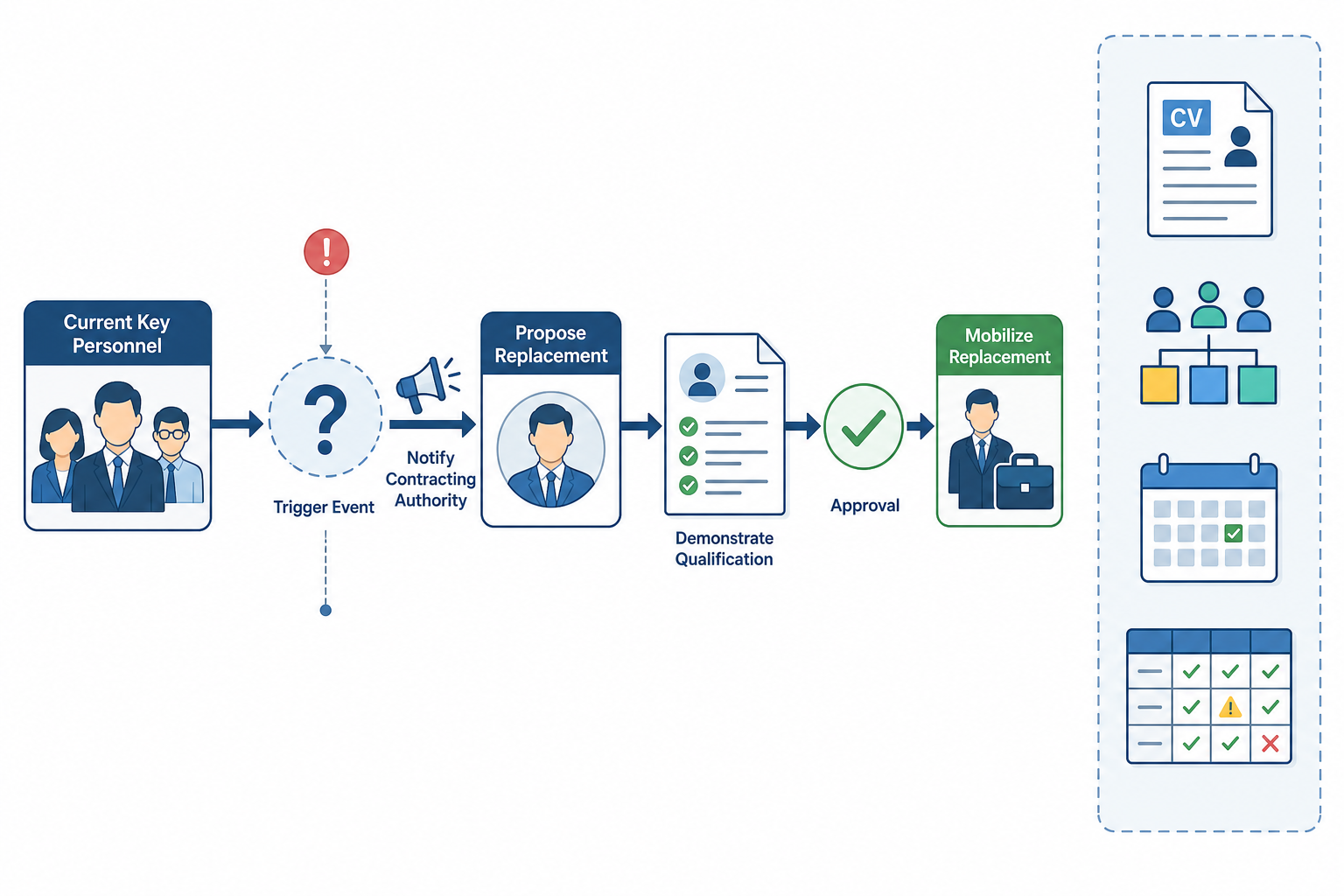
Step 3 — Map the substitute against the original tender commitment
This is the heart of the request. A replacement consultant on an EU specific contract must be assessed role by role, not by reputation or seniority alone. Published clauses commonly require equivalent qualifications and experience. Others require equal or better standing. BlueLight Commercial call-off terms go further by referring to skills, training, status and full competence to undertake the same responsibilities.
Use a comparison matrix that makes the authority’s review easy. The objective is not to claim that the new person is “better” in a generic sense. The objective is to show that the proposed individual meets or improves on the profile that mattered for this precise assignment.
| Comparison point | Original approved profile | Proposed replacement evidence |
|---|---|---|
| Role and responsibilities | Named function and committed workstream | Clear statement of ability to perform the same responsibilities |
| Qualifications and training | Credentials relied on in the bid | Equivalent or stronger relevant credentials |
| Relevant experience | Years and type of experience required by the tender | Directly comparable assignment and domain experience |
| Specialist skills | Technical, sector or delivery capabilities | Evidence tied to the contract’s actual scope |
| Availability and deployment | Committed capacity for the contract role | Confirmation that the person can take up the role when approved |
A CV alone forces the reviewer to do this comparison themselves. That creates avoidable friction. A structured mapping lets the authority see the answer without searching through several pages of career history.
Step 4 — Submit a complete, justified replacement file
The best replacement file is not the longest file. It is the one that answers the authority’s likely questions in the order they arise: why is a change necessary, who is proposed, how does that person meet the required standard, and can they perform the role as committed?
- A written notice and justified request for substitution.
- The reason the original key person is unavailable.
- The exact role title and responsibilities affected.
- A complete CV or résumé for the proposed substitute.
- A direct equivalent-or-better profile comparison against the original nominee.
- Evidence of role-specific qualifications, experience, skills and competence.
- A statement of availability for deployment once approved.
- Any further information requested by the contracting officer or contracting authority.
PRAG guidance explicitly links approval to a substantiated request. Published key-personnel clauses outside that regime also repeatedly require a written request, a complete résumé and any additional information needed to assess the impact on the contract effort. The practical lesson is the same: submit a decision-ready file, not a recruitment shortlist.
Step 5 — Prepare for a live competence check
Where the tender provides for an authority interview, build that into the replacement plan from the start. The substitute should be ready to explain the assignment, the role’s responsibilities and the evidence behind their claimed equivalence. They should not arrive as a generic candidate who has only read a summary of the work.
This is the point at which a nominally equivalent CV can fail. A candidate may have the required years of experience but lack the specific domain knowledge, communication capability or understanding of the workstream needed to carry the role. An interview provision allows the authority to test that distinction directly.
Step 6 — Keep delivery continuity separate from approval
Plan the handover, knowledge capture and interim coverage internally, but do not present interim operational arrangements as a substitute for formal consent. Where the clause says no substitution may be made without written approval, the authority’s written acceptance is the control point.
PRAG states that the Contracting Authority has 30 days from receipt of the request to reply within that specific external-actions regime. That is not a universal framework-contract processing promise. It is a useful reminder that approval can involve a real review period, particularly when additional information or an interview is required. The commercial response is to prepare early, not to assume a same-day decision.
What makes a replacement file quick to approve
No supplier can guarantee an approval outcome or a processing time. The supplier can, however, remove the avoidable reasons a file is returned, challenged or delayed. A quick-to-assess file has three qualities: it is complete, traceable to the contract wording and easy to verify.
- It uses the contract’s language. If the tender calls for equivalent qualifications and experience, demonstrate those points. If it requires equal or better standing, address standing directly rather than relying on broad claims of seniority.
- It makes one candidate recommendation. A list of possible people shifts the selection burden to the authority and signals that the supplier has not completed its own assessment.
- It connects evidence to responsibilities. The file should show full competence for the same role, not just relevant experience somewhere else.
- It anticipates interview scrutiny. The candidate, CV and role-mapping note should tell the same story.
- It confirms practical availability. A replacement who is technically strong but cannot take up the required role does not protect delivery continuity.
The phrase equivalent or better profile should never become a slogan. It is an evidence standard. A better-known title, a longer CV or broad sector exposure does not automatically prove equivalent capability for a specialist role. Match the tender’s actual criteria: qualifications, experience, skills, training, status and the ability to undertake the defined responsibilities.

How a staffing partner shortens the gap without weakening the file
A staffing partner adds value before the key person becomes unavailable. The useful partner maintains a pre-vetted bench mapped to the roles that the framework actually requires. That means candidate evidence is organised around named key-person profiles rather than held as a collection of generic CVs.
For a substitution of key experts on an EU contract, the partner should be able to produce a candidate whose credentials align with the relevant domain, geography, language and clearance requirements already present in the tender documentation. It should also be able to support the authority-facing file with a role map, complete CV, availability confirmation and evidence that the replacement can carry the specific contract responsibilities.
The advanced move is to run a controlled readiness review after award and whenever the specific contract changes. For each critical role, test whether the supplier can produce a plausible equivalent replacement dossier from existing validated records. This exposes weak points early: an overly narrow candidate pool, an original profile with unusual mandatory criteria, missing credential evidence or a role where interview readiness will be decisive.
Failure points that turn a manageable change into a contract risk
Submitting a stronger generalist for a specialist role
A senior candidate is not automatically an equivalent candidate. Fix this by mapping the person to the role’s exact technical, sector and delivery requirements. Where the original nominee carried a distinctive qualification or domain background, the replacement file must address that feature directly.
Waiting to notify until a perfect candidate is found
Published clauses commonly require immediate or prompt notice. Fix this by separating the notice of unavailability from the substantiated substitution request. Notify in accordance with the governing clause, then submit the full recommendation as quickly as the evidence can be completed properly.
Assuming absence-related exceptions remove the approval requirement
Long-term sickness, parental leave and termination may be recognised triggers for a replacement, but the contract can still require written approval of the proposed substitute. Fix this by treating the reason for absence as the justification for change, not as permission to bypass the change-control mechanism.
Using the framework agreement but ignoring the specific contract
The replacement consultant on an EU specific contract may be governed by more detailed call-off terms, an order form or an approved staffing schedule. Fix this by checking the complete contract hierarchy before sending the request. Small wording differences can materially change the evidence required.
What good looks like
Done properly, a key-personnel change does not surprise the contracting authority with an unexplained new face on a critical workstream. The authority receives prompt notice, a written and justified request, a complete replacement profile and a direct explanation of why the proposed individual is equivalent or better for the role.
- Build the replacement dossier around the original tender commitment.
- Obtain contracting-authority approval before making a controlled substitution.
- Prove equivalent or better standing with role-specific evidence, not generic seniority.
- Prepare candidates for possible authority interviews and additional scrutiny.
- Use a staffing partner to keep an evidence-ready bench aligned to the framework’s real constraints.
Final checklist: the approval-ready substitution file
Before a disruption happens, each key role should have a live file that can be turned into a formal request quickly. As a final control, make sure the pack contains the following deliverables:
- The exact clause wording for notice, written approval and the applicable replacement standard.
- The original approved role profile, including the tender CV and role description.
- A current call-off or specific-contract overlay showing actual responsibilities and delivery context.
- A notice-of-unavailability template aligned to the contract route.
- A justified replacement request template.
- A complete substitute CV.
- A side-by-side mapping matrix against qualifications, experience, skills, training, status and responsibilities where those are required.
- Supporting evidence for credentials and domain fit.
- An availability statement for deployment once approved.
- An interview brief if the authority may require the replacement to be interviewed and approved.
- A record of who must review, sign and send the request internally before it goes to the authority.
The supplier that prepares this material before it is needed protects both delivery continuity and the credibility of its original bid. On an EU framework or call-off, key personnel replacement is a controlled contract event, and the file has to prove that the delivery promise remains intact. When the dossier is ready in advance, approval becomes a manageable governance exercise rather than a rushed staffing scramble.