Win EU Institution BI Contracts: What Shortlists Check

EU-institution BI work is not a dashboard-only job
The strongest route into an EU-institution data or BI assignment is to present yourself as a practitioner who can make reporting traceable, governed and safe to use — not simply attractive or technically functional. A common mistake is to lead a profile with dashboard screenshots, tool logos and generic claims about “data-driven decision-making.” That can work in a commercial self-service environment. It is a weaker fit where every metric may need a clear definition, a documented source, controlled access and an accountable owner.
For a data analyst working as an EU institutions consultant, the role often sits across reporting, dashboarding, data-quality work, metadata management and controlled use of datasets. The technical output matters, but it is only one part of the delivery. A report that cannot be traced to a governed source, or a dashboard that exposes more personal data than necessary, creates a problem rather than solving one.
This guide recommends a governance-first approach to both delivery and applications. It is the most reliable way to show that you understand the institutional environment: build the reporting skill, explain the metadata and control model around it, and demonstrate that you know where data-protection obligations affect day-to-day BI work.
TL;DR
- EU-institution BI work is usually broader than dashboard building and may include metadata, data-quality controls, access management and compliance evidence.
- Regulation (EU) 2018/1725 matters directly to analytics work when datasets contain personal data or identifiable information.
- Shortlists may check formal eligibility, languages, qualifications, tool adaptability and context-relevant experience, depending on the call.
- There is no single universal BI stack across all EU institutions, so profiles should show controlled delivery, not vendor loyalty.
The standard to aim for: trusted reporting, not just visual reporting
A business intelligence consultant supporting an EU institution is often expected to help turn complex data into usable information while preserving the controls around that information. That changes the definition of good work. A polished dashboard is not enough if its measures are inconsistent, its source is unclear, its refresh logic is undocumented or its audience has not been properly considered.
- Reporting and dashboards: producing decision-support outputs that are understandable and consistent.
- Data-quality checks: identifying incomplete, inconsistent or unreliable data before it reaches a report.
- Metadata: documenting what a data asset means, where it comes from, who owns it and how it should be used.
- Controlled access: helping ensure that sensitive information is available to the right users without becoming broadly visible by default.
- Governance evidence: maintaining the definitions, records and accountability artefacts that make an output defensible.
The practical distinction is simple: some commercial BI teams may accept a useful answer first and tidy the surrounding documentation later. EU-institution work is more likely to require the answer and its supporting evidence to travel together. That is why data governance is not an adjacent specialism here. It is part of the analyst’s professional value.
This point also helps explain why a data analyst EU institutions consultant is assessed differently from a pure visualisation specialist. In a governed environment, the value of a report includes its meaning, lineage and accountability. “Lineage” here means the path back from an indicator or chart to the governed source data and the documented logic used to derive it.
What to prepare before applying
Do not begin by rewriting your CV around a long list of products. Start by gathering evidence that you can operate in a structured data environment. This preparation makes it easier to tailor your application to the actual requirement instead of relying on broad claims.
- A concise inventory of reporting, analysis, dashboarding and data-quality work you have performed.
- Examples of how you documented metric definitions, source systems, data lineage, ownership or data-quality rules.
- A clear summary of your work with structured data, governed repositories, catalogues or registries where applicable.
- Evidence that you can adapt to different IT tools rather than treating one preferred platform as the entire solution.
- Your qualification details, language capabilities and relevant experience presented in a format that can be checked quickly.
- A privacy-aware explanation of how you handle datasets containing personal or identifiable information.
Do not overstate the stack. There is no single universal BI platform across EU institutions, bodies, offices and agencies. Tooling is shaped by the entity and the requirement. A profile that presents one dashboard product as the answer to every reporting need can look narrow. A profile that explains how it works with governed data, controlled definitions and enterprise reporting tools looks adaptable.
That adaptability matters because procurement scope can be framed very specifically. In one published EU tender for a Power BI-based data reporting and analysis system, published on 27/12/2024 with tender opening on 13/02/2025 and award on 24/04/2025, the scope covered creating and customizing interactive reports, automating reporting processes, optimizing and configuring data flows, and providing consultancy and technical support. Other procurement notices frame BI and data analytics work as separate service lots. The lesson is simple: read the requirement as a concrete service package, not as a generic “BI role.”
Step 1: Read the requirement as a service need, not a job title
Step 1 → Map the stated need to evidence → Build a precise match
Titles such as Data Analyst, BI Consultant or Data Governance Consultant can conceal very different priorities. One requirement may centre on reporting and dashboard production. Another may focus more heavily on metadata governance, data-quality controls, registry support or regulatory context. Treating every data role as interchangeable is the fastest route to a generic application.
Break the requirement into four practical categories: the business output, the data environment, the governance expectation and the working context. Then attach one credible piece of evidence from your background to each category. This gives reviewers an immediate line of sight between the need and your experience.
- Business output: reporting packs, dashboards, analytical datasets, recurring indicators or decision-support products.
- Data environment: structured sources, data repositories, data catalogues, registries or controlled datasets.
- Governance expectation: metadata, lineage, ownership, standard definitions, quality controls and documentation.
- Working context: multilingual teams, institutional processes, regulatory subject matter or cross-functional coordination.
The judgment call is to lead with the service gap you can fill, not the task you most enjoy. If the assignment is governance-heavy, do not make dashboard design the headline. If it centres on reporting, do not bury your reporting experience under broad governance terminology. The best applications are specific without becoming over-engineered.

That specificity is also the best protection against weak matching. A shortlist reviewer does not need a life story. They need a clean answer to a narrower question: can this person support this reporting environment, with these controls, in this institutional setting?
Step 2: Describe tools by the control they enable
Step 2 → Connect tooling to governance → Show operational maturity
Institutional data work often involves reporting and analytics tooling alongside data catalogues, metadata registries and governed data repositories. The important point is not to claim a universal vendor stack. The requirement may specify a platform, but the underlying capability is more durable: producing reliable outputs from structured data while maintaining shared definitions and a controlled record of the data asset.
Describe your technical experience in a way that shows this connection. Instead of writing only that you created dashboards, state the working discipline behind the output: you translated business questions into defined metrics, validated data quality, documented assumptions and maintained consistent reporting logic. Instead of listing a catalogue or repository as a tool, explain your role in keeping data assets understandable and discoverable.
Metadata is the point many otherwise strong analysts underplay. In an EU-institution environment, standardised metadata accompanies data assets as a minimum requirement. That makes it operational, not decorative. Good metadata gives users enough context to determine what a dataset is, whether it is authoritative, what it covers, who is responsible for it and whether it is suitable for a particular use.
- Definitions: establish what a metric, field or classification actually means.
- Lineage: connect a report or indicator back to its governed source and documented derivation.
- Ownership: identify the responsible role or authority for the asset and its definition.
- Authoritative registries: provide a controlled reference point instead of competing spreadsheet versions.
- Quality controls: make it possible to assess whether information is complete, consistent and fit for use.
For a business intelligence consultant EU institutions role, this is a major differentiator. Many candidates can say they understand data. Fewer can explain how metadata roles, responsibilities, policies, principles and decision-making processes govern the metadata lifecycle. That is the language of a consultant who can contribute beyond the first dashboard release.
It is also the language that aligns better with how institutional data work is organised. Where a registry functions as an authoritative source, and where standardised metadata is expected around each asset, the consultant is not just building outputs. The consultant is helping preserve shared meaning across those outputs.
Step 3: Treat Regulation (EU) 2018/1725 as part of BI delivery
Step 3 → Identify personal-data exposure → Design for appropriate control
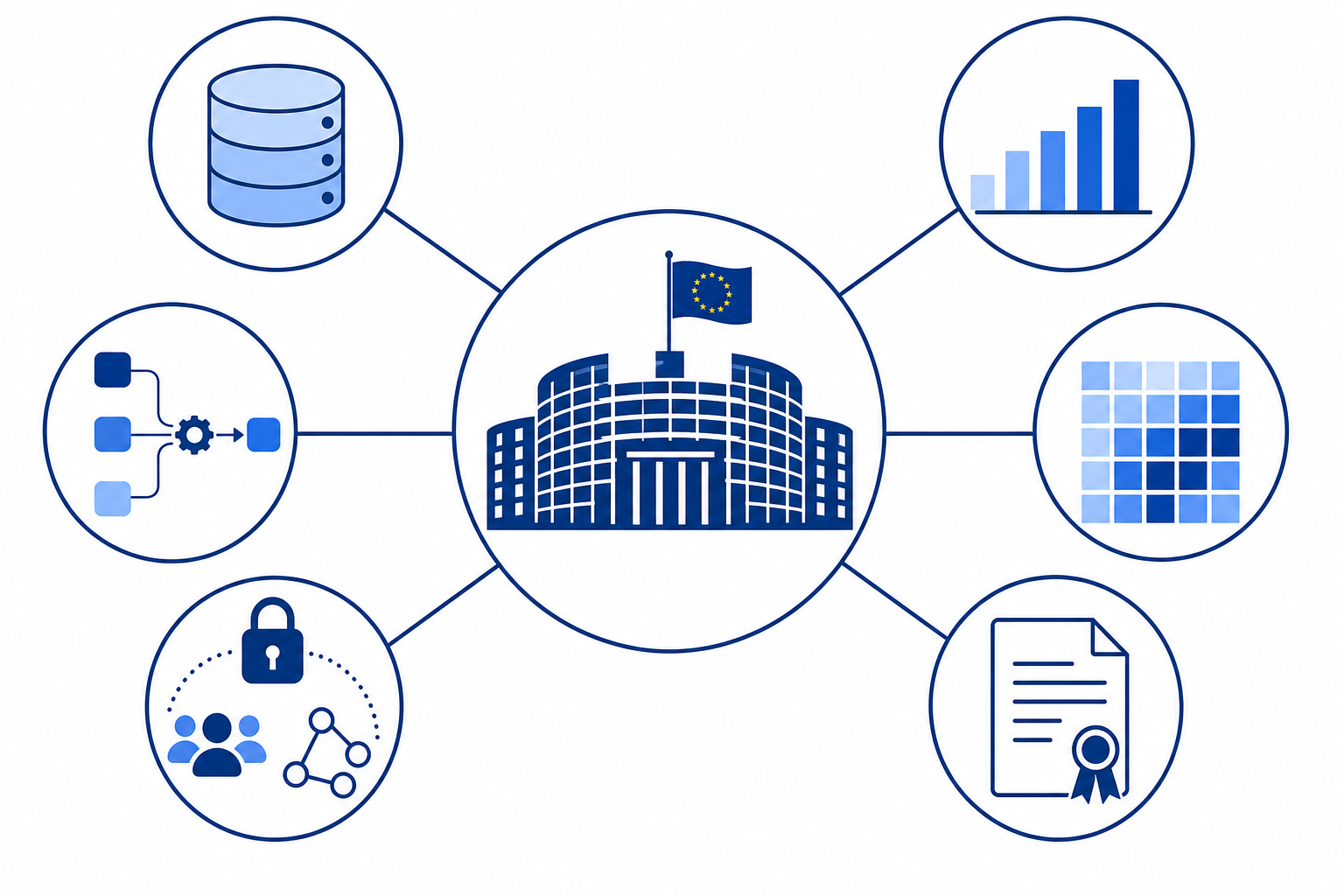
Regulation (EU) 2018/1725 is the central data-protection framework for personal-data processing by EU institutions, bodies, offices and agencies. It entered into application on 11 December 2018 and repealed Regulation (EC) No 45/2001 and Decision No 1247/2002/EC. It is aligned with GDPR-style principles but applies as the dedicated regime for EU institutions and bodies.
This matters to BI professionals because analytics does not sit outside data protection. A dashboard, analytical extract or reporting model can involve regulated personal-data processing when the underlying data contains identifiable information. The fact that the final output is aggregated does not remove the need for careful design while data is being accessed, joined, filtered, stored or shared.
The core operating principles are familiar but need to be applied deliberately: personal data must be processed for clearly defined and legitimate purposes, fairly and lawfully, securely, and not kept longer than necessary. Individuals have rights including access, rectification, erasure, restriction, objection, portability where applicable, and withdrawal of consent where consent is the legal basis.
For delivery, the most useful translation of those obligations is privacy by design and by default. Build the analytical solution so it does not expose or retain more personal data than the purpose requires. Limit extracts, avoid unnecessary identifiability, apply appropriate access restrictions and make outputs explainable. In this setting, a dashboard cannot be treated as a convenient back door into sensitive data.
Do not position privacy as somebody else’s department. Data protection officers and the European Data Protection Supervisor have formal roles within the institutional framework, but the analyst still has to recognise when a requirement raises a data-protection issue. Documentation, records and accountable design are part of compliance evidence. Where a dataset or dashboard supports a high-risk processing operation, a data protection impact assessment (DPIA) and consultation with the European Data Protection Supervisor can become relevant to the work.
This is where many applications stay too abstract. If you have worked with access-sensitive datasets, say how you reduced exposure, limited user visibility, documented data use or separated operational detail from reporting views. Those are not legal decorations. They are delivery choices that show you understand data governance EU institutions contractor work in practice.
Step 4: Build a shortlist-ready profile around evidence
Step 4 → Make eligibility and fit easy to verify → Reduce reviewer doubt
Shortlisting for EU-institution data roles checks more than whether a candidate has used the right BI product. Formal calls can include eligibility conditions alongside technical requirements. Depending on the call, these may cover EU nationality, full civic rights, military-service compliance where relevant, fitness for the duties, character references, educational qualifications and language capability.
A data analyst call can require completion of at least three years of university study, knowledge of one official EU language and satisfactory knowledge of a second official EU language to the extent required for the duties. Technical fit may also be assessed through studies in areas such as ICT engineering, computer science, physics or economics, as well as relevant experience in a regulatory or advisory setting. These are requirement-specific conditions, not a universal scoring formula, so the vacancy notice or tender documentation must always lead.
The practical lesson is that a strong profile needs to be easy to audit. Do not force a reviewer to infer whether you meet a criterion. Place the evidence where they expect to find it.
- Qualifications: state the degree, field of study and the relevant foundation it provides.
- Languages: present them clearly and accurately, especially where the requirement refers to official EU languages.
- Tool adaptability: show experience using different IT tools for specific application areas, not loyalty to one platform.
- Domain relevance: connect prior work to regulatory, advisory, public-sector or governance-heavy environments where applicable.
- Delivery evidence: show how you handled reporting, quality checks, metadata, controlled definitions or access-sensitive data.
A good shortlist does not reward volume for its own sake. It rewards verifiable alignment. A two-page profile that directly maps your experience to reporting, data governance, metadata and data protection is more useful than a lengthy document that leaves the evaluator to guess where the relevant capability sits.
The same caution applies if you are describing procurement or submission workflows. Some framework documents set minimum working-day thresholds for parts of the process, but those are framework-specific mechanics, not a universal EU rule for all institutions or all BI contracts. Deadlines, evaluation flow and even lot structure can vary by call, and non-compliant or late proposals may trigger returns to earlier stages rather than a straight-line process.
Where capable candidates lose credibility
The recurring failure point is presenting BI as a visualisation service. That signals a narrow interpretation of the role and creates doubt about whether the candidate can work inside a formal institutional data environment.
- Problem: the CV is a software inventory.
Fix: retain relevant tools, but connect each one to reporting, modelling, quality, documentation or governed delivery. - Problem: governance is mentioned once as a buzzword.
Fix: explain practical experience with definitions, ownership, catalogues, registries, lineage or quality controls. - Problem: privacy is treated as a legal disclaimer.
Fix: show how privacy-by-design thinking changes extracts, access, identifiability and dashboard design. - Problem: every past role is described at the same level of detail.
Fix: prioritise assignments that demonstrate regulated, structured or accountability-heavy data work. - Problem: the candidate claims a universal institutional toolset.
Fix: acknowledge that the stack depends on the entity and requirement, then demonstrate transferable enterprise BI and governance capability.
Another avoidable mistake is treating metadata as administrative clean-up. In governed environments, poor metadata creates immediate delivery risk: users cannot establish the meaning of a field, reconcile conflicting figures, locate the authoritative source or understand whether data can be reused. A consultant who can bring order to this layer is more valuable than one who only consumes already-prepared datasets.
That is why shortlist reviewers may respond better to one well-described example of controlled reporting than to five vague claims about insight generation. If you can show how you supported definitions, ownership, quality checks and access discipline around a reporting output, you look closer to the real service need.
The advanced move: make every metric defensible
The most compelling analysts develop a simple habit: they can explain every important metric from source to output. That does not mean creating unnecessary documentation for its own sake. It means making the report resilient when a stakeholder asks what the number means, where it came from, who owns the definition, what data-quality limitations apply and who should be able to see it.
Use that discipline in both your work and your application. For each significant project, prepare a short explanation of the reporting purpose, governed source, definition logic, quality checks, access considerations and delivery outcome. This turns abstract claims about governance into evidence of professional judgment.
That is also the better way to bridge analyst and governance roles. You do not need to present yourself as a specialist in every legal or policy function. You do need to show that you understand the analyst’s responsibility within a controlled data lifecycle — and that you know when a technical choice has governance or data-protection consequences.
In practical terms, the metric is not defensible because it exists in a dashboard. It is defensible because its purpose is clear, its source is governed, its derivation is understandable and its audience is appropriate. That mindset travels well across different institutions, stacks and contract structures.
Key moves to carry into your next application
- Lead with governed reporting and traceable metrics, not dashboard design alone.
- Show that you can work with metadata, lineage, ownership, authoritative registries and data-quality controls.
- Apply Regulation (EU) 2018/1725 to practical BI decisions involving personal data, access and identifiability.
- Do not claim a universal EU-institution technology stack; demonstrate adaptable, enterprise-ready capability instead.
- Make qualifications, languages, tool flexibility and context-relevant experience easy for shortlist reviewers to verify.
- Present every key project as evidence that you can deliver useful analytics without weakening governance, documentation or accountability.
Done well, an application for an EU-institution data role reads less like a catalogue of technical tools and more like a clear assurance: this consultant can produce reliable insight, preserve the meaning of the data behind it, and work responsibly inside a formal public-sector data environment.
Conclusion
EU-institution BI work rewards analysts who can connect reporting skill to governance, metadata and accountable handling of personal data. If your profile makes traceability, control and requirement-specific fit easy to verify, you are much closer to how these assignments are actually assessed. The strongest application does not just promise insight; it shows that the insight can be trusted, explained and used safely.