Limosa for Consultants in Brussels: Who Declares and When

“Consultant” is a job description, not the status that determines the Limosa process. Someone supplied to a Brussels assignment may be an employee posted by a foreign employer or a self-employed professional established abroad. That distinction determines who declares, which requirements apply and how the receipt reaches the Belgian client.
The right approach is to separate responsibility for declaring from responsibility for collecting the receipt. A staffing partner may manage the document handover without becoming the legal declarant. Resolve both responsibilities before the consultant’s first Belgian workday, not after onboarding has already allowed work to begin.
What Limosa covers in Brussels
Limosa is Belgium’s system for declaring the presence of foreign posted workers and foreign self-employed people who temporarily or partly perform professional activities in Belgium. Brussels falls within that Belgian framework; the declaration records the Belgian work location, assignment period and work schedule.
After a valid declaration, the system issues the Limosa-1 receipt, also called L-1, immediately. The declaration is the filing; Limosa-1 is the resulting evidence. Asking for “the Limosa” without distinguishing the two can leave a staffing team with an assurance that someone will file, rather than the receipt needed for the pre-start check.
This guide concerns cross-border assignments involving foreign employers or foreign self-employed consultants. It does not address ordinary employment by a Belgian employer.
Establish the consultant’s status before assigning the filing
Employee posted by a foreign employer
The foreign employer must submit the Limosa declaration, or an authorised representative may submit it on the employer’s behalf. The declaration must be completed before the employee starts work in Belgium.

Each posted employee must present Limosa-1 to the Belgian client or principal before activities begin. A staffing intermediary can collect and forward the receipt, but that administrative route does not replace the employer’s filing responsibility or the employee’s presentation duty.
Independent consultant established outside Belgium
For a foreign self-employed consultant, check the activity, professional status and any exemption first. Where a declaration is required, responsibility rests with the self-employed person, and the declaration must precede the Belgian activity.
INASTI, Belgium’s social-security institute for self-employed people, specifically identifies construction and cleaning as sectors with Limosa requirements for foreign self-employed people working temporarily or partly in Belgium without permanent residence or establishment there. Category-specific exclusions also exist. For another consultancy activity, do not infer the answer from the word “consultant”: assess the actual activity and applicable rules.
A prime contractor or staffing partner may require an independent consultant’s receipt as a contractual onboarding condition. That request is not, by itself, a determination that the consultant must declare, and the employee-specific presentation and client-reporting rules should not automatically be applied to every self-employed assignment.
Who asks for Limosa-1 in the staffing chain
The organisation requesting the receipt is not necessarily the organisation responsible for filing. Establish the recipient and the handover route explicitly, especially where a foreign supplier, staffing intermediary and Belgian institution are all involved.
| Party | Why it requests the receipt | When the handover belongs |
|---|---|---|
| Belgian client or principal, including a prime contractor acting in that capacity | For posted employees, this is the party to whom the worker must present Limosa-1. | Before the employee begins activities in Belgium. |
| Institution receiving the consultant’s services | It commonly collects evidence through supplier and consultant onboarding. “Institution” is not a separate legal category under the stated presentation rule. | Before the assignment starts, through the agreed supplier route. |
| Staffing partner, agency or managed service provider | It commonly obtains the receipt from the foreign employer or independent consultant and forwards it to the prime or institution. | Before placement activation or site access under the onboarding process. |
For a posted employee, do not treat “sent to the agency” as the end of the process. Check that the receipt reaches the Belgian client or principal. For an independent consultant, identify the recipient required by the assignment’s contractual compliance process.
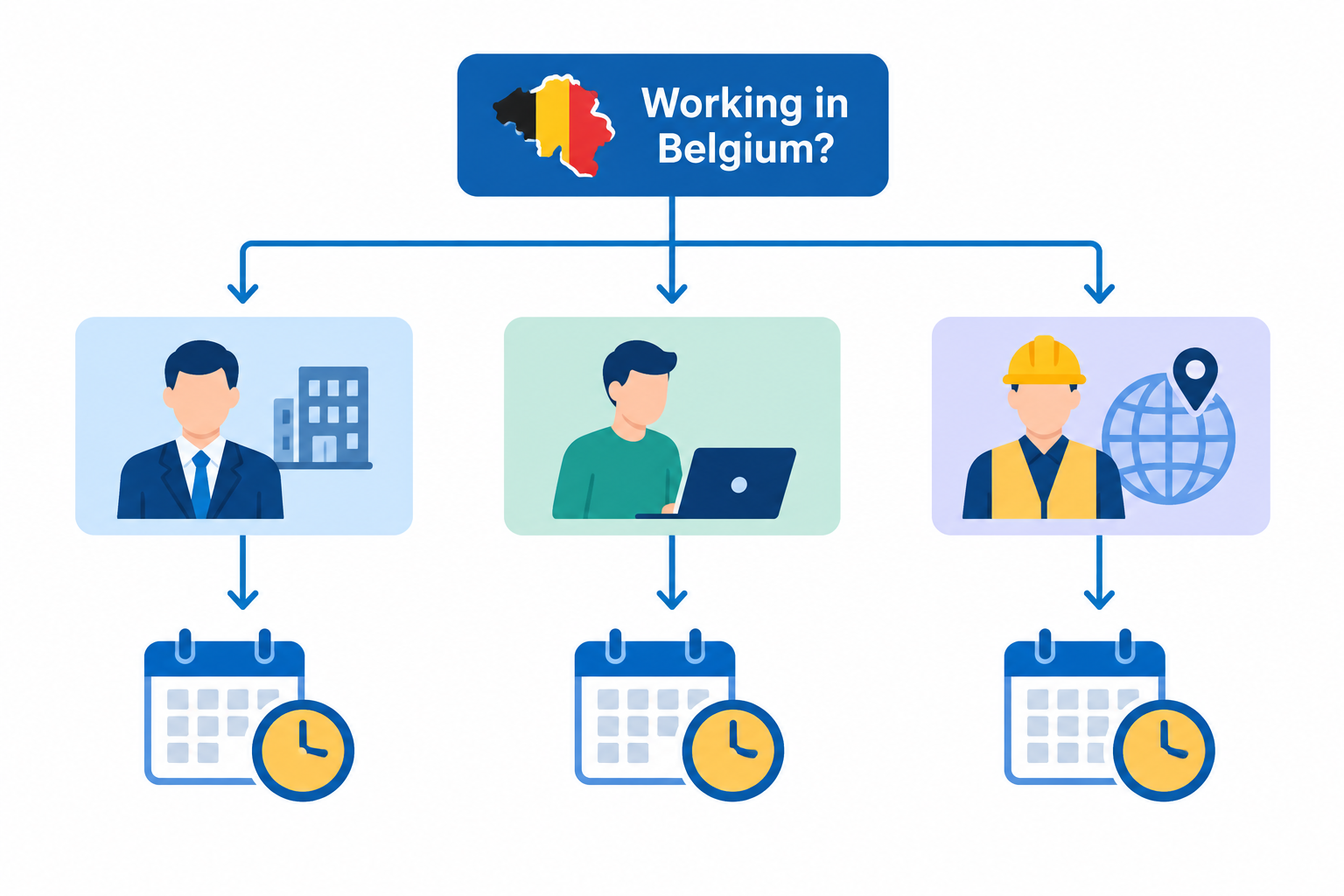
Organise the declaration and receipt before work begins
- Classify the arrangement before assignment confirmation. Establish whether the person is employed by a foreign employer or genuinely self-employed abroad. Resolve any claimed exemption at this stage. Otherwise, the staffing team may chase a receipt from the wrong party or assume a declaration is unnecessary.
- Prepare the assignment information. For a posted employee, the declaration includes worker and employer details, the Belgian work location, posting duration and work schedule. Check those assignment details against the planned Brussels placement before submission.
- Complete the required declaration before Belgian work starts. The foreign employer or authorised representative handles the employee declaration; the self-employed consultant handles an applicable independent declaration. A staffing partner’s document request does not transfer those responsibilities.
- Obtain and route the actual Limosa-1. The receipt is issued immediately after a valid declaration. For an employee, arrange presentation to the Belgian client or principal before activities begin. For an independent consultant, retain it and provide it through the agreed pre-start compliance route.
The key timing distinction is before work begins, not merely before an internal onboarding deadline. An organisation may request the receipt earlier for access clearance, but collecting it after the consultant has started does not satisfy a pre-start requirement.
Resolve missing receipts, mismatched details and exemptions
- A posted employee cannot produce Limosa-1. Escalate this to the Belgian client or principal rather than treating it only as an incomplete supplier file. The client or principal must report the absence to the Belgian authorities, except where the client is a natural person and the work is exclusively for private purposes. That exception is not a general waiver for businesses or institutions.
- The receipt shows a different location, period or schedule. Check the declaration against the actual assignment. A receipt for another work location should not be accepted for a Brussels placement without checking the record. If the assignment changes, check the relevant details in the Limosa system before the changed activity proceeds; do not invent a universal amendment deadline.
- The consultant says an exemption applies. Retain the applicable exemption basis and supporting status information. Being called a consultant, working through a staffing partner or having a client willing to waive its document request does not establish a Limosa exemption.
- An independent consultant has no receipt. First resolve whether the activity requires a declaration or falls within an exemption. Do not automatically import the employee-specific client-reporting rule into the self-employed case, or treat a contractual request as the legal assessment.
Keep Limosa separate from other employment checks
Limosa-1 records completion of the Limosa declaration. It does not, by itself, settle the applicable social-security position or establish compliance with immigration and work-authorisation requirements. Equally, a Limosa exemption does not remove those separate checks.
This distinction matters when a supplier offers another compliance document in place of L-1. Assess each document for the obligation it addresses, rather than treating the consultant’s file as cleared because it contains some cross-border paperwork.
Make the pre-start decision traceable
The most useful improvement is to record two separate decisions: whether Limosa applies to this person and activity, and whether the required receipt matches the assignment and has reached the right recipient. That prevents an onboarding request from being mistaken for a legal status assessment, or a valid filing from being mistaken for a completed handover.
Before mobilisation, verify the consultant’s status, Belgian activity, sector, location, dates, schedule and any claimed exemption with the consultant’s accountant or the prime contractor’s compliance team. A well-managed Brussels assignment has a clear declarant, an accurate receipt where required, and a completed pre-start handover — not simply a promise that the paperwork is being handled.