EU Conference and AV Technician Day-to-Day
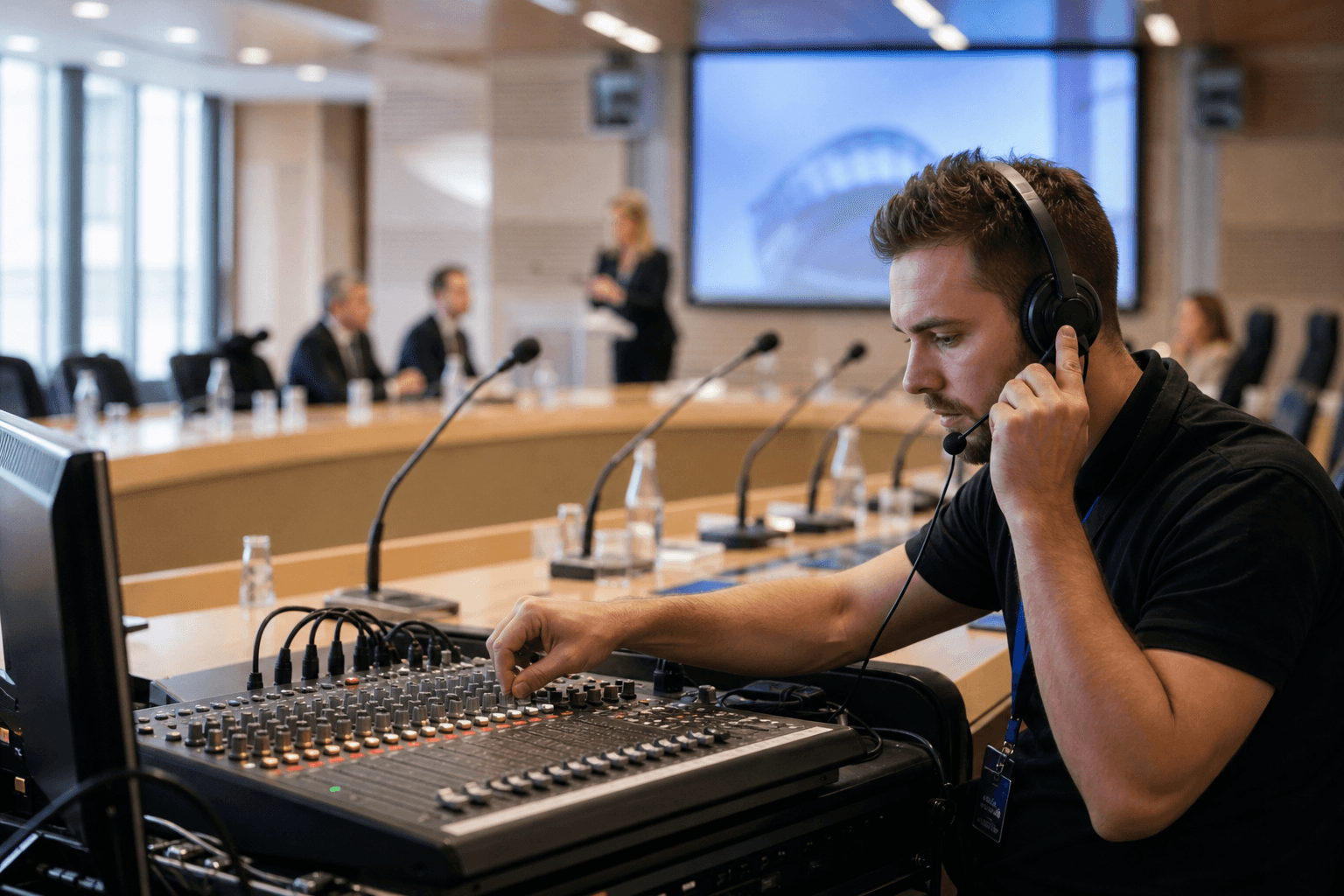
A conference AV technician at the EU institutions is not there to “run the room” in the narrow event-production sense. The work sits much closer to meeting-critical infrastructure: a chain of conference, interpretation, video, streaming, recording and remote-participation systems that must work before the meeting starts and remain reliable while it is live.
That distinction is what catches out otherwise capable AV technicians. A strong background in corporate events, hotel conferencing or live production is valuable, but it is not enough on its own. Institutional work is shaped by multilingual meetings, recurring session calendars, hybrid participation, formal technical specifications and systems that have to be maintained as well as operated.
The right way to approach a conference AV technician EU institutions role is to position yourself as a technician who protects meeting continuity. That means being equally credible with microphones and cameras, interpretation systems, remote room supervision, upgrades, testing, documentation and technical coordination. The best candidates do not present themselves as people who can operate equipment. They show that they understand how every part of the meeting chain affects the people in the room, the interpreters and the remote participants.
TL;DR
- This role is closer to meeting-critical infrastructure than to general event AV.
- Day-to-day work is shaped by session calendars: pre-meeting checks, live supervision, post-meeting restoration and planned maintenance windows.
- Interpretation systems are central, especially in multilingual and hybrid meetings with remote interpretation.
- Strong applications make systems experience, integration work and operational discipline obvious; certifications can support that story, but they do not replace it.
What the role actually covers
A 2025 Conference and Audio-Visual Technician vacancy at the European Committee of the Regions in Brussels is a useful picture of the breadth involved. The position sat in Unit A.2 – Bureau, plenary and central meeting service, within the Directorate for Members, Plenaries, Strategy. It was published on 20 March 2025, was open at AST1-AST9 level and closed on 3 April 2025 at noon Brussels time.
The important point is not the historic vacancy date. It is the scope. The role combined maintenance and upgrades of conference and interpretation equipment with the integration of new cloud-based technologies. That is a much broader brief than placing a camera, checking a projector and reacting when somebody reports a fault.
For an AV technician in Brussels EU institutions, the work can include on-site and remote configuration and supervision of meeting rooms; testing microphones, headsets and cameras; supporting streaming and recording; running videoconferencing solutions with remote interpretation; maintaining digital signage; and deploying mobile sound and video systems. Support can extend beyond standard rooms to plenary sessions and events in dedicated spaces, including Atria, Ledra Street and the Foyers.
Recommended mindset: treat every meeting as a service with a live operational phase and a technical lifecycle. The meeting must work today, but the equipment also has to be maintained, upgraded, documented and prepared for the next programme of meetings.
That same broad institutional pattern is relevant beyond one building or one body. Brussels is the clearest reference point in the vacancy material, but multilingual conference and interpretation support also exists in Luxembourg-facing institutional work, and wider Parliament-related audiovisual support is not limited to a single site. For candidates, the practical lesson is simple: the role is defined less by venue glamour and more by dependable support for formal meetings.
Working context
The technician works across routine meeting rooms, multilingual conference spaces, plenary environments and hybrid meeting setups. Some support is delivered on site, but the role also includes remote room supervision, which changes how faults are spotted and escalated. In other words, you are not only dealing with what is physically in front of you. You are also responsible for whether the room, the interpretation chain and the remote meeting layer remain aligned.
Core responsibilities
The day-to-day core is wider than many AV job titles suggest. It includes room configuration, testing of microphones, headsets and cameras, interpretation setup based on the language combinations required for that meeting, and support for streaming, recording, digital signage, videoconferencing and mobile sound or video systems. In live sessions, it also means rapid intervention when something breaks or behaves unpredictably.
Typical day flow
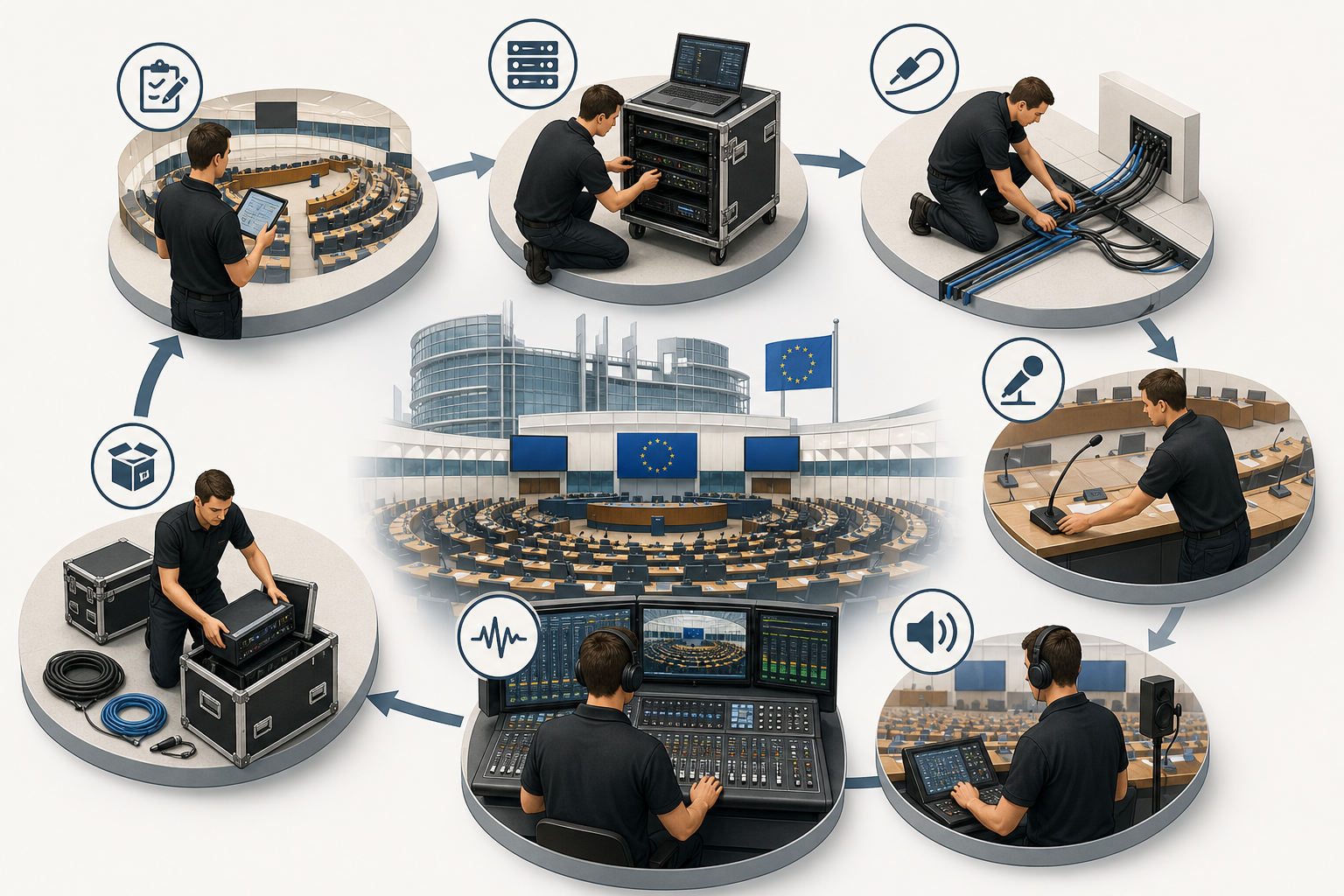
A readable way to think about the workflow is this: morning room checks, pre-session configuration, live monitoring during the meeting, then restoration and technical follow-up afterward. In a routine room, that may mean confirming devices are online and the room is ready before participants arrive. In a multilingual meeting, it means protecting the interpretation chain. In a plenary or high-visibility session, it means tighter supervision, faster fault ownership and clearer coordination across a larger operational environment.
The operating reality: the meeting calendar runs the job
The most useful expectation to set before taking contractor work in this environment is simple: the calendar, not a fixed office rhythm, determines the workload. Plenary sessions and recurring institutional meetings create the operational peaks. Technicians are needed before meetings to prepare and test systems, during meetings to supervise them and intervene when an issue arises, and between meetings to restore, maintain, configure or upgrade the technical environment.
This is why “I can troubleshoot under pressure” is too weak as a description of your value. Pressure matters, but the real professional standard is preventing avoidable faults from reaching the live meeting. That depends on understanding the session plan, knowing which rooms and services are in use, and identifying where work can safely be done without disrupting meeting traffic.
Session calendar → preparation window → live supervision → maintenance window
That sequence is the practical backbone of the role. The live part is highly visible, but it is only one stage. If maintenance or configuration work is left until the wrong moment, the technician creates risk for the next meeting. If it is planned around the calendar, the work becomes controlled rather than reactive.
- Read the meeting programme as a technical workload. Identify where plenary activity, recurring meetings, remote participation and interpretation needs are likely to concentrate demand. The mistake is to see the calendar as administration. In this role, it is the operating plan.
- Use pre-meeting time for system readiness, not cosmetic room checks. Microphones, headsets and cameras are explicitly within the technician’s testing scope, but their condition only matters if the conference and remote-participation chain works as a whole.
- Protect the time between meetings. Maintenance, upgrades and configuration changes must fit around active meeting traffic. Live support is the priority during a session; preventive technical work belongs in the windows around it.
- Stay prepared for remote supervision. Institutional rooms are not always supported only from inside the room. The ability to configure and supervise rooms remotely changes how issues are detected and resolved.
What usually goes wrong: technicians coming from a pure event background sometimes concentrate all their effort on the visible meeting moment. That approach underestimates the pre-session checks, the post-session restoration work and the planned upgrade activity that make reliable service possible.

Before the meeting starts
At a practical level, the day often begins before the room is occupied. The useful mental checklist is not glamorous: which rooms are active, which meetings need interpretation, which sessions include remote participants, which spaces need streaming or recording, and where temporary or mobile systems may be required. From there, the job becomes a sequence of readiness checks: microphones, headsets and cameras are tested; interpretation settings are matched to the day’s language combinations; videoconferencing and remote interpretation links are verified; and signage, recording or streaming paths are confirmed where they are part of the meeting.
This is also the point where experienced technicians quietly reduce the risk for everyone else. They notice a weak link before the meeting depends on it. They do not wait for a chair, delegate, interpreter or remote participant to become the first person to discover a problem.
During the session
Once the meeting is live, the job shifts from preparation to controlled supervision. That means continuously watching and listening across the service chain: microphone behaviour, headset output, camera coverage, display confidence, interpretation output, recording status, streaming health and videoconferencing stability. The official role material supports quick intervention in case of technical issues, and that is exactly where professional calm matters most.
The faults themselves are often less dramatic than the consequences. A microphone dropout, the wrong interpretation channel, a camera feed that stops updating, a missing remote audio return or a recording path that is no longer active can each disrupt the meeting in different ways. The technician’s value lies in recognising the fault quickly, understanding which part of the chain owns it, and acting without turning a local issue into a room-wide interruption.
After the room clears
Post-meeting work is where many outside candidates underestimate the role. Once participants leave, the job is not simply “done.” Rooms may need to be reset for the next session. Temporary or mobile equipment may need to be struck, packed or repositioned. Incident notes may need to be logged so recurring problems are not rediscovered under pressure the next day. If something behaved inconsistently during the meeting, this is the window to verify it, clean it, report it, isolate it or schedule the next action.
That follow-through matters because institutional AV reliability is cumulative. One well-run meeting helps the next one only if the technician leaves the environment stable, documented and ready for reuse.
Maintenance windows and remote supervision
The role also includes maintenance and upgrade work, and that must be planned around meeting traffic rather than forced through it. A quiet maintenance window is where the technician can contribute to configuration changes, equipment upkeep, installation follow-up and other planned technical work without putting the next live session at unnecessary risk.
Remote supervision adds another layer. Some rooms can be configured or monitored without the technician remaining physically inside them throughout the meeting. That does not make the work lighter; it changes the judgment required. You need to know what can be resolved remotely, what requires immediate presence in the room, and how to keep the conference, interpretation and cloud-based layers working together while moving between spaces or monitoring more than one active environment.
That scheduling reality leads directly to the most distinctive part of the job: interpretation support.
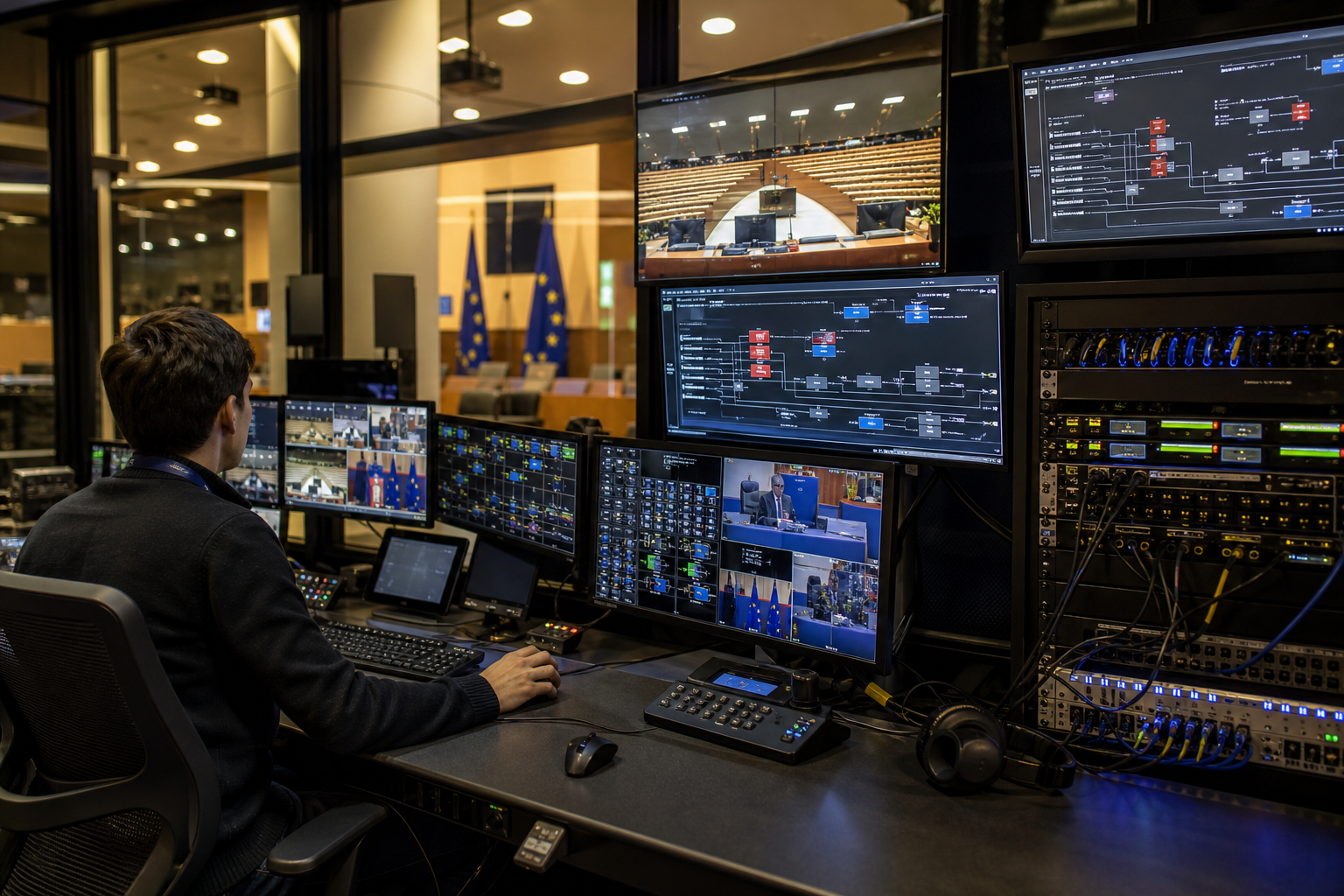
Interpretation is not an add-on to the AV system
Multilingual meetings are where the nature of EU institutional AV work becomes clearest. Simultaneous interpreting means real-time interpreting delivered through conference interpretation equipment, including soundproof booths, earphones and a microphone. Conference technicians support interpreters by ensuring that the technical equipment functions properly and by managing and maintaining interpretation equipment before and during meetings.
For a conference AV technician, this means interpretation cannot be treated as a specialist feature that only matters when a technician from another team is present. The role includes configuring interpretation systems according to language combinations. That points to a job where the technician must understand the operational logic of routing, booth, headset and audio configuration, not simply general-purpose sound troubleshooting.
The professional judgment here is straightforward: a video issue may affect the quality of a meeting; an interpretation-system failure can prevent participants from following it at all. That makes audio quality, headset reliability, microphone performance and the integrity of the interpretation configuration mission-critical.
In day-to-day terms, that often means listening for audio dropouts, checking that the correct language channel is active, confirming that booth and headset paths are behaving as expected, and making sure remote interpretation elements have not introduced a new fault into the room. These are still AV tasks, but they are AV tasks with direct consequences for multilingual access to the meeting.
Step 1: Build real conference-interpretation credibility
Describe direct work with conference and interpretation systems precisely. Focus on the responsibilities you held: preparation, configuration, live supervision, maintenance, fault response and post-meeting restoration. General AV experience remains relevant, but vague references to “audio support” do not demonstrate that you understand multilingual conferencing.
Do not overstate language ability either. The operational requirement is to configure systems accurately for the language combinations in use and to understand why the configuration matters. If you also have working language skills, present them as part of your ability to operate in a multilingual environment, not as a substitute for systems competence.
Step 2: Treat remote interpretation as hybrid AV work
Remote interpretation adds a further layer: videoconferencing behaviour, network-dependent services, audio routing and the cloud-based tools that connect remote participants to the meeting. The wrong approach is to divide the room AV system from the conferencing platform and hope both work independently. In practice, the meeting succeeds only when they work together.
This is why cloud-based technologies matter in the role. They do not replace the physical conference environment. They expand the technical chain that the contractor has to understand and support.
What day-to-day support looks like beyond the meeting room
A strong audiovisual technician European Parliament contractor profile is broader than live room support. The work can cover streaming and recording systems, digital signage, mobile sound and video equipment, videoconferencing solutions and technical support during plenary sessions. At the Committee of the Regions, the scope also included support for colleagues drafting technical specifications for external meetings.
That last responsibility matters. It separates technicians who can only operate a finished system from technicians who can help define what is needed before an event or installation takes place. You do not need to claim to be a design engineer to be valuable here. You do need to show that you can translate meeting needs into technical requirements, recognise integration constraints and work constructively with IT, infrastructure teams and external providers.
- Live operations: configure rooms, test equipment, supervise meetings and respond quickly when a technical issue occurs.
- Technical maintenance: contribute to equipment maintenance, upgrades and planned changes outside the most sensitive meeting periods.
- Systems integration: connect conference, interpretation, camera, recording, streaming and cloud-based components into a dependable service.
- Project contribution: help draft specifications, supervise installations and support technical projects with partner services.
- Provider coordination: monitor external providers and contribute to procurement-related audiovisual work where the role requires it.
The shortcut to avoid: presenting project work as something completely separate from operations. In institutional AV, operations experience is what gives project input value. A technician who has supported live multilingual meetings knows which details are harmless on paper but damaging in a real room.
This is also where the role becomes a bridge between disciplines. Conference technicians in this environment sit between AV, IT-adjacent services, infrastructure constraints and external delivery. The stronger candidates are usually the ones who can explain not only what they operated, but how they coordinated across those boundaries when a system had to keep working live.
What a shortlist tends to check — and how to make the evidence obvious
No published contractor scoring rubric defines a single pass-or-fail profile for these roles. However, the responsibilities and requirements of the Brussels vacancy make the direction clear. In practice, applications are easier to shortlist when they show strong knowledge of conference and audiovisual equipment, system integration, current software tools and cloud-based solutions, alongside the practical ability to support both day-to-day operations and technical projects.
Experience within the European institutions is an asset, but it should not be the only story in your application. Candidates without that background can still make a strong case when they show that they understand the non-negotiables of the setting: multilingual conferencing, calendar-led support, reliable live operations, maintenance discipline and collaboration across technical teams.
The evidence that carries the most weight
- Conference and interpretation systems experience. Be specific about the environments you have supported and the responsibility you held before and during meetings.
- Systems integration capability. Show how your work connects room equipment, videoconferencing, recording, streaming and IT-adjacent services.
- Live operational discipline. Demonstrate that you can prepare, supervise and intervene without losing control when a meeting is underway.
- Maintenance and upgrade exposure. The role is not limited to break-fix support; it includes maintaining and improving the technical environment.
- Technical project contribution. Highlight specification work, installation supervision, coordination with IT or infrastructure teams, and provider-facing responsibilities where applicable.
- Multilingual meeting awareness. Make clear that you understand language combinations and the operational importance of interpretation equipment.
AVIXA CTS may be a useful way to signal professional development, but it should not be presented as a confirmed mandatory requirement for this type of EU role. The relevant vacancy material emphasises practical conference AV knowledge, system integration, current software and cloud-based solutions rather than naming AVIXA CTS as compulsory. A certification can support your profile; it cannot replace direct evidence that you can handle interpretation-led, meeting-critical AV work.
How the role grows into project and engineering work
The most attractive part of this contractor path is that it does not have to stop at room support. The technical responsibilities already point toward a progression into project-facing AV work and engineering-minded systems integration. That progression comes from taking ownership of the connection between operational requirements and technical decisions.
| Development stage | Core contribution | What moves the technician forward |
|---|---|---|
| Conference operations technician | Room configuration, equipment testing, live meeting supervision and rapid technical intervention. | Consistent performance in conference and interpretation environments, including hybrid meetings. |
| Project-facing AV specialist | Technical specifications, installation supervision, coordination with partner services and external providers. | Using operational knowledge to define workable technical requirements and spot integration risks early. |
| Systems and technology contributor | Upgrades, pilot projects, technical experiments, technology watch and cloud-based service integration. | Combining reliable operations with the confidence to assess, test and improve the wider AV ecosystem. |
The Brussels role also included technology watch, professional trade shows, pilot projects and technical experiments. Those are useful signals for technicians who want more than a reactive support position. They create space to contribute to future systems, not merely maintain existing ones.
There is also a procurement and vendor-management dimension. Acting as a financial operational initiating agent for audiovisual-equipment procurement broadens the work beyond technical delivery into purchasing and provider coordination. That is not an automatic career step, but it shows how institutional AV roles can develop into work that sits between technology, projects and service management.
Common mistakes that weaken an otherwise strong application
- Leading with generic event AV. Replace broad claims with evidence of conference rooms, interpretation systems, hybrid meetings, scheduled support and technical continuity.
- Making interpretation sound secondary. In multilingual institutional work, it is central to meeting delivery. Address it directly.
- Focusing only on emergency troubleshooting. Show preparation, maintenance and upgrade discipline as well as your ability to intervene quickly.
- Ignoring cloud-based tools. The role includes cloud technologies and remote meeting support. A room-only profile will look incomplete.
- Listing certifications without context. Credentials help, but system knowledge and operational evidence are what make the certification believable.
- Presenting availability as the whole scheduling answer. The more valuable point is that you understand work is planned around plenary and meeting calendars, with critical preparation before sessions and controlled maintenance around them.
The stronger way to present yourself
Build your CV, technical profile and interview examples around a simple capability map rather than an unfocused equipment list. Group your experience under conference systems, interpretation support, hybrid AV, live operations, maintenance and upgrades, and technical project work. This makes it easier for a recruiter or hiring manager to see whether you can cover the full institutional workflow.
For Brussels and Luxembourg opportunities, the strongest profile is not the technician who claims familiarity with every possible platform or hardware brand. The stronger profile is the one that demonstrates sound technical judgment: you understand the importance of meeting calendars, protect the interpretation chain, work confidently across physical and cloud-based systems, and know when a live-service problem requires fast intervention versus planned follow-up.
If you want your application to read clearly, convert duties into meeting examples. Instead of listing “AV support,” show where you configured rooms, tested interpretation-related equipment, supported hybrid sessions, restored rooms after use, or coordinated with another service to complete an upgrade. That framing makes your experience legible to people hiring for meeting continuity, not just equipment familiarity.
What good looks like
- Treat the role as meeting-critical infrastructure, not basic room support.
- Plan work around session calendars: prepare before meetings, supervise during them and use the available windows for maintenance or upgrades.
- Make conference and interpretation systems a central part of your technical story.
- Show that you can support microphones, headsets, cameras, streaming, recording, videoconferencing and remote interpretation as one service chain.
- Build shortlist evidence around systems integration, cloud-based tools, live support, maintenance and project contribution.
- Use certifications such as AVIXA CTS as supporting evidence, not as a substitute for relevant conference and interpretation experience.
- Develop beyond operations by contributing to specifications, installations, pilots, technology watch and provider coordination.
Done well, contractor work as a conference and AV technician in EU institutional environments builds a profile that is both operationally trusted and project-ready. That combination — reliable live support, multilingual conference competence and systems-level judgment — is what turns a good AV technician into a credible institutional specialist.
Conclusion
The day-to-day reality of this work is disciplined rather than theatrical: prepare thoroughly, monitor calmly, restore properly and improve the environment between meetings. What separates strong candidates is not just familiarity with AV equipment, but the ability to protect the full conference and interpretation chain across live, hybrid and multilingual settings. If you present yourself as someone who safeguards meeting continuity, you will be much closer to how these roles are actually understood.