What CMDB and ITSM Experience Counts in EU Contracts

The experience that counts on EU-institution IT Service Management assignments is not a vague claim that you “maintained a CMDB” or “worked in ITIL”. It is evidence that you can keep configuration data reliable while services, releases, stakeholders and technical environments continue to change. The common mistake is presenting a tool-led CV when the contract requirement is really about operational control.
For a CMDB specialist supporting EU institutions, the strongest approach is requirement-first evidence mapping. Start with the operational obligation in the profile, then show the platform, the configuration-management activity and the service outcome. This works better than leading with a list of tools or certifications because institutional tenders commonly assess whether experience maps to specific responsibilities: CI lifecycle control, relationship accuracy, change impact, reporting, hybrid infrastructure and service-management practice.
TL;DR
- What counts most is evidence that you kept configuration data accurate and operationally useful, not just that you used a CMDB tool.
- Strong applications connect CMDB work to incidents, changes, requests, releases, reporting and stakeholder decision-making.
- Tender wording matters: mirror terms such as Operations CMDB, lifecycle integrity, CI attributes and relationships, baselining, controlled change and reporting.
- Tool names help only when paired with specific activity, such as ServiceNow modules, Synergia SMT updates, or HP Universal CMDB and IBM TADDM integration work.
What these roles are really designed to achieve
EU-institution contracts can involve central applications, hosting infrastructure, operational service-management tools and coordination across multiple locations and stakeholders. A 2024 DG TAXUD tender, EC-TAXUD/2024/OP/0004, covered IT Service Management for the deployment and operations of Trans-European Systems involving both Commission systems and Member States. That is a useful indicator of the operating environment: the CMDB is not an isolated database owned by one technical team. It supports shared visibility across a distributed service model.
Configuration management in this context means identifying, controlling, recording, reporting, auditing and verifying configuration items throughout their lifecycle. In European Parliament technical requirements for ICT infrastructure and hosting, the contractor must create and maintain a common Operations CMDB containing all configuration items in scope, together with metadata and relationships. The work covers CI attributes and, critically, the relationships between CIs. An application server record with an owner and IP address is incomplete if it does not show the service, hosting layer, dependent database, interface or release relationship that gives the record operational meaning.
This is why a strong CMDB specialist EU institutions profile must demonstrate more than record administration. It must show that the specialist understands how configuration data is used when an incident is escalated, a change is assessed, a release is planned or an operational report is prepared. In tender language that treats the CMDB as part of Service Asset and Configuration Management, or SACM, the duty is not simply to store data. It is to keep records accurate enough to support live operations.
The recommended preparation method: map evidence before polishing the CV
Do not begin by rewriting job titles or expanding a tools section. Start by extracting the verbs from the role requirement. Institutional tenders tend to be precise about duties, and those verbs reveal what must be proven. The useful sequence is Requirement → Action → Result: take the tender wording, connect it to work you actually performed, then state the operational result without inflating the claim.
- Requirement: maintain an Operations CMDB containing infrastructure and hosting CIs, relevant metadata and relationships.
- Action: populate or update CI records, validate relationships, support discovery integration, manage exceptions and keep records aligned with operational changes.
- Result: configuration data supports incident handling, change assessment, reporting and lifecycle control.
This distinction matters because “CMDB administration” can mean anything from correcting fields to leading governance across a complex estate. The tender language defines the level of responsibility. Your profile should match that level directly rather than relying on the reviewer to infer it.
Prerequisites: build an evidence inventory before targeting a role
Before adapting a profile, collect the details that turn broad experience into credible tender-aligned evidence. This is the preparation work that candidates often skip, then try to reconstruct under deadline pressure. It is also where otherwise capable ITSM practitioners lose precision.
- The ITSM platform or CMDB product used.
- The modules, workflows or integrations you worked with.
- The types of CIs in scope: infrastructure, hosting, applications, cloud services or other managed components.
- The CI attributes and relationships you maintained or validated.
- The operational processes connected to the CMDB, including incidents, changes, releases, requests or reporting.
- The stakeholders who used the information, such as operations teams, service owners, change authorities or support teams.
- The control activities involved: baselining, audit, data-quality review, reconciliation, reporting or lifecycle updates.
Do not invent detail to make a profile look more complete. If your role covered incident workflows but not CMDB governance, state the incident contribution accurately. A credible narrow claim is more valuable than a broad claim that cannot be defended against follow-up questions.
Step 1: Show that you understand configuration management in a hybrid estate
Institutional configuration management can cover on-premises and cloud CIs. The technical requirement is not simply to know that a hybrid environment exists. It is to preserve the integrity of configuration items as they move through their lifecycle, including controlled change and baselining.
In a large Operations CMDB, scope breadth matters. Requirements can cover all CIs within ICT infrastructure and hosting, with metadata and relationships maintained in a common operational model. That means a specialist needs to think beyond individual servers or application records. The work may include reference configurations and images adapted to different technologies and manufacturers, while still preserving a consistent configuration-management discipline.
A better profile statement names the estate and the control applied. For example, instead of writing “updated asset records”, describe the configuration-management activity: maintaining CI records and relationships for infrastructure or hosted services, keeping changes reflected in the CMDB, and supporting operational use of the data. Only include the components and responsibilities that genuinely formed part of your work.

The mistake to avoid is treating assets and configuration items as interchangeable. Asset information may be valuable, but configuration management is concerned with operational dependencies, states, attributes and relationships. A reviewer looking for Service Asset and Configuration Management experience will notice whether that distinction is understood.
Step 2: Connect CMDB work to service operations, not just data maintenance
A current CMDB has operational value only when it is integrated into daily service-management procedures. DG TAXUD technical requirements have included populating and improving the service-management tool and CMDB, maintaining CI data, managing changes and releases in the CMDB, and producing reports. The operational tool context here is specific: the service-management tool is Synergia SMT, and the broader dossier also links the DG TAXUD environment to HP Service Manager functions for incident, problem, change, configuration, request fulfilment, service level management and known-error management. This is the right mental model for an IT service management European Commission contractor role: CMDB quality is part of service delivery, not a one-off migration exercise.
When adapting your experience, make the operational connection explicit. State how the configuration data informed one or more of the following activities:
- Incident investigation and escalation.
- Problem analysis and root-cause work.
- Change impact assessment and risk review.
- Release updates and deployment controls.
- Service reporting and operational visibility.
- Data-quality, audit or reconciliation activity.
Do not claim every process simply because you worked in an ITSM team. Use the processes where you had a real contribution. The point is not to produce the longest possible list; it is to make a clean connection between configuration data and an operational decision or workflow.
Step 3: Present ITIL 4 as applied practice, not a certification label
ITIL consultant EU institutions assignments reward practitioners who can translate the framework into service-management mechanics. One tender from the European University Institute explicitly aligned service sections and subsections with ITIL 4 practices including incident management, change management, service requests, change requests, monitoring and reporting, upgrade activities and technical support.
Listing “ITIL 4” in a skills section does not demonstrate this. The effective approach is to attach the relevant practice to the work performed. If you supported change management, specify whether your contribution involved impact analysis, risk input, implementation documentation, approvals, release coordination or CMDB updates. If you supported incident management, state whether you worked with categorisation, escalation, service restoration, CI context or reporting.
A practical profile should distinguish between related but separate practices. Service requests and change requests are not interchangeable. Incident management and problem management are connected, but they serve different purposes. Monitoring produces signals; reporting turns operational data into usable information for stakeholders. Precision here signals that you have operated within a real service-management model rather than learned the terminology in isolation.
Some institutional environments also expect familiarity with ISO/IEC 20000 alongside ITIL practices. Treat this as standards literacy connected to service delivery. Do not overstate certification requirements: the exact accreditation or equivalent-policy expectation varies by tender.
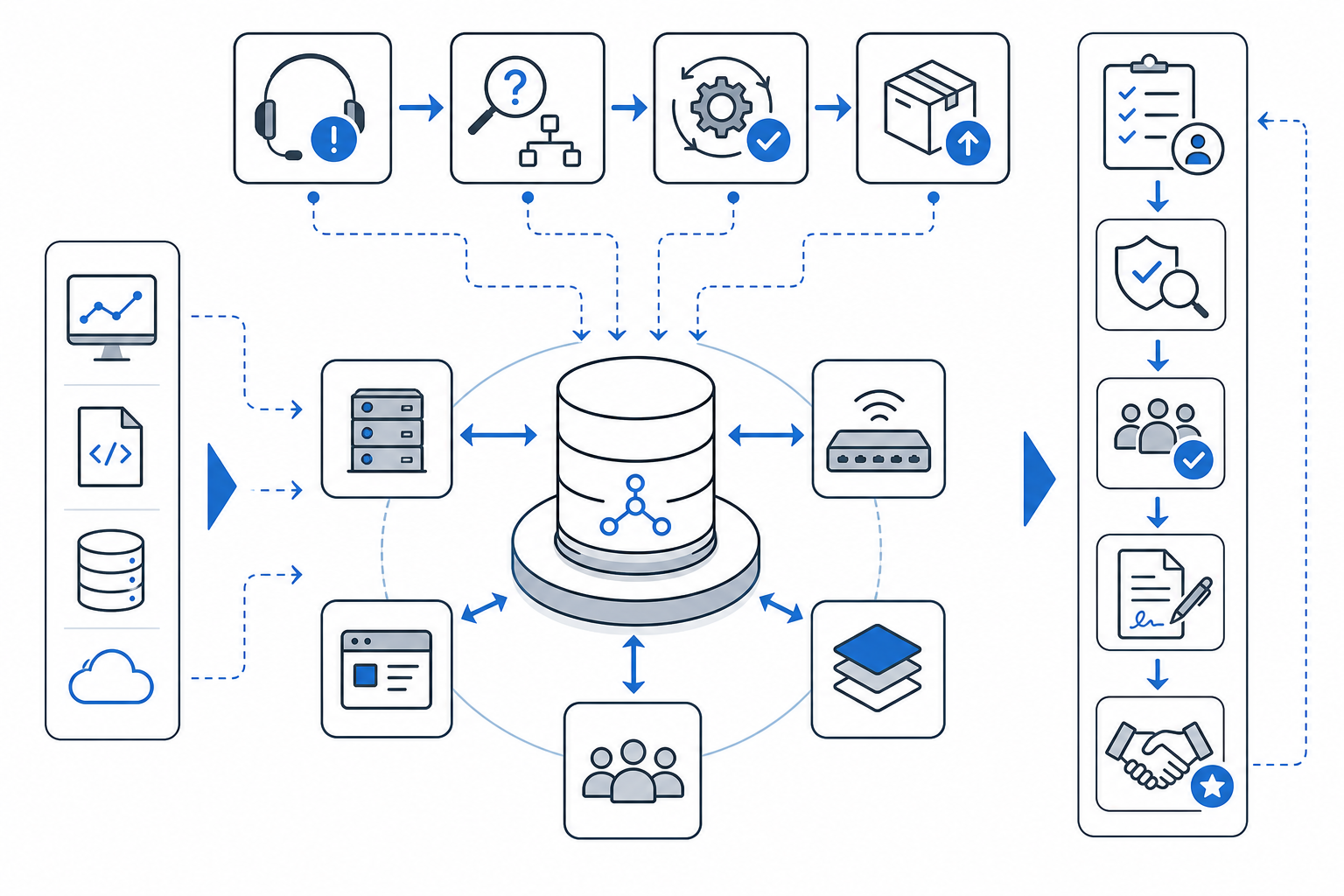
The ITIL-to-CMDB link: which practices matter and what evidence fits
This is where many profiles become clearer. In tender language that explicitly uses ITIL 4, the named practices include incident management, change management, service requests, change requests, monitoring and reporting, upgrade activity and technical support. In DG TAXUD operational tooling, adjacent service-management functions also include problem management, configuration management, request fulfilment, service level management and known-error management. The safe way to present this experience is not to claim all practices equally. It is to show which ones you handled and what CMDB action sat behind them.
| Practice or function | What the CMDB contribution looks like | Evidence worth showing in a profile |
|---|---|---|
| Incident management | Use CI records and relationships to identify affected services, dependencies and likely ownership | Linked incidents to CI context, supported escalations, improved record accuracy after service restoration |
| Problem management | Use stable CI data and relationship views to support root-cause analysis | Provided CI history, dependency mapping or reconciliation input for recurring issue analysis |
| Change management | Assess impact, risk and affected relationships before implementation; update the CMDB after approval or release | Maintained change-linked CI updates, documented impact scope, validated post-change records |
| Service requests / request fulfilment | Ensure standard fulfilment actions create, update or retire relevant CIs consistently | Handled request workflows that triggered CMDB updates or ownership changes |
| Change requests | Separate routine request handling from controlled change affecting configuration baselines | Showed when requests became formal change items with CMDB traceability |
| Monitoring and reporting | Turn CI and service data into daily operational visibility for teams and stakeholders | Produced configuration, service, exception or data-quality reports |
| Upgrade and technical support | Keep versions, reference configurations and support relationships aligned with operational reality | Updated CI attributes after upgrades, maintained support mappings or validated affected dependencies |
| Service level / known-error functions | Support performance review and structured error knowledge with reliable CI references | Worked in the ITSM environment where service targets or known-error records relied on accurate CI links |
That table is also a reminder that “worked in ITIL” is too abstract. The stronger statement is narrower: which practice, what CI action, and what operational use followed from it.
Step 4: Name tooling experience at module and integration level
Tool familiarity matters, but product names alone are weak evidence. The useful detail is what you did inside the tool, what data was managed, and how the platform supported service operations. In EU-institution procurement language, ServiceNow has been specified with service catalogue, incident and request workflows, CMDB and reporting modules. This is a much stronger guide for describing experience than the bare statement “ServiceNow user”.
| Tool or platform | Relevant institutional context | Experience worth stating clearly |
|---|---|---|
| ServiceNow | Service catalogue, incident and request workflows, CMDB and reporting modules in an EU-agency production service-management environment | Modules used, workflows supported, CI information maintained and reports produced |
| HP Universal CMDB | Named in DG TAXUD material as part of CMDB maturity improvement | CI modelling, relationship management, reconciliation or integration contribution |
| IBM TADDM | Named in DG TAXUD material as the discovery tool integrated with the CMDB | Discovery scope, data validation, integration handling and exception management |
| Synergia SMT | Operational service-management and CMDB tool used for CIs falling under DG TAXUD contract scope | CI population, updates, change and release handling, and reporting activity |
A useful extra distinction is that these platform references come from different institutional contexts. Synergia SMT and the HP Universal CMDB plus IBM TADDM integration sit in DG TAXUD documentation. ServiceNow module references appear in a separate EU-agency tender environment. That means you should never blur them together as if every institution uses the same stack. The transferable point is the discipline behind the tools, not a false claim of platform identity.
The same principle applies to automation and supporting utilities. Some technical annexes require implementation and maintenance of CMDB tools, deployment activity and automation of procedures related to those tools. If you worked on automation, keep the statement tied to the actual toolset and the actual CMDB outcome.
Step 5: Turn broad CV language into requirement-level evidence
This is where most otherwise suitable applications become mediocre. Broad language is easy to write but difficult to assess. Replace it with evidence that mirrors the profile requirement without copying tender text mechanically.
| Weak wording | Why it falls short | What the stronger version must include |
|---|---|---|
| Maintained the CMDB | Does not establish scope or quality responsibility | CI population and updates, attributes, relationships, lifecycle control and data quality |
| Supported change management | Does not show a role in the change lifecycle | Impact assessment, risk input, documentation, approvals, release updates or CMDB change handling |
| Worked in ITSM | Too broad to map to a service requirement | Named practices such as incident, change, requests, monitoring, reporting, upgrades or support |
| Used ServiceNow | Does not reveal practical platform experience | Specific workflows or modules: catalogue, incident, requests, CMDB and reporting |
| Configured discovery | Does not identify technical relevance or operational outcome | Discovery product, CI scope, CMDB integration and data-validation responsibility |
The stronger version does not need inflated outcomes. Its value comes from being testable. A reviewer can see exactly where the experience sits: data stewardship, service operations, ITIL practice, tooling or stakeholder reporting.
Experience mapping checklist: mirror the tender wording
Once the basics are clear, translate the dossier concepts into a checklist you can apply role by role. This is especially useful when the shortlist may include both a CMDB specialist and an ITIL consultant profile, because the same operational environment can be described from two different angles.
| Tender concept to mirror | CMDB specialist evidence | ITIL consultant evidence |
|---|---|---|
| Operations CMDB scope covering ICT infrastructure and hosting | Managed CIs across infrastructure, hosting or application layers; maintained shared operational records in scope | Used that CMDB scope to support incident, request, change or service coordination workflows |
| Lifecycle integrity, baselining and controlled change | Maintained CI status, versions, baselines or post-change updates; supported audit and verification | Connected lifecycle control to change enablement, release governance and operational risk reduction |
| CI attributes and relationships | Validated attributes, ownership, support groups and dependencies; corrected relationship errors | Used relationship accuracy for impact analysis, escalation paths, problem investigation or stakeholder reporting |
| Reporting for Operations and other stakeholders | Produced CMDB, exception, reconciliation or data-quality reporting | Turned operational data into service reporting, management visibility or process improvement inputs |
| Hybrid scope: on-premises and cloud | Worked with both on-prem and cloud CIs where that was genuinely in scope | Showed how service processes operated across mixed environments rather than one technical silo |
| Tool and process integration | Supported CMDB population, discovery integration or operational maintenance in tools such as Synergia SMT, HP Universal CMDB or IBM TADDM | Worked in service-management workflows or modules such as incident, request, catalogue, CMDB and reporting in platforms such as ServiceNow |
This matrix helps prevent a common mistake: presenting the same experience in generic language no matter which profile is advertised. The words should shift depending on whether the requirement emphasizes CMDB stewardship, ITIL process execution or both.

Where profiles commonly fail — and how to fix them
Failure point: treating the CMDB as a completed implementation
A migration or initial population is relevant, but it is not the full job. Institutional requirements emphasise ongoing updates, controlled change, reporting, audit and verification. Fix this by showing the operating rhythm after implementation: how CI accuracy was maintained, how exceptions were handled and how changes or releases affected records.
Failure point: omitting CI relationships
Attributes alone do not support impact analysis. A CI record becomes operationally useful when its dependencies are known. Fix this by identifying the types of relationships you maintained or validated, but only where that was genuinely within your remit. Infrastructure-to-service, application-to-database and discovery-to-CMDB relationships are more meaningful than a generic claim of “data maintenance”.
Failure point: leaving reporting out of the story
Reporting is not an administrative afterthought. Operational CMDB requirements can include daily information needs for operations and other stakeholders. Fix this by including the reporting activity itself: producing configuration, service, change or data-quality reports; preparing information for operational teams; or translating records into stakeholder-facing visibility.
Failure point: presenting a certification as a substitute for delivery experience
ITIL or ISO/IEC 20000 knowledge can be relevant, and some tenders specify accreditation or equivalent policies. It does not replace examples of applied service-management work. Fix this by placing certification and framework knowledge alongside specific operational responsibilities, never in place of them.
The advanced move: create a tender-ready evidence matrix
Maintain a private evidence matrix that can be adapted to each opportunity. Put the role requirement in one column, your exact evidence in the next, and the platform or process context in the third. This is more efficient than rebuilding your application from memory every time, and it reduces the risk of claiming work that belonged to another team.
- Configuration management: CI scope, attributes, relationships, lifecycle, baselines and audit activity.
- ITIL practices: the named practice, your role in the workflow and the operational hand-off.
- Tooling: product, module, integration, automation or reporting responsibility.
- Service operations: incident, problem, change, release, request or monitoring connection.
- Stakeholder delivery: operational reporting, coordination and the audience for the information.
For Trans-European or multi-site service environments, include evidence of distributed governance and coordination where it is real. The ability to maintain shared operational information across multiple stakeholders is central to this type of assignment.
What “done right” looks like
A strong CMDB or ITSM profile for an EU-institution contract makes three things immediately clear: you understand configuration items as lifecycle-controlled, relationship-based operational data; you can apply service-management practices in live workflows; and you can name the platform modules, integrations and reporting responsibilities behind your experience.
The key moves are straightforward: lead with tender requirements rather than tool lists, show how CMDB data supports operations, describe practices with real workflow detail, and keep every claim specific enough to be assessed. That is the difference between a generic ITSM CV and a profile that maps cleanly to institutional service-management work.
The practical lesson is simple. EU-institution shortlists are more likely to respond to evidence of control, accuracy and operational use than to broad statements about frameworks or tools. If your experience is real, specific and mapped to the wording of the role, it will usually read stronger than a longer but vaguer profile.