When a Specific Contract Ends: Extend or Hand Over

Your end date is real until a written extension says otherwise
TL;DR: A specific contract ends on its stated date unless the contract route for renewal or extension is actually used in time. If continuity is needed, the decision sits with the contracting authority under the applicable contract model, and it normally has to be documented in writing before expiry. If continuity is not confirmed, prepare a full handover early and communicate only conditional availability for what comes next.
A specific contract can have a maximum duration of 48 months including addenda in one current Commission tender model. In another EU external-action model, it may not exceed 730 calendar days, with requested input capped at 260 working days per expert. Those numbers matter less than the operating principle behind them: your assignment has a defined scope and period, and neither continues simply because work remains.
The mistake I see most often at the end of an EU consultant assignment is treating a positive conversation as an extension. A project lead may want continuity. A delivery team may still need support. Neither fact changes the contract end date. An EU consultant assignment ending extension becomes real only through the mechanism allowed by the specific contract and framework contract, with the necessary written agreement completed before expiry.
The right approach is deliberately two-track: protect the current assignment with a clean extension decision or handover, while preparing for the next assignment without assuming that the current one will continue. This avoids the awkward middle ground where a consultant is neither properly extended nor properly available.
What a specific contract end actually means
Under EU framework-contract arrangements, the specific contract is the work order that defines the assignment’s period and scope. The framework contract creates the route for the work; the specific contract governs the particular engagement. That distinction is essential when the end date approaches.
- The framework contract sets the wider contractual rules, including how specific contracts may be requested and managed.
- The specific contract sets the assignment’s defined scope, period and terms.
- An addendum or renewal may extend the specific contract only where the applicable contract documents allow it and the required agreement is in place before the existing period expires.
Do not confuse an extension of a specific contract with an extension of offer validity. These are different mechanisms. Offer validity concerns whether an offer remains open for acceptance during procurement. A specific-contract extension concerns the duration of work already awarded. The language can look similar in correspondence; the contractual consequence is not similar at all.
There is also a hard outer boundary that gets missed in otherwise sensible extension discussions: the framework contract’s survival period. Put simply, the survival period is the outer time limit within which specific contracts and any permitted addenda can still operate under the framework. Even if a specific contract has room in its own duration, an extension cannot run beyond the period permitted under the framework contract. In the Commission model that allows specific contracts of up to 48 months including addenda, an extension still cannot exceed the framework contract’s survival period.
That is why a calm end-date review matters. Before you ask whether the work should continue, check whether it can continue under the contract structure that already exists.
Recommended approach: run an end-of-assignment review early
Do not wait for a final-week conversation. Run a structured end-of-assignment review while there is still enough time to clarify the extension position, assemble the handover and position yourself for subsequent work. The exact lead time depends on the assignment documents and delivery context, but the judgment is straightforward: start before the decision becomes urgent.
Step 1 → Confirm the contractual boundary → Replace assumptions with a workable plan
Gather the documents that actually govern the assignment before discussing what happens next:
- The signed specific contract and any existing addenda.
- The relevant framework-contract provisions and request documentation.
- The documented start and end dates, scope and expected outputs.
- Any provisions on renewal, extension, phase-out, transfer of materials, confidentiality and return or deletion of information.
- The current list of work in progress, unresolved decisions, dependencies and planned deliverables.
This is not paperwork for paperwork’s sake. It prevents the most expensive practical error: committing to an outcome that the contract structure cannot support. A useful review separates three questions that are too often bundled together:
- Can the work continue under the applicable contractual rules?
- Does the contracting authority want it to continue?
- What must be transferred if it does not?
Only after those questions are separated can you give a credible availability position to the organisation that employs or contracts with you. From there, the next task is to identify the actual decision-maker rather than the loudest stakeholder.
Step 1: establish who decides an extension
Step 2 → Identify the decision owner → Direct the extension discussion to the right place
The specific contract contracting authority decides whether to request or grant an extension under the contract model. That is the decisive point for a consultant approaching the end of an assignment: operational demand alone does not approve an extension.
Where the specific contract does not expressly provide for automatic renewal, renewal requires the express written agreement of the parties before expiry, in line with the framework contract. In practice, this means that a consultant should treat the project team’s desire to retain knowledge as evidence of a business need, not as contractual confirmation.
Some Commission procurement language permits a one-off specific extension only in exceptional cases and only with prior approval by the competent authority. Other contract models allow an initially limited specific contract to be renewed where the contract itself provides for it and agreement is reached before the end date. The governing document matters more than generic expectations about “how extensions normally work.”

Do this instead of chasing an informal promise: give the person managing your contract relationship a concise factual briefing. State the existing expiry date, the deliverables completed, the work that remains, the operational consequence of a gap and the decision that is needed. This gives the contracting authority and the framework contractor a usable basis for the formal route without you presenting yourself as the approval authority.
Do not pressure the operational team to “confirm” an extension that has not been formalised. That creates avoidable confusion and can undermine the handover planning that should be happening in parallel.
Extension decision paths: renew, extend, or let the contract end cleanly
As the end date approaches, there are usually only a few defensible paths. Thinking in paths is useful because it stops a vague hope of continuity from masquerading as a decision.
- Renew or extend under the existing route: this works only if the contract documents allow it, the period remains within any maximum duration and survival-period limits, and the parties complete the required written agreement before expiry.
- End on time and hand over: if the route for extension is unavailable, not approved or simply not chosen, the assignment ends on the stated date and continuity is protected through phase-out and transfer of knowledge.
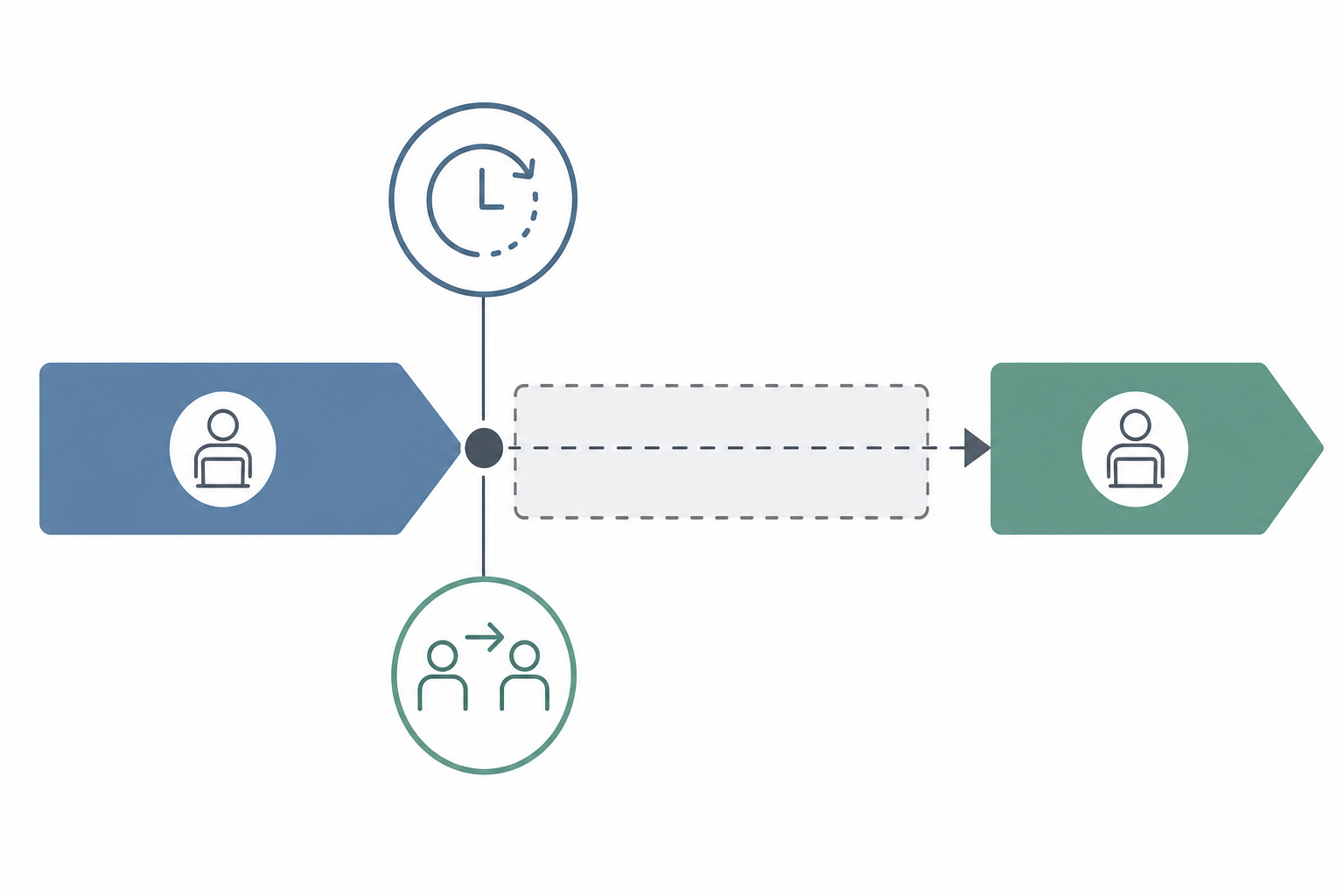
- Hold a conditional position while the decision is pending: you can stay professionally available for a possible continuation, but you should describe that availability as conditional until the written mechanism is complete.
What you should not do is operate in a fourth, informal path where everyone behaves as if the contract will continue and no one completes the paperwork in time. Once the period has lapsed, the extension mechanism in the Commission model does not operate in the same way. That is why even a likely continuation should be handled as unfinished until the signed extension or renewal is actually in place.
This leads directly to the next check: even when the business case is obvious, the extension still has to fit inside the contract rules.
Step 2: test whether an extension is contractually possible
Step 3 → Check the renewal route and limits → Avoid pursuing an extension that cannot be executed
An extension is not one generic action. Check the contract text for four things before treating it as a live outcome:
- Renewal wording: Does the specific contract provide for a renewal or extension?
- Written-agreement requirement: Does the mechanism require express agreement before the current term ends?
- Duration limits: What is the maximum duration, including addenda, under the applicable model?
- Framework boundary: Does the proposed period remain within the framework contract’s survival period?
The important judgment call is to stop describing an extension as likely when one of those checks is unresolved. You can remain helpful and ready, but availability is not authorisation to perform beyond the end date.
Be particularly careful with terms such as “validity extension.” In some external-action procurement procedures, offer validity can be extended once for a limited period, and the contractor is not necessarily obliged to accept that extension. That is a procurement-stage mechanism. It does not itself extend the duration of an active specific contract.
The practical discipline here is simple: if the document in front of you extends the offer, that is not the same as a document extending the work. Treat those as separate questions until the paperwork clearly joins them.
Step 3: build the handover before the outcome is known
Step 4 → Prepare a usable handover package → Protect continuity without working past expiry
The best handover is not a retrospective account of what you did. It is a practical starting point for whoever must continue the work. Commission service-transition material frames phase-out clearly: handover to another contractor or the customer must happen while service continues until the end of the specific contract.
That means phase-out is part of delivery, not an optional administrative task for the final day. Start by identifying what the next person would need in order to act without repeatedly coming back to you for basic context.
A Commission tender specification for the European Migration Network provides a useful standard of completeness. It requires a digital handover file containing ongoing outputs, digital copies of relevant assets, address lists, concept papers, questionnaires, newsletters, event materials and meeting minutes. That file must be finalised and handed over one month before framework-contract expiry, followed by a handover briefing meeting involving the Commission and the next contractor. Remaining issues are discussed and an oral task handover takes place.
Not every specific contract will require that exact file, timing or meeting format. Treat it as a quality benchmark, not as a universal checklist. Your own contract and assignment instructions remain controlling.
A strong working handover usually makes the following visible:
- What has been delivered, where the authoritative version sits and what still needs approval.
- What is in progress, including the next action, dependency and practical deadline.
- Which decisions remain open, who owns them and what information is needed to resolve them.
- Which materials are relevant to continuation and how access is governed.
- What meetings, reporting cycles or recurring tasks the successor needs to know about.
- Which risks could become urgent after the assignment ends.
Do not turn the handover into a document dump. A folder full of files without a clear index, status and ownership trail transfers volume, not understanding. The quality test is whether another authorised person can find the current position, understand the next action and continue responsibly.
Where the assignment requires deletion or return of materials after handover, that close-out step matters too. In the EMN specification, the contractor must erase the relevant material after handover and notify the Commission that this has been done. Even where your own assignment uses different wording, the underlying principle is consistent: handover and information-governance duties do not disappear just because the operational team is busy.
Shortening the gap before the next assignment
This is where many consultants need something more concrete than “stay visible.” If you want to shorten the gap between assignments EU institutions work can create, focus on actions that make continuity easier before the current contract expires.
- Finalise the handover file early: where a contract model uses a formal handover package, treat that as a live workstream, not a last-day task. The EMN example sets a demanding benchmark by requiring the file to be finalised one month before expiration.
- Hold the briefing meeting before the end date: a pre-expiry handover meeting lets remaining issues be discussed while you are still formally on assignment. If a successor is known, that is the cleanest moment for an oral task handover.
- Confirm any transition support only in writing: if someone wants you available beyond the current end date, that needs a valid written extension, renewal or other written transition arrangement that fits the contract route. Goodwill is not a bridge across expiry.
- Use conditional availability messaging: tell your employer or framework contractor when you are confirmed to finish, whether an extension is signed, pending or not expected, and from what date you could start something else if no written continuation is completed.
Those steps do two things at once. They reduce disruption for the current assignment, and they make your next-start date more credible for whoever may place you next. What they do not do is create a universal right to remain attached to the institution informally between assignments. The applicable mechanics remain contract-specific and framework-specific.
Step 4: keep next-assignment options open without crossing a line
Step 5 → Separate availability planning from current delivery → Create momentum without breaching obligations
The period between assignments at EU institutions is easier to manage when you stop treating it as a passive waiting period. There is no single EU-wide rule that maintains consultant availability between assignments. The practical mechanics depend on the specific contract, framework contract and your own contractual relationship with the framework contractor or employer.
Use the final stage of the current assignment to make your availability legible without disclosing protected information or implying that you are free before you are. A clear professional update should distinguish:

- Your confirmed end date under the current specific contract.
- Whether a formal extension has been executed, is under consideration or is not expected.
- Your anticipated availability after the confirmed end date.
- Your relevant capability at a level that does not reveal confidential project information.
- The type of scope in which your current experience is transferable.
This is the better way to shorten the gap before the next assignment: create a reliable view of when you can start and what you can deliver, while keeping current obligations intact. Do not share client material, internal contact lists, draft outputs or confidential operational detail to market yourself. Do not accept new work that conflicts with the existing contract or interferes with completing the agreed handover.
Where an extension is possible but not signed, communicate that position accurately. “Available subject to the conclusion of my current assignment” is more responsible than treating a hoped-for extension as fixed or pretending the current commitment does not exist.
Real failure points and the practical fix
The extension conversation starts too late. The problem is not merely delay; it is that written agreement must be secured before expiry where the model requires it. Fix this by raising the decision while there is still time to assess scope, authority and contractual limits. Continue preparing the handover even when the outlook is positive.
The team wants continuity, but no one owns the formal action. Operational stakeholders may identify the need without being the contracting authority. Fix this by recording the remaining work and the continuity risk in a concise status briefing that can be taken through the correct contractual route.
The handover is left until after the extension decision. This is backwards. A delayed decision does not remove the end-date risk. Fix this by building the handover package as current work proceeds, then refining it as the final period becomes clearer.
The consultant becomes unavailable for future work while waiting. Waiting for an uncertain result can lengthen the gap between assignments. Fix this by communicating conditional availability through the appropriate contract relationship, keeping the message factual and not disclosing current-assignment information.
Employment-status assumptions are made from the EU assignment alone. A specific contract does not establish one universal country-level answer on employment status. Check the applicable local jurisdiction and your contract form separately. That is a compliance point to verify with the appropriate local professional support, not a conclusion to draw from the assignment end date.
The advanced move: make the transition evidence-based
Step 6 → Leave a traceable close-out record → Make continuity and availability easier to assess
Strong consultants do more than finish tasks: they make the end state visible. Maintain a short close-out record alongside the handover file. It should identify the confirmed contract end date, the extension status, deliverables completed, live issues, handover materials prepared and any required next action before expiry.
This record should not replace contractual documentation or formal approval. Its value is operational: it prevents the same questions from being asked repeatedly, supports an orderly handover briefing and lets the organisation managing your placement understand your availability position without speculation.
What done right looks like
- The current end date is known and treated as the live contract boundary unless a valid written extension is completed before expiry.
- The extension decision has been directed to the specific contract contracting authority, not left as an informal project expectation.
- The renewal route, duration limits and framework-contract survival period have been checked.
- A practical, indexed handover package is ready before the final days of the assignment.
- Your next-assignment availability is communicated accurately, without exposing confidential information or undermining current delivery.
- Any employment-status question is checked separately under the relevant local rules and contract form.
The cleanest transition is not the one where an extension happens at the last moment. It is the one where every party knows the contractual position, the work can continue or transfer without confusion, and you can move into the next assignment with your professional reputation intact.
In other words, treat the end date as real, treat extension as discretionary and document-dependent, and treat handover as part of delivery rather than an afterthought. That combination protects the current assignment and gives you the best chance of reducing the gap before the next one without overpromising or stepping outside the contract.