Europass CV or Tender Template: The Right Format for EU Work
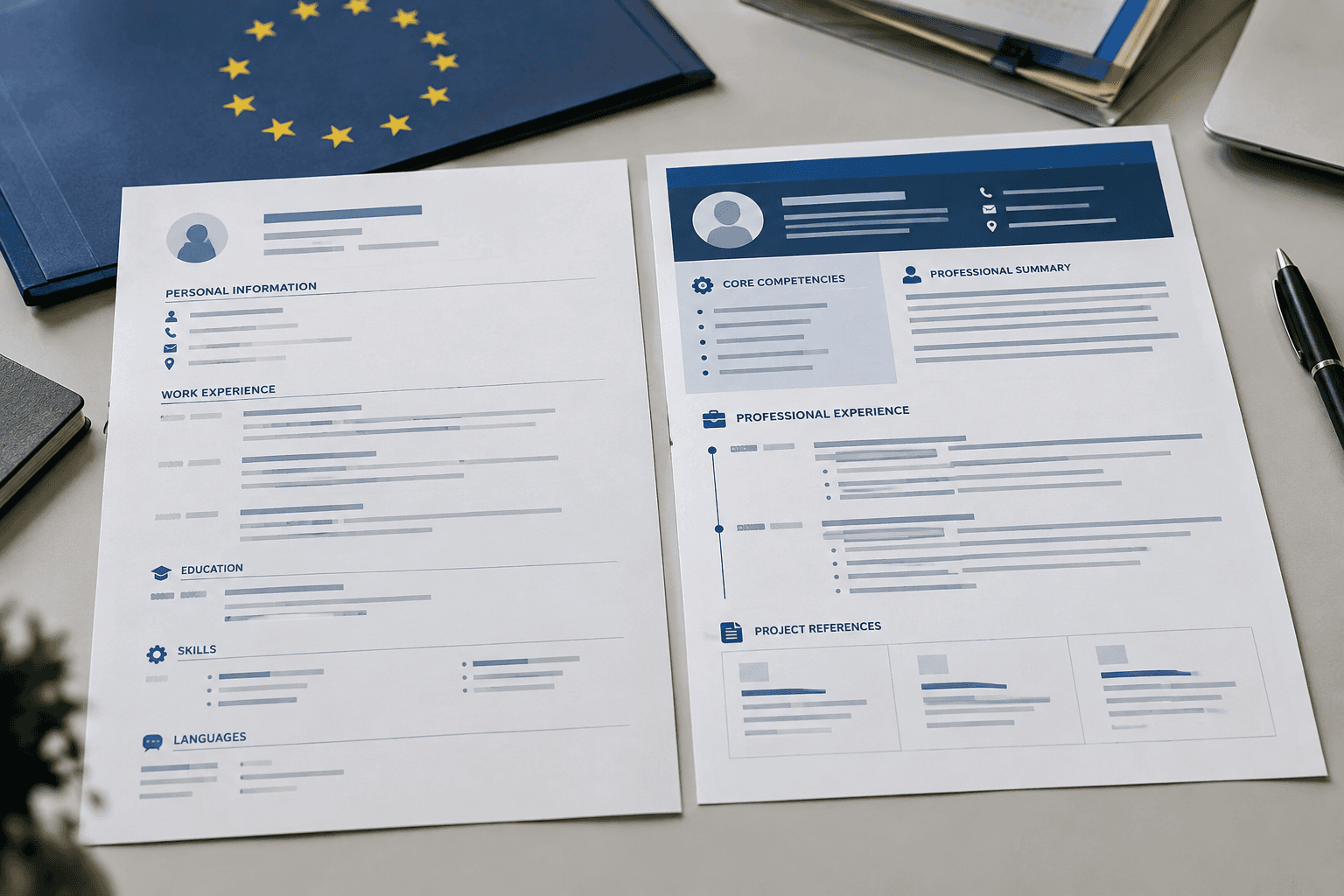
A consultant can deliver a complete Europass CV and still leave the agency without the project table, declaration or signature required for submission. A familiar layout does not compensate for a missing mandatory field.
Start with the submission requirements, not the consultant’s preferred layout. Identify the required form first, then have the agency transfer the consultant’s information into it. Keep formatting decisions with the agency and factual confirmation with the consultant: the agency can standardise a date’s presentation, but it cannot supply a missing start month.
Which CV format controls an EU assignment?
Europass provides a structured European CV format covering personal information, employment history, education, skills and language competence. It is not a blanket requirement for every EU-funded assignment. The tender notice, terms of reference, framework agreement, contract annex or submission portal determines what must be submitted.
| Submission requirement | Format to use | Practical consequence |
|---|---|---|
| “Europass CV” or “CV in Europass format” | The requested Europass structure or supplied Europass annex | Complete the required fields and follow any additional tender instructions. |
| “Use the attached CV template” | The tender’s own form | Preserve its required headings, project tables, declarations, length limits and signature fields. |
| “Europass or equivalent” | Europass, or another format meeting the stated requirements | A substitute must retain the requested evidence and level of detail; visual similarity alone is insufficient. |
| No CV format specified | A structured CV addressing the tender’s information requirements | Use clear month/year chronology, project-level experience, qualifications and CEFR language entries to make the information easier to check. |
If the documents request a “European format,” check the accompanying annex and instructions before selecting a generic Europass CV template. Likewise, a European Commission CV template may belong to a particular procurement procedure, framework contract, institution or service lot. It is not a single form that governs every Commission assignment.
Establish the requirements before reformatting
The useful preparation is not a redesign. It is identifying which information must survive the transfer into the submission form.
- Locate the applicable instructions and attachment. Read the CV requirements in the procurement documents, framework agreement and submission form together. Do not assume that a consultant’s existing Europass file satisfies a contract-specific annex.
- Record the actual constraints. Check field order, project-reference structure, page limit, file format, declarations, availability information and signatures. These determine both the layout and what the consultant must provide.
- Identify factual gaps before layout work begins. Separate missing dates, project technologies and language levels from formatting tasks. Return those gaps to the consultant rather than filling them through inference.
Where the documents prescribe a specific CV form, treat it as a submission requirement rather than optional presentation guidance. Do not replace it with a visually similar Europass CV unless equivalent formats are expressly permitted. If the instructions conflict, seek clarification rather than silently choosing the easier layout.
What the agency can reformat — and what it cannot
The agency can transfer a source CV into Europass, a framework-contract form or an authority-specific annex. That work can include heading order, typography, page breaks, table structure, consistent terminology, duplicate removal and conversion into the required file format.

The boundary is factual meaning. The agency should not change employment dates, job titles, responsibilities, certifications, language levels or technology exposure without the consultant’s confirmation.
- Dates: standardise supplied dates into the requested presentation. “2021-present” cannot become a month-level entry until the consultant supplies the start month.
- Technology names: make naming consistent while preserving the products and versions supplied. A technology in a general skills list cannot automatically be attributed to a particular project.
- Language descriptions: enter CEFR levels supplied or substantiated by the consultant. Do not turn “fluent” into C1 or C2 as an editorial decision.
- Empty sections: remove them only where the adopted template permits it. An empty optional heading is different from an unanswered mandatory field.
Retain the original source CV and a change record when reformatting affects dates, project descriptions, technology lists or language classifications. This makes the consultant’s review more precise: they can check substantive changes rather than compare two entire documents line by line.
What the consultant needs to supply
Month-level dates for relevant employment and projects
Request a start and end month and year for each relevant role, such as 03/2021-11/2023. Europass supports different date precisions, so month-level dates are not a universal requirement of the format itself. They are nevertheless the better operational standard for staffing submissions where duration and overlapping experience need to be checked.
Keep employer dates separate from project dates when they differ. An employment entry covering several years does not establish how long the consultant worked on a particular assignment or technology. Ask the consultant to identify gaps, part-time work and concurrent engagements accurately; do not add overlapping periods together without checking the tender’s treatment of experience.

Project-level technologies and responsibilities
When the tender requires project evidence, a general employer entry is not enough. Each relevant project should identify the client or sector where disclosure is permitted, its period, the consultant’s role, responsibilities, outputs, methods and technologies.
Attach technologies to the work in which they were used. For example, an entry naming Java 17 or PostgreSQL 15 should also explain the consultant’s activity: development, administration, architecture, configuration, testing, maintenance, training or management. Those activities are not interchangeable.
Include versions where the consultant knows them. If the version cannot be established, use the product name without inventing a release number. Project-level technology detail is driven by the tender’s evidence requirements; it is not a universal Europass field requirement.
CEFR language levels, not adjectives alone
The Europass language matrix distinguishes listening, reading, spoken interaction, spoken production and writing. Where the form uses that matrix, the consultant should provide a level for each skill rather than one undifferentiated “fluent” label.
The Common European Framework of Reference for Languages, or CEFR, uses A1 and A2 for basic users, B1 and B2 for independent users, and C1 and C2 for proficient users. Ask the consultant for their assessment and any language certificate name and level. A descriptive adjective alone does not establish a CEFR code.

If the tender separately asks for the working language of previous assignments, record that against the relevant projects. It is distinct from the general language matrix.
Qualifications and tender-specific declarations
Collect qualification names, awarding institutions, dates and the European Qualifications Framework level where known and relevant. Separately identify any declarations, availability statements, consent forms, nationality information or conflict-of-interest information requested by the tender.
Do not treat every personal-data field in an older Europass template as an instruction to collect it. Include fields such as sex, date of birth or nationality only where the applicable tender requires them and applicable data-protection rules permit their transfer.
Fix the submission problems that formatting alone cannot solve
- The consultant has supplied Europass, but the framework requires a project table. Transfer the information into the prescribed form and request the missing project detail. Attaching a generic CV does not fill unanswered fields in the required table.
- The CV exceeds the page limit. Remove duplication and trim narrative before removing required evidence. Keep mandatory dates, project fields and declarations intact; a shorter document is not useful if it no longer meets the form’s requirements.
- An “equivalent” CV omits required information. Compare it field by field with the tender’s requirements. Equivalence must preserve the requested evidence and detail, not merely produce a professional-looking document.
- A required field remains unanswered. Distinguish a missing fact from a genuinely inapplicable field, and follow the form’s instructions for each. Do not delete the heading simply to make the CV look complete.
A better handoff: review the facts separately from the layout
Have the consultant review substantive changes — dates, project descriptions, technology attribution and language levels — while the agency checks the final document against the submission instructions. This keeps factual ownership clear without asking the consultant to manage tender formatting.
Submission-ready means the prescribed form is complete, the consultant has checked the career facts, and the agency has checked the fields, length, file format and required declarations. Europass is the right choice when requested. A tender-specific form is the right choice when prescribed. In either case, accurate chronology and project evidence matter more than preserving the original CV’s appearance.