EU Contractor Day Rates: Belgium vs Luxembourg Net Pay
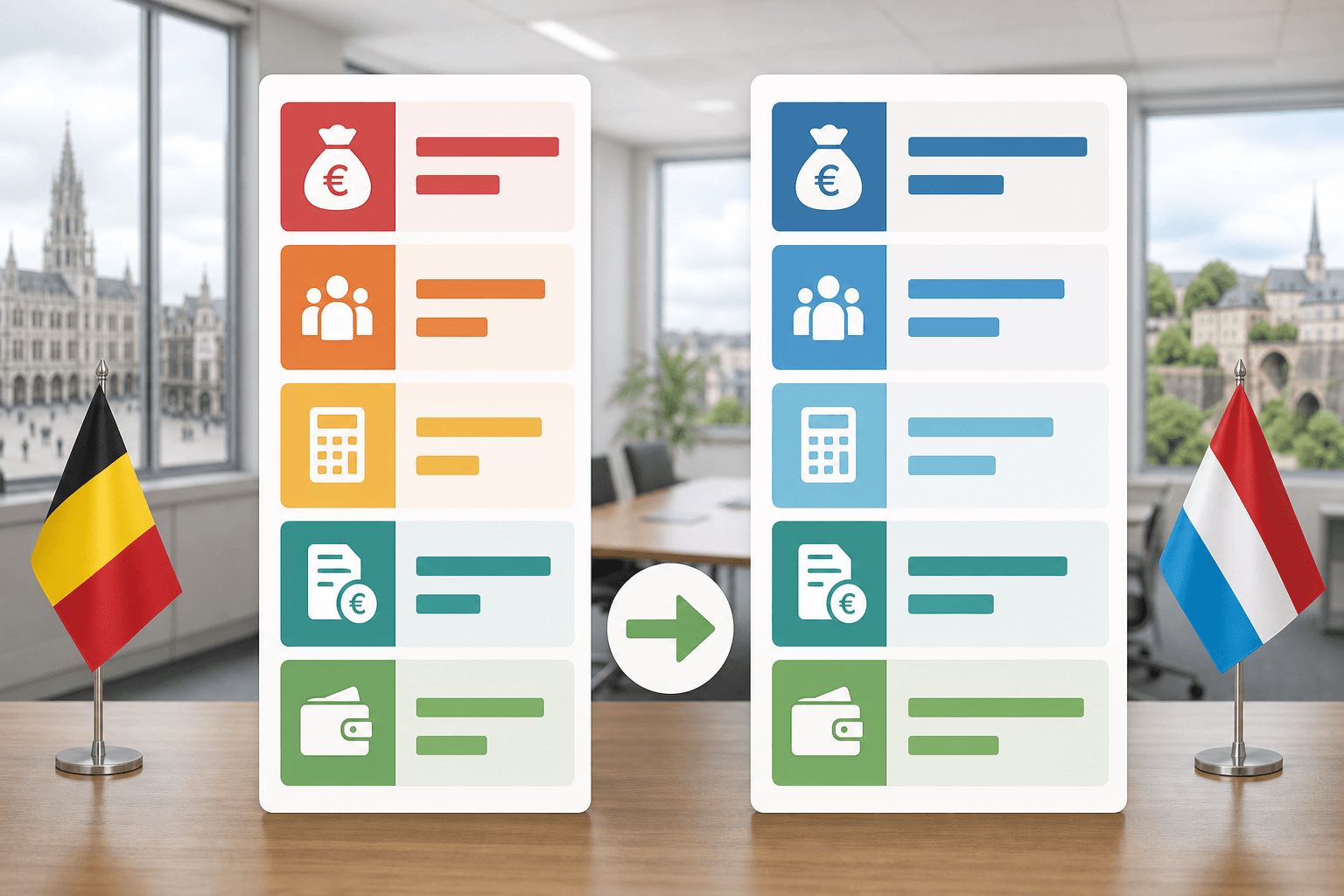
A note on the numbers: every day rate and net-income figure in this article is a market-observed planning range for the Brussels–Luxembourg AV/IT contracting market — not an Alsena rate card, and not what any specific assignment pays. Use them to sanity-check an offer, then confirm your own position before signing anything.
The invoice rate is not your income
A €600 day rate can look like a decisive career upgrade-until you annualise it properly, remove unpaid time, then account for tax, social security, business costs and the contract structure sitting between you and the client. That is where newcomers to EU-institution contracting most often get caught out.
The mistake is treating a quoted day rate as a salary equivalent. It is not. For AV and IT assignments, the rate is generally a gross billing rate: the amount invoiced before VAT treatment, agency margin, service or umbrella fees, business overhead, social contributions and income tax.
The right way to assess an offer is to start with a realistic number of billable days, apply the tax and social-security position that genuinely applies to you, and only then compare the remaining income with your living costs. This is especially important when comparing Belgium and Luxembourg, where the same headline rate can lead to a very different take-home result.
Use this approach before you negotiate or accept a contract
For consultant day rates and net pay in Belgium, Luxembourg and EU-institution work, start with the structure-not the most flattering number on the offer. Your result depends on four things:
- your actual day rate and profile level;
- how many days you can genuinely bill in a year;
- whether you operate as a self-employed person, through a company, through an umbrella arrangement or as an employee; and
- where you live and pay social security: Belgium or Luxembourg.
Recommended approach: build a cautious annual plan using 180-210 billable days unless the assignment is sufficiently stable to justify a higher assumption. A 220-day year can happen, but it should not be the starting point for deciding whether a rate works for you.
Public-sector and EU-institution assignments can be stable, but procurement timing, contract gaps, holidays, sickness, training and administration all reduce the days that actually generate revenue. The strongest contractors price for that reality rather than hoping it will not apply to them.
Prerequisites: know what is behind the day rate
Before putting any number into a net-pay calculation, establish the commercial route. A rate offered through a staffing firm, a service company or a consultancy umbrella does not automatically reach you in full.
- Self-employed natural person: straightforward to start, but your income is exposed directly to personal taxation and social contributions.
- Company contractor: can provide more flexibility around expenses and income planning, but brings accounting, compliance and potentially employer-level costs.
- Employee-like or fixed-term contract: the quoted billing rate is converted into salary, with payroll withholding, employer charges and benefits affecting the final employee net.
- Umbrella, portage or payroll solution: reduces administration and can make client access easier, but fees reduce effective take-home.
Do not assume a company is automatically the best answer, or that self-employment automatically produces the best net result. A company only improves the picture when it is properly managed and legally structured. For a solo consultant with limited deductible costs, direct personal taxation can still take a substantial share of the income.
Step 1: benchmark the role before judging the offer
Job titles in the EU-institution environment can hide major differences in market value. An AV technician, IT support consultant and solutions consultant may all work within the same procurement ecosystem, but their responsibility and rate bands are not interchangeable.
Step 1 -> Match the work to profile depth -> Judge the offered rate against the responsibility it buys
- AV support / conference-room technician: the entry band — hands-on operation and first-line support.
- IT support / workplace / service desk consultant: a step up where autonomy and user-facing responsibility widen.
- AV/IT specialist with integration or project responsibilities: materially higher — the profile carries delivery risk, not just execution.
- Senior consultant, lead engineer or niche systems expert: the top of the market — scarce expertise, language coverage or clearance commands the premium.
These bands reflect an environment where framework agreements, procurement rules and competition around Brussels tend to keep rates disciplined. Higher rates normally need something more than general competence: rare technical expertise, language coverage, security clearance or direct responsibility for live operations.


Common mistake: accepting a senior-sounding title as proof that the rate is senior. Judge the work by its scope: live operational responsibility, specialist systems knowledge, integration work, leadership and the consequences of failure.

Step 2: annualise the rate using billable days, not weekdays
A year contains about 260 weekdays. It does not contain 260 billable days. That distinction separates a useful contractor forecast from a misleading one.
Step 2 -> Day rate × realistic billable days -> Annual gross billing
- €400 per day × 210 billable days = €84,000 gross billing.
- €500 per day × 210 billable days = €105,000 gross billing.
- €550 per day × 210 billable days = €115,500 gross billing.
- €650 per day × 220 billable days = €143,000 gross billing.
- €700 per day × 220 billable days = €154,000 gross billing.
For planning, many contractors end up closer to 180–210 billable days once holidays, illness, training, administration, procurement delays and gaps between assignments are included. If a contract has no guaranteed continuity, do not build your personal budget around an uninterrupted 220-day year.
What breaks if you skip this: you may decide that a day rate is enough to support your household, only to find that a few unpaid weeks turn a comfortable forecast into a tight one.
Step 3: remove the money that is not take-home pay
Annual gross billing is the beginning of the calculation, not the answer. From it, you still need to account for social contributions, income tax, accountant and legal costs, equipment, connectivity, travel, insurance and any company or employer-level costs.
Step 3 -> Gross billing − statutory deductions − operating costs − downtime allowance -> Cautious usable-income estimate
VAT must also stay out of your personal income calculation. It is collected on behalf of the state, not revenue you can treat as available cash. Poor VAT discipline creates a cash-flow problem quickly, particularly when invoices are paid later than expected.
A broad planning rule is that usable income can fall to roughly 45%–65% of gross billing, depending on country and employment structure. The range is deliberately wide because legal status, tax residence, social security and real expenses matter more than an attractive invoice rate.

Step 4: apply the Belgium reality check
Belgium is often the tougher personal-income route for solo contractors. Self-employed workers face social contributions on net professional income, while progressive personal income taxation can become heavy as earnings rise.
Step 4 -> Apply Belgian tax and social-security pressure -> Avoid overstating personal take-home
- Lower gross-billing band: plan for around 35%–45% net take-home.
- Mid-range billing band: plan for around 40%–50% net take-home.
- Higher billing band: absolute net income rises, but marginal tax pressure remains significant.
For a solo contractor with limited deductible business expenses, simplified planning examples look like this:
- €400/day × 210 days = €84,000 gross billing: plausible net take-home of about €34,000–€42,000.
- €550/day × 210 days = €115,500 gross billing: plausible net take-home of about €48,000–€60,000.
- €700/day × 220 days = €154,000 gross billing: plausible net take-home of about €65,000–€80,000.
These are planning ranges, not filing calculations. Marital status, dependants, municipality surcharge, deductible costs and whether you operate through a company can all materially change the result.
The Belgian trap: assuming that being self-employed automatically produces business-like tax efficiency. At a moderate rate or with limited billable days, personal taxation and social contributions can leave an effective hourly net that is far less impressive than the invoice suggests.
Step 5: apply the Luxembourg reality check
Luxembourg can retain more net income than Belgium for the same gross billing, but it is not a free pass. Social contributions and tax still matter, while housing and day-to-day living costs can narrow the lifestyle advantage.
Step 5 -> Apply Luxembourg taxation, contributions and living costs -> Compare the real rather than theoretical advantage
- Lower gross-billing band: plan for around 45%–55% net take-home.
- Mid-range billing band: plan for around 50%–60% net take-home.
- Higher billing band: net retention can remain comparatively strong, but higher rent and other costs may offset part of the gain.
Simplified planning examples for Luxembourg-based personal taxation and social contributions are:
- €400/day × 210 days = €84,000 gross billing: plausible net take-home of about €38,000–€46,000.
- €550/day × 210 days = €115,500 gross billing: plausible net take-home of about €55,000–€68,000.
- €700/day × 220 days = €154,000 gross billing: plausible net take-home of about €78,000–€92,000.
The key condition is that you must be genuinely subject to the Luxembourg position you are modelling. Cross-border work between Belgium and Luxembourg adds complexity around tax residence and social security. The country where the client is based is not automatically the country that determines every contribution.
The blunt Belgium versus Luxembourg comparison
At €550 per day for 210 billable days, annual gross billing is €115,500. A practical planning comparison is:
- Belgium, solo contractor: about €48,000–€60,000 net.
- Luxembourg, solo contractor: about €55,000–€68,000 net.
On paper, Luxembourg wins. In practice, do not stop there. Higher rent, commuting, insurance, childcare, business overhead and gaps between contracts can make the final lifestyle difference much smaller than the net-pay comparison suggests.

The better judgment is not “which country has the lower tax burden?” It is “which structure leaves enough reliable usable income after my actual work pattern and living costs?”
Troubleshooting the failures that undermine contractor forecasts
“The rate looks high, but the annual result feels weak”
Check your billable-day assumption first. A rate can be perfectly respectable but inadequate if you budgeted for 220 days and only bill 180–200. Rework the annual model with a downtime allowance before blaming the rate alone.
“I am comparing gross billing with someone else’s salary”
Stop comparing the invoice number with employee gross pay. A contractor must fund non-billable time, administration, equipment, insurance and often their own buffer between assignments. Compare usable annual income after those costs instead.
“I expected Luxembourg to create a much bigger advantage”
Check the full cost picture. Luxembourg can provide stronger net retention in the planning ranges above, but the advantage may be diluted by housing, commuting and status-specific rules. The headline net gap is not the whole decision.
“The agency says the day rate is €X, but my payslip or payment is much lower”
Identify whether you are paid as an employee, through an umbrella arrangement or through a company. The client-facing rate may have agency margin, payroll costs, fees and statutory deductions removed before it becomes your pay.
The advanced move: set a minimum viable rate, not a target invoice
The most useful negotiation number is not the rate that sounds impressive. It is the lowest day rate that still works after realistic utilisation, your legal structure and your living costs.
Required annual usable income -> Add costs and statutory deductions -> Divide by realistic billable days -> Minimum viable day rate
This approach also changes how you assess a slightly lower offer. A lower rate can be the better commercial decision when it comes with stable continuity, fewer unpaid gaps, lower commuting costs and less administrative burden. Conversely, a high rate with short contract periods and frequent bench time can be financially weaker than it first appears.
TL;DR: the key moves
- Treat every EU AV/IT day rate as gross billing, never as your salary.
- Benchmark the role by responsibility and profile depth, not by title alone.
- Use realistic utilisation: for many contractors, 180–210 billable days is safer than assuming 220+.
- Remove tax, social security, agency or umbrella fees, business costs and downtime before judging the offer.
- For solo contracting, Belgium often has heavier personal tax pressure than Luxembourg.
- Luxembourg can leave more net income at the same billing level, but higher living costs can reduce the practical benefit.
- Decide on a contract structure only after modelling your real position; self-employment, a company, employee status and umbrella solutions do not produce the same take-home.
- Set a minimum viable day rate from the income you need after costs-not from the biggest invoice number you can imagine.
The figures and ranges in this article are planning guidance, not tax or legal advice. Actual outcomes depend on your status, household situation and the Belgian and Luxembourg rules in force — confirm your own position with a qualified adviser before committing to a contract structure.