Belgium–Luxembourg Consultants: Tax and Social Security

A consultant can remain taxable in Luxembourg under the 34-day cross-border tax tolerance and still move into Belgian social security because home-working reaches the 25% multi-state activity threshold. That split is the compliance point that gets missed most often.
For Belgium-Luxembourg assignments, do not run tax, payroll and social security as one decision. Tax follows the bilateral treaty and its cross-border working-day tolerance. Social security follows EU coordination rules, principally Regulation 883/2004. Treating Luxembourg payroll withholding as proof of Luxembourg social-security coverage is how teams create wrong deductions, double-tax exposure and an A1 coverage gap.
The recommended approach: run two separate compliance tracks
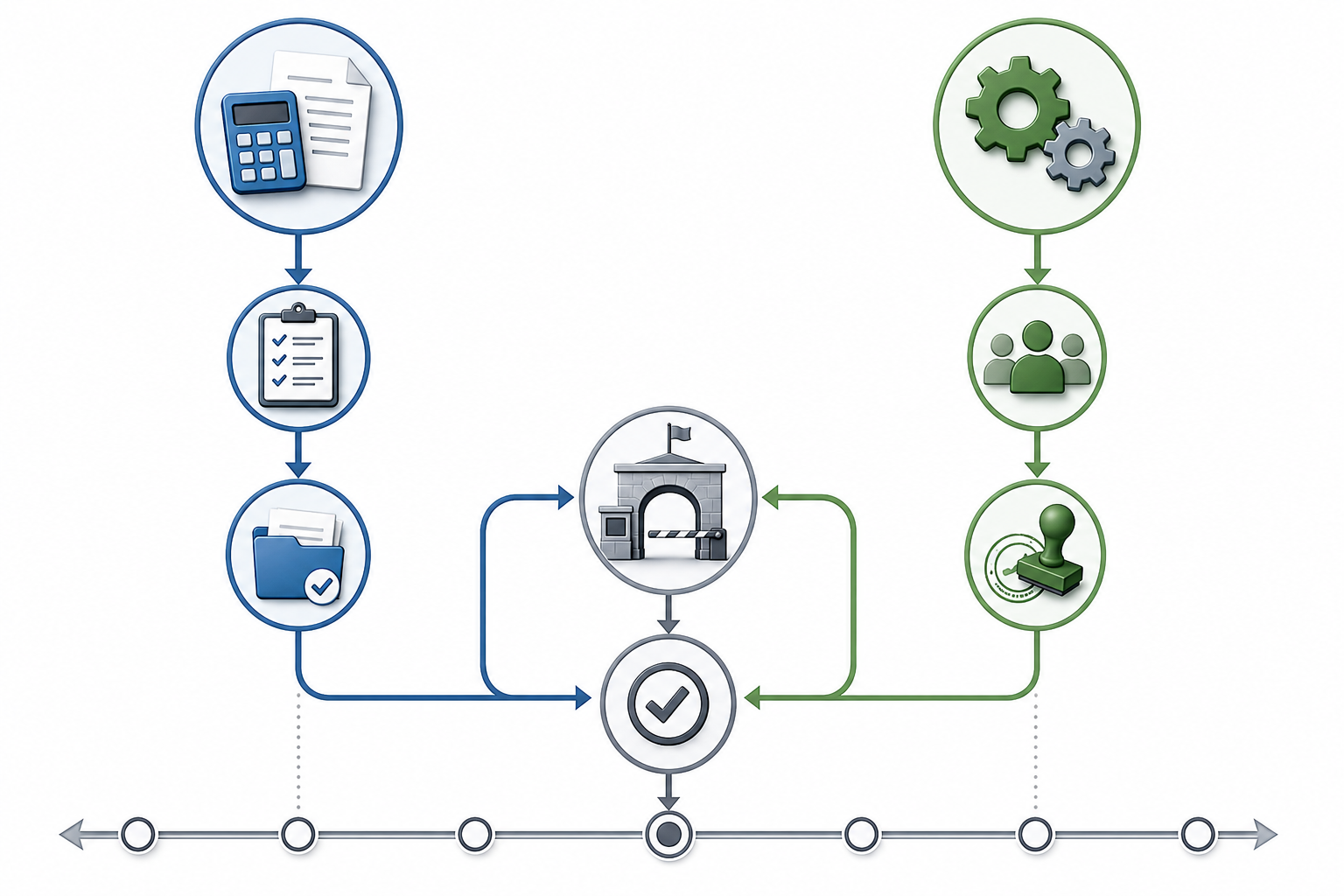
The right approach is simple in principle and demanding in execution: classify the consultant first, then track tax days and social-security activity separately throughout the assignment. Do not use one remote-work calendar for both tests and assume the result will match.
Classify the engagement → map the work pattern → test tax and social security separately → confirm the A1 position
| Compliance question | Tax position | Social-security position |
|---|---|---|
| Primary rule | The Belgium-Luxembourg tax treaty and the applicable cross-border tolerance. | EU Regulation 883/2004 and the multi-state activity rules. |
| Key operational measure | Days worked outside the usual work state. | The share of activity carried out in the state of residence, measured by working time or remuneration. |
| Critical threshold | Up to 34 working days outside the usual work state for the Belgium-Luxembourg tolerance in 2024–2026 planning. | A substantial part of activity in the residence state; the practical benchmark is 25%. |
| Evidence that matters | A reliable record of physical workdays, the engagement structure and where the cost is borne. | The actual multi-state work pattern and a valid A1 certificate confirming the applicable system. |
The judgment call: the tax allowance is not a teleworking allowance. A team that allows 34 days of Belgian home-working because tax still works may already be creating a separate Belgian social-security problem if the overall pattern reaches the 25% threshold.
Start with the facts that determine the result
Before approving a hybrid arrangement, build a short assignment file. This is not paperwork for its own sake; each item answers a different legal question. If these facts are unclear at the outset, the day count and A1 review will be built on assumptions rather than the actual engagement.
- The consultant’s country of residence: Belgium or Luxembourg.
- The usual work state and the intended locations where services will actually be performed.
- The consultant’s legal status: employee, self-employed, or a person with mixed activity.
- The contractual chain, including whether an intermediary is involved and whether the fee is billed through a foreign entity.
- The party paying the remuneration and the entity or permanent establishment bearing the cost.
- Expected home-working days, business-travel days and other days worked outside the usual work state.
- The expected proportion of activity performed in the residence state.
- The current A1 position and whether it still reflects the planned work pattern.
Do not begin with nationality or payroll location. Residence, status, work location, payer and cost-bearing facts are more useful. A consultant engaged through an intermediary can look like a standard frontier worker on an organisation chart while requiring a different treaty and social-security analysis.

Step 1: classify the consultant before applying frontier-worker rules
The 34-day tolerance is commonly applied in the employee cross-border context. That does not mean every person called a “consultant” should be processed as an employee commuter. The first task is to establish the legal character of the assignment, because both tax and social-security rules depend on it.
| Consultant status | Tax issue to examine | Social-security focus |
|---|---|---|
| Legally employed consultant | Employment-income rules, including the treaty’s Article 15 logic and the relevant 34-day tolerance. | Whether the person works habitually in one state or in two or more states. |
| Independent consultant | Business or professional income treatment and whether a fixed place of business or fixed base is involved. | The coordination rules applicable to self-employed activity and the actual multi-state work pattern. |
| Mixed employee and self-employed activity | Do not force all income into a single employee-commuter assumption. | Confirm the applicable coordination analysis for the person’s combined activity. |
The treaty framework beneath the tolerance also matters. The usual employment-income analysis includes the familiar 183-day, employer and permanent-establishment conditions. Where remuneration is borne by a local permanent establishment or fixed base, or where the engagement is routed through another entity, a day-count-only approach is incomplete.
Common failure: HR receives a staffing supplier’s invoice and assumes the consultant is outside the employee analysis, or sees a consultant working like an employee and assumes the frontier-worker treatment automatically applies. Neither label settles the position. Classify the relationship before making payroll or telework promises.
Step 2: apply the 34-day tax tolerance to the right workdays
For a Belgian resident who normally works for a Luxembourg employer in Luxembourg, the current Belgium–Luxembourg tolerance allows up to 34 working days per calendar year outside Luxembourg while preserving Luxembourg taxation under the frontier-worker approach. The same reciprocal logic applies to a Luxembourg resident normally working for a Belgian employer.
The 34-day rule replaced the earlier 24-day rule. It is useful, but it is not a blanket exemption from analysing the treaty or the consultant’s status.
Track the relevant out-of-state professional activity, including:
- Home-working days in the residence state.
- Days worked in Belgium by a person whose usual work state is Luxembourg.
- Business trips outside the usual work state where they fall within the applicable cross-border tolerance category.
If the 34-day limit is exceeded, residence-state tax exposure can arise on the relevant income. The operational lesson is not to wait until year-end payroll reconciliation. Record work location when the work happens, and use the same calendar-year basis consistently.
Common failure: counting only full remote days. The workable discipline is to capture all physical workdays outside the usual state that may be relevant, including business travel. A tracker that records only “work from home” is not a treaty day tracker.
Step 3: run the 25% social-security test independently
Once a consultant habitually works in two or more EU states, Regulation 883/2004 requires a separate social-security assessment. The central question is whether the consultant performs a substantial part of the activity in the state of residence. The practical benchmark is 25% of working time or remuneration.
When residence-state activity reaches that level, social security may follow the state of residence rather than the usual work state. For a Belgian resident mainly working in Luxembourg, regular Belgian home-working can therefore move the social-security position to Belgium even where the 34-day tax tolerance still preserves Luxembourg taxation.
This is why the two thresholds cannot be traded against each other:
- 34 days is a tax-day tolerance measured against work outside the usual work state.
- 25% is a social-security assessment of substantial residence-state activity.
- A consultant can satisfy the first test and fail the second.
The better way: maintain a tax-day tracker and a separate activity-allocation record. The first records where work was physically performed. The second tests the expected and actual share of residence-state activity. Combining them into one number hides the very difference the rules require you to manage.
Step 4: treat the A1 certificate as a live control, not a formality
The A1 certificate confirms which country’s social-security system applies. For a cross-border consultant, that confirmation is not optional administration. It is the document that supports the social-security position where activity spans Belgium and Luxembourg.

Check that the A1 position matches the real assignment pattern, particularly where Belgian or Luxembourg home-working becomes regular. If residence-state activity changes enough to affect the 25% assessment, the social-security position and A1 file must be reviewed. Continuing to rely on an A1 position designed for an office-based assignment after the consultant becomes a routine home-worker creates a coverage risk.
Common failure: assuming that Luxembourg tax withholding proves Luxembourg social security. It does not. Tax residence and working-day rules are governed by the bilateral treaty; social-security affiliation follows EU coordination rules. Each result needs its own evidence.
Where cross-border consultant arrangements usually break
- “The consultant is within 34 days, so everything is fine.” Fix: test the 25% residence-state activity share separately. Tax compliance does not determine social-security coverage.
- “The agency handles payroll, so the end client has no exposure.” Fix: review the contractual chain, payer and cost-bearing facts. An intermediary does not remove the need to understand who is engaging the consultant and where the cost is borne.
- “Home-working is informal, so it does not need tracking.” Fix: put the permitted work pattern in writing and compare actual activity with it. Regular home-working is still cross-border activity.
- “The A1 was checked when the assignment started.” Fix: revisit the position when the work pattern changes. A certificate must align with the activity it is intended to confirm.
- “Consultant” means self-employed. Fix: establish the person’s actual status. The label alone does not answer the tax treaty or social-security question.
The advanced move: control the pattern before it becomes a problem
The strongest staffing teams do not wait for payroll to identify a cross-border issue. They define the expected work pattern at assignment launch, record deviations as they occur and review the tax and A1 position when hybrid work changes from occasional to habitual.
For a Belgium-resident consultant intended to work mainly in Luxembourg, the practical discipline is to document the permitted Belgian home-working arrangement, monitor the 34-day tax tolerance and separately ensure the Belgian share of activity does not alter the social-security analysis. The reciprocal discipline applies to Luxembourg residents working mainly in Belgium.
That is the difference between a workable cross-border arrangement and a year-end repair exercise: the business can still support flexibility, but it does so with a clear view of the tax treaty, the 25% social-security threshold and the A1 evidence required to support the result.
Key moves to keep the assignment defensible
- Separate tax analysis from social-security analysis from day one.
- Use the 34-day tolerance for the tax question; do not treat it as a social-security safe harbour.
- Test habitual residence-state activity against the 25% benchmark under Regulation 883/2004.
- Classify consultants correctly before applying employee frontier-worker assumptions.
- Track all relevant out-of-state workdays, not only home-working days.
- Keep the A1 position aligned with the consultant’s actual cross-border work pattern.