Verify Consultant Profiles Before EU Contract Submission

A consultant profile is a delivery commitment, not a sourcing document
The most expensive profile failure is not an obviously weak CV. It is a strong-looking profile that cannot survive validation once the prime contractor has put it forward for an EU contract. The consultant is unavailable, a date does not reconcile, a certification cannot be produced, a language level falls apart in discussion, or a referee cannot confirm the work described.
For a prime contractor, consortium lead or delivery manager, that is not a minor recruitment issue. It creates avoidable delivery risk: a proposed expert may be rejected, a replacement search may be needed at the worst possible point, and confidence in the wider submission can fall with it.
The right approach to consultant profile verification for an EU framework contract is simple in principle and disciplined in practice: treat every submitted claim as something that must be confirmed by the consultant, reconciled against the CV and supported by evidence if the buyer asks for it. Do not submit first and investigate later.
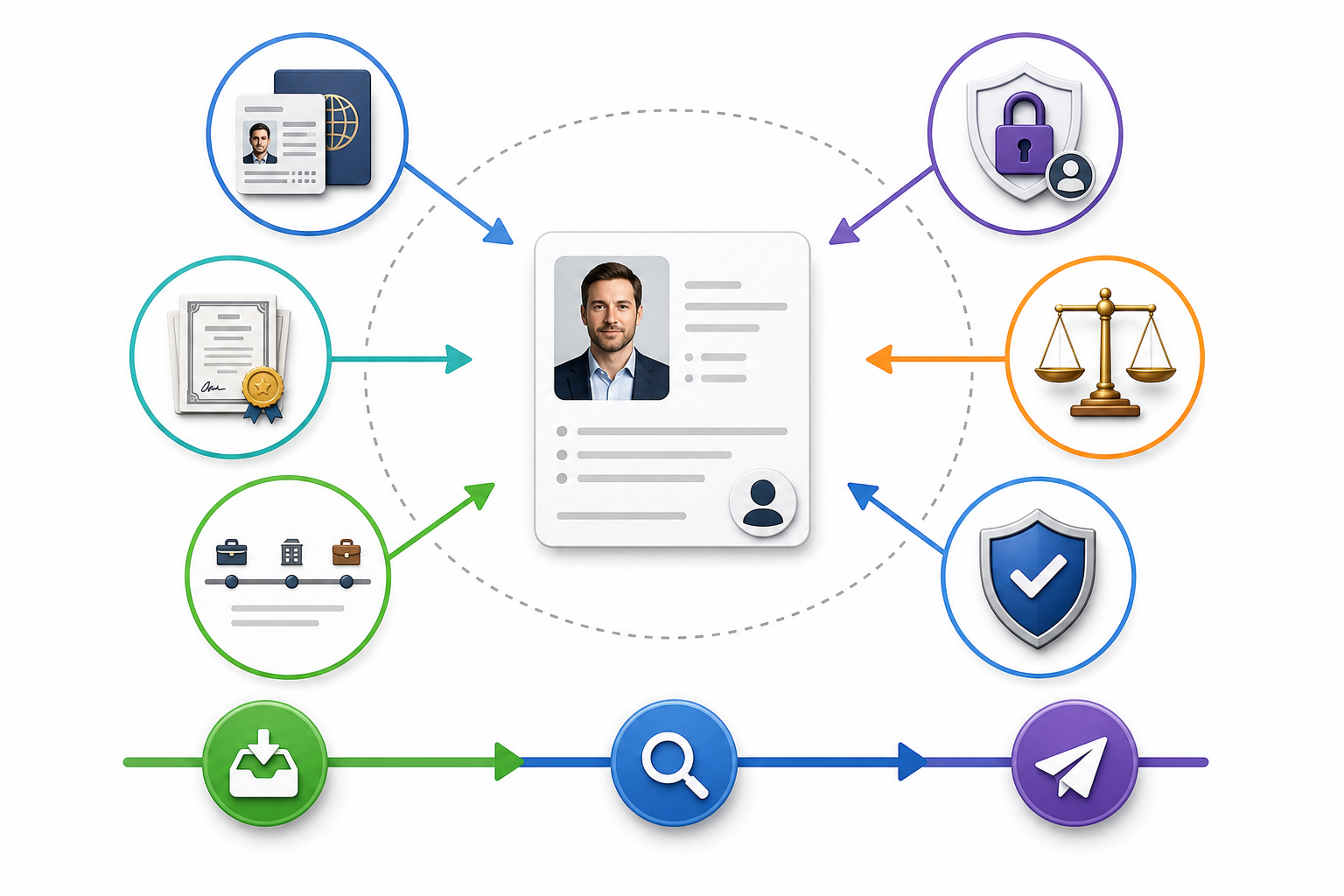
A sound control sequence is requirement -> evidence -> consultant confirmation -> submission decision. This order matters. It prevents a staffing partner from building a polished profile around assumptions that only become visible during validation, interview preparation or mobilisation.
TL;DR
- Do not submit a consultant profile for an EU contract until the consultant has explicitly approved that specific submission.
- Check the CV line by line against the experience being claimed, especially dates, overlaps, employer changes and assignment continuity.
- Only present qualifications, certifications and language levels that can be defended through documents, prior work or direct discussion.
- Use named, authorised professional referees tied to the CV timeline, and keep the submission pack limited to what the tender or selection step actually asks for.
The recommended standard: verify before the profile leaves your control
Do not rely on a generic “candidate is interested” note, a historic CV, or a broad assurance that documents are available somewhere. Those are sourcing signals, not submission controls.
The recommended standard is a controlled pre-submission review against the actual contract requirement. The staffing partner should be able to show, internally, why every mandatory claim in the proposed profile is credible. This does not mean collecting an open-ended file of personal documents. It means requesting and retaining only the information necessary for the relevant selection step, while ensuring the consultant understands why their data are being processed and how the profile will be used.
| Control area | What the staffing partner should establish | Delivery risk reduced |
|---|---|---|
| Consent and availability | The consultant has explicitly approved this submission and confirmed their practical ability to take up the work. | Submitting a person who has not agreed to the opportunity or cannot mobilise. |
| CV chronology | Assignments, employers, dates, overlaps and gaps reconcile with the experience claimed. | Profile rejection when experience is checked against supporting records. |
| Qualifications | Education and certifications can be tied to a real issuer, title, date and available evidence. | Unsupported credentials being challenged during validation. |
| Languages | Stated language levels are honest and can be defended through evidence or assessment. | A consultant being unable to operate at the level presented. |
| Readiness documentation | The consultant can provide the required national documentation if the role calls for it. | Late-stage failure over suitability or documentary requirements. |
| References | Named professional referees are reachable, relevant and connected to the CV timeline. | Reference checks that contradict, or cannot validate, key assignments. |
This is the standard a staffing partner supporting EU institutions should work to. In EU selection and recruitment notices, applicant data can include professional experience, education, language skills, references and a declaration of honour, meaning a signed self-declaration used in the process. At recruitment stage, supporting evidence for qualifications and experience may be checked against originals or certified copies. A submitted profile must therefore be treated as an evidence-backed representation of the consultant, not a marketing summary.
That principle becomes much easier to apply when the file is structured before any documents move. So the first job is preparation, not persuasion.
What to prepare before verification starts
Start with the requirement, not the consultant. The most reliable teams build a short verification sheet from the specific contract need before they approach the candidate for final confirmation. This prevents the familiar mistake of verifying impressive but irrelevant credentials while missing a mandatory requirement buried in the role description.
- The exact profile requirement: mandatory experience, qualifications, languages, documentation expectations and any stated availability need.
- The consultant’s current CV: use the version the consultant confirms is accurate, not a historic version held in a database. If the tender asks for a Europass CV, use that format unless the procurement documents allow another approach.
- An evidence inventory: identify which claims need documentary proof and whether that proof is available if requested.
- A controlled approval record: capture submission approval, availability confirmation and authorisation to contact referees.
- A data-minimised submission pack: include only the information needed for this buyer and this selection step.
The discipline here is important. EU selection and recruitment notices describe structured processing of candidate information, not unlimited collection of background material. A clean, purpose-specific file is easier to review, easier to defend and less likely to contain irrelevant personal data.
What to record in the approval record
A useful approval record is brief but specific. It should capture the requirement or lot reference, the profile title being submitted, the name of the consultant, the CV version or date used for the submission, the date and time of the consultant’s approval, the confirmed start point, the expected level of time commitment, and the consultant’s permission to use named referees for this opportunity. If there are open points, such as a pending certificate copy or a clarified date range, record those as visible risks rather than burying them in email.
What to include in the evidence inventory
The evidence inventory should map each important claim to a proof category and a file location. For example, list the profile designation, consultant name, work-experience classification if the tender uses one, the exact certification title, the date it was acquired, and where the supporting document is stored. For experience claims, note which assignment on the CV supports the requirement and what proof exists behind it, such as a contract copy or another document confirming professional experience.
How to keep the pack data-minimised
Keep consultant-profile material separate from wider company tender documents. Some procurement packs divide attachments into legal and regulatory capacity, economic and financial capacity, and technical and professional capacity. That is a useful internal discipline even where the portal labels differ: the consultant CV and related proof belong with the profile evidence, while items such as legal entity forms, financial identification forms, authorised signatory forms or consortium paperwork should sit in the corporate submission file if the tender requests them. Not every procedure asks for every document, so the rule is simple: include what the specifications name, and leave out unrelated personal material.
Once the file is prepared, the first operational control is consultant approval.
Step 1: Secure explicit consent and real availability
Difficulty: Easy, but non-negotiable. A consultant should explicitly approve submission before their profile is sent to the prime, consortium or contracting-side process. That approval should relate to the actual opportunity, not to a vague statement that the person is “open to roles.”
The approval record should confirm that the consultant has reviewed the profile being submitted, agrees that the stated experience and qualifications are accurate, understands the intended purpose of the submission and agrees to the use of named referees. It should also confirm the consultant’s available start point and time commitment in writing.
This control does more than protect the candidate experience. It prevents a direct mismatch between the profile package and the consultant’s own position on availability, references and evidence. It also gives the delivery manager a reliable answer when a proposed expert is shortlisted and needs to progress quickly.
Do not accept verbal availability as final clearance. Interest changes. Existing commitments change. A consultant may be open to an assignment while unavailable for the required start period or level of commitment. Submission approval and availability confirmation should be distinct checks because they answer different questions.
Applicants should be informed about the purpose of processing and their rights before a selection process starts. Apply that principle operationally: make clear what will be shared, with whom, and for what specific selection purpose. Reusing a consultant’s details for another EU buyer or another requirement without fresh authorisation where needed is exactly the kind of loose process that creates distrust and unnecessary risk.

With consent and scope settled, the next control point is the one most likely to expose hidden weakness: chronology.
Step 2: Reconcile every experience claim with the CV chronology
This is where strong staffing partners separate themselves from CV-forwarding suppliers. The experience section must be checked line by line against the consultant’s chronology. Every assignment used to satisfy the contract requirement should connect to a stated employer or engagement, a credible date range and a clear description of the work performed.
Pay particular attention to overlapping roles, short gaps, changes in employer names, sequential contracts and assignments presented as one continuous engagement. None of these automatically disqualifies a consultant. The problem is leaving them unexplained. If the submitted profile implies full-time delivery across overlapping assignments, or claims years of experience that the CV dates cannot support, the issue will be harder to correct after submission.
- Map the requirement to the CV. Identify the exact assignments that support each required area of experience.
- Check dates and employers. Confirm that the dates, organisations and role descriptions in the proposed profile match the current CV.
- Resolve inconsistencies before drafting around them. Ask the consultant to clarify the chronology rather than smoothing over a discrepancy with broader wording.
- Match evidence to the claim. Ensure professional-experience proof, where needed, supports the assignment being relied upon.
- Align declarations. Confirm that the profile is consistent with any declaration of honour concerning experience, education or language skills.
EU institutional recruitment practice includes verification of proof of education and professional experience. In tender procedures, proposed CVs may also be required to demonstrate that the candidate meets stated profile requirements, including relevant years of experience with named technologies or methods. That makes chronology a validation issue, not a formatting detail. The cleanest profile is not the one with the longest skills list; it is the one whose claimed experience can be traced back to dates, assignments and evidence without forcing the reviewer to guess.
The common mistake: rewriting an unclear CV into a sharper proposal profile without resolving what the dates mean. That may improve the document aesthetically, but it increases the validation burden and exposes the prime to a preventable challenge later.
Once the timeline holds together, the next question is whether the qualifications being used to strengthen the profile can actually be produced.
Step 3: Verify qualifications and certifications as evidence, not badges
A certification belongs in a submitted consultant profile only when it can be evidenced. The verification standard should be straightforward: every listed qualification maps to an issuer, the qualification title, an issue date and an available copy or other supporting record.
This applies equally to education and professional certifications. Where evidence is required in an institutional recruitment process, originals may need to be presented and certified copies may be retained. A staffing partner does not need to create a large document archive before every submission, but it does need to know whether the consultant can produce the evidence behind the claim.
- Record the qualification exactly as evidenced rather than upgrading its title for the profile.
- Confirm the issuing body and the supporting document held by the consultant.
- Check that the qualification supports the contract requirement rather than merely adding prestige.
- Flag any certification that cannot be evidenced instead of presenting it as verified.
- Request only the supporting material needed for the applicable selection step.
Where a tender asks for a tabular overview of proposed profiles, it is good practice to pre-fill the fields you will later need: profile designation, consultant name, work-experience classification where the procurement uses labels such as Senior, Junior or Normal, certification titles and the date each certification was officially acquired. That internal discipline catches errors early. It also prevents a last-minute scramble to turn a loosely written CV into a structured offer document.
Do not solve an evidence gap with softer language that still implies verification. If a credential cannot be produced, it should not be presented as a confirmed qualification. A profile that is modest but fully supported is much safer for the prime than a more impressive profile that collapses when documents are requested.
Qualifications alone do not make a profile safe to submit. Language claims can create just as much exposure when they are overstated.
Step 4: State language levels honestly and make them defensible
Language skills are not decorative information in an EU selection context. They are part of the applicant data considered in recruitment procedures. If a profile states that a consultant can work at a particular level in a language, the consultant should be able to support that claim in discussion, interview, written work or documentary evidence.
The right standard is defensibility, not optimism. A staffing partner should not upgrade a self-assessment to make a profile fit a requirement. Nor should it use broad claims that hide the difference between basic familiarity, working communication and the ability to contribute confidently in a panel or delivery setting.
Where available, use language examination results, certificates or credible prior-work evidence to support the stated level. In some procedures, supporting material for language proficiency can include certificates, studies, reports, publications or a declaration on honour. Where formal proof is not available, confirm with the consultant what they can actually do in the language and state the level accordingly. The objective is not to create unnecessary hurdles; it is to avoid placing the consultant, the prime and the buyer in an awkward position when the claim is tested.
What goes wrong: a profile says “fluent” because the consultant has used the language occasionally, but the role requires sustained professional communication. The safer decision is to present the consultant accurately or not use that language claim to satisfy the requirement.
After language, the next check is narrower but still important when the role calls for it: documentary readiness.
Step 5: Check security and good-conduct documentation readiness
For roles that require criminal-record, police-record or certificate-of-good-conduct documentation, verify readiness before submission. Readiness is more useful than a generic assurance that the consultant is willing to comply. It means the consultant can identify the relevant national authority and is in a position to supply the type of document the buyer or institution requests.
This is particularly important because there is no single EU-wide document format described by institutional recruitment practice. The relevant documentation may depend on the consultant’s current and recent residence and on which national authority can issue the required record.
Keep the check proportionate. Do not collect sensitive documentation before the process requires it. Instead, establish whether the consultant can provide it if requested, whether there are any practical blockers and whether the information in the profile remains consistent with later documentary checks.
That same discipline carries into references, which should be treated as evidence linked to real assignments, not as decorative names on a CV.
Step 6: Validate references against the assignments that matter
References should confirm professional work, not merely provide character reassurance. EUIPO recruitment practice asks candidates for at least two names and telephone numbers of previous and/or current employers and carries out reference checks as part of selection. For EU contract submissions, two reachable professional referees is a strong working minimum unless the contract requirement sets a different standard.
Before submitting consultant CVs for an EU tender, confirm that each referee is real, reachable and relevant to an assignment used in the proposed profile. The referee should have worked with the consultant during the dates stated on the CV and be able to speak to the work being relied upon.
- Confirm the referee’s name, role and contact details with the consultant.
- Link the referee to a specific professional assignment and date range on the CV.
- Obtain authorisation before initiating contact.
- Use referees who can validate the relevant delivery experience, not generic personal qualities.
- Do not promise verification from a current manager where that is not authorised or is outside the buyer’s requested process.
EUIPO notes that reference checks may cover past professional assignments while excluding current employment. That boundary is worth respecting. A staffing partner should never treat access to a current employer as automatic. The candidate’s authorisation, the buyer’s requirement and the relevance of the check must all be clear.
Once consent, chronology, evidence, languages and references have been checked, the file is ready for a genuine submission decision rather than a hopeful send.
The pre-submission quality gate that prevents avoidable replacements
Before the profile is sent, run one final quality gate. This is not another CV review. It is a delivery-risk decision: can the prime confidently put this named consultant forward for this requirement?
- Consent: explicit approval to submit this profile for this purpose is recorded.
- Availability: the stated start point and commitment have been confirmed in writing.
- Chronology: experience claims reconcile with the CV dates, employers and assignment history.
- Evidence: qualifications, certifications and experience claims can be supported if requested.
- Languages: stated levels are accurate and defensible.
- Readiness: required police-record or good-conduct documentation can be pursued if the role requires it.
- References: professional referees are authorised, reachable and tied to relevant work.
- Data discipline: the pack contains only what the specific selection step needs, and the consultant understands its purpose.
If one of these points is unresolved, do not hide it in the profile. Escalate it as a clear risk, obtain the missing clarification or hold the submission. The wrong move is to assume that a gap will never be checked. In some recruitment and procurement processes, selection records and supporting documents may be retained well after closure, so every submitted field should be treated as reviewable later.

A practical submission-pack check
Before sending, confirm that the profile pack contains the correct CV, the minimum profile summary required by the tender, and only the supporting documents tied to the stated selection criteria. Depending on the procedure, that may include experience proofs, qualification evidence, a declaration on honour, and specific corporate forms elsewhere in the offer. It does not justify attaching unrelated identity, medical or background material simply because it might become relevant later.
Common verification failures and the practical fix
Failure: “The consultant is interested” is treated as consent.
Fix: obtain explicit approval for the specific submission, including profile accuracy, intended use, availability and referee contact.
Failure: the proposed profile is more precise than the CV.
Fix: reconcile the claim with the consultant before submission. The profile must not create experience detail that the underlying chronology cannot support.
Failure: a certification is listed because it appeared on an old CV.
Fix: confirm the issuer, exact title, issue date and available evidence. Remove or clearly flag anything that cannot be substantiated.
Failure: language levels are upgraded to meet the requirement.
Fix: state only what the consultant can defend through evidence, prior work or direct assessment. An honest profile is more valuable than a strategically inflated one.
Failure: “clearance ready” means nothing more than willingness.
Fix: establish whether the consultant can obtain the required national record or good-conduct document if requested, without collecting sensitive documents prematurely.
Failure: a referee is named without checking relevance.
Fix: connect every referee to a stated assignment and ensure they can validate the work that makes the consultant suitable for the EU contract.
Failure: the evidence pack grows by habit rather than by requirement.
Fix: build the submission around the tender specifications, separating consultant-profile proof from company-level forms and leaving out documents that have no stated evaluation purpose.
The advanced move: maintain a controlled evidence register
The better staffing partners do not repeat the full investigation from scratch every time. They maintain a controlled internal evidence register for active consultants, with a clear distinction between information that has been verified, information supplied by the consultant and information still requiring confirmation for a particular requirement.
The register should not become a dumping ground for personal documents. Its purpose is to make the next submission more reliable: the team can see which CV version was confirmed, which certifications have evidence, which language claims are supported, whether reference permissions exist and what must be reconfirmed for the next opportunity.
A practical register can include the profile designation, consultant name, CV version date, required languages, named referees, qualification titles, qualification dates, evidence status, and the storage location of each file. It can also separate “held”, “seen”, “pending” and “not requested” so the team does not confuse a consultant’s statement with a verified record. That sounds simple, but it prevents one of the most common submission failures: assuming an item was checked because it was mentioned somewhere in a previous process.
That distinction is valuable for delivery managers. It turns staffing partner EU institution support from a stream of untested CVs into a controlled supply of submission-ready consultant profiles. The prime receives fewer surprises, the consultant receives clearer communication, and the delivery team spends less time replacing experts after selection has already begun.
Submission-ready: the key moves
- Get explicit consultant consent before the profile is submitted.
- Confirm availability separately from general interest in the role.
- Reconcile every experience claim with CV dates, employers and assignments.
- Present certifications and education only when evidence can be produced.
- State language levels honestly and support them where possible.
- Check readiness for any required police-record or good-conduct documentation.
- Use authorised, reachable professional references tied to relevant work.
- Keep the submission package accurate, minimal and specific to the selection process.
Done properly, profile verification is not administrative overhead. It is the point at which a staffing partner proves that a proposed consultant is genuinely deployable, evidence-backed and safe for the prime to put forward.
Conclusion
A consultant profile for an EU contract should be handled as a controlled submission record, not as a polished expression of sourcing intent. The safest sequence is still the right one: check the requirement, match it to evidence, obtain explicit consultant confirmation, then decide whether to submit. When that discipline is applied consistently, the prime gets fewer surprises, the consultant is represented accurately, and the staffing partner becomes part of delivery assurance rather than part of the risk.