EU Consultant Security Checks: Badges and Clearances

A signed offer is not an access authorisation. That distinction is where consultants and delivery managers lose time: they treat a site badge as if it were a security clearance, or assume a clearance removes every remaining building and system-access hurdle.
For an external consultant starting an EU-institution assignment, there are usually two separate questions. The first is whether the person may enter a Commission site or use the relevant IT assets. The second is whether the person may access EU classified information, or EUCI, at the level required by the assignment. The right preparation is to identify both tracks before the offer is signed, then run the required checks without confusing one for the other.
This matters particularly for Commission work in Belgium. Security appendices published with some Commission tenders state that access rights to Commission premises or IT assets in Belgium depend on positive security advice from the Belgian authorities. Non-EU nationality personnel also face an additional Commission screening process before access is granted. Neither point automatically means that a personnel security clearance is required, but both can determine whether a consultant can begin work as planned.
TL;DR
- A site badge or access right is not the same thing as a personnel security clearance.
- Commission Decision (EU, Euratom) 2015/444 is the core Commission framework for protecting EU classified information.
- For Commission-related work in Belgium, premises or IT access can depend on individual consent and positive Belgian security advice.
- If the role requires access to CONFIDENTIEL UE/EU CONFIDENTIAL or SECRET UE/EU SECRET, the consultant may need a personnel security clearance, or PSC, from the competent national authority.
- Most start delays come from mixing up those tracks, submitting incomplete information, or discovering too late that the role needs classified-information access.
Start with the distinction that prevents most delays
The practical rule is simple: a badge gets a consultant into the right place or system; a personnel security clearance permits access to classified information at an approved level. They may be needed at the same time, but they are not interchangeable.
| Control | What it is for | What it does not prove |
|---|---|---|
| Site access badge or access right | Entering Commission premises and, where applicable, using IT assets. | That the consultant may handle EU classified information. |
| Positive Belgian security advice | A condition for granting premises or IT access in the Belgium-specific Commission tender context described in published security appendices. | That the consultant holds a PSC for EUCI. |
| Personnel security clearance (PSC) | Authorisation, following a security investigation by the competent national authority, to access EUCI up to a specified classification level. | That building entry, account activation, badge issuance, or local site-access administration is complete. |
| Facility security clearance (company-level, where required) | A company or site-level security status that can matter in some classified contracts. | That an individual consultant personally holds the clearance needed to access classified information. |
The mistake to avoid is planning only for the control that is most visible. A consultant may have completed the badge route and still be unable to access classified material. Equally, a consultant who holds the necessary PSC may still be unable to enter the relevant building or use the required IT assets until the local access process is complete.
For delivery managers, this means the offer date, the contractual start date, and the date on which the consultant can perform every part of the role are not necessarily the same date. Treating them as identical creates avoidable pressure later.
That distinction leads directly to the legal framework, because the rules become much easier to apply once each control is tied to its real purpose.
The framework behind the checks
Commission Decision (EU, Euratom) 2015/444, adopted on 13 March 2015, is the Commission’s core framework for protecting EU classified information. Its practical effect is not that every contractor requires a clearance. Its effect is that access to EUCI must be controlled according to the classification level and the person’s need to know.
For contractor personnel, the threshold becomes more formal when the work requires access to CONFIDENTIEL UE/EU CONFIDENTIAL or SECRET UE/EU SECRET. Personnel who need that access must hold a PSC issued by the competent national authority. The clearance is linked to a defined level of classified information; it is not a general-purpose employment credential.
That point is worth stating plainly for candidates searching for security clearance EU institutions consultant guidance: some assignments require only ordinary site and system access, while others add a classified-information route on top. The contract, the location, the nationality route, and the information involved determine which checks matter.
This is why a good staffing conversation starts with the task, not the paperwork. Before anyone asks a consultant to submit information, establish whether the assignment requires:
- access to a Commission building;
- access to Commission IT assets;
- access to EUCI; and
- if EUCI is involved, access at a level that requires a PSC.
Most weak start plans reverse that order. They begin with a generic badge request, then discover late in the process that the consultant’s actual deliverables require access to information covered by a different security route. The better approach is to map the role’s access needs before the security process begins.
What may be requested, depending on the role
The documents do not establish one universal “EU consultant badge pack.” Requirements depend on the assignment, location, competent authority, nationality, and whether classified information is involved. Do not try to solve that uncertainty by sending a large bundle of personal documents before anyone has confirmed what the assignment needs. Prepare the information instead, then provide it through the requested process.

In practical terms, what is requested usually falls into two groups: ordinary access material for premises or IT use, and higher-security material where classified-information access is required. The exact mix is contract-dependent.
Ordinary premises and IT access requests
Where the role needs building entry or Commission systems, the request is usually about identity validation and access-right administration rather than classified clearance. In some Commission contract materials, external service providers are asked to attend the Service Cards Office for identity validation and badge issuance. Those same materials indicate that Commission IT equipment may be collected only after that validation, and a SECEM certificate may also be issued where it is required for email or remote-access authentication.
That does not mean every Commission assignment follows the same mechanics. It does show the basic pattern: access to premises or IT assets is its own onboarding stream, and visible items such as a badge, an account, equipment handover, or remote-access certificate sit at the end of that stream, not at the beginning.
Higher-security requests where classified access is involved
If the assignment involves EUCI at the relevant classification level, the focus changes. The sources support three broad points: the consultant may need to give individual consent where the Belgium-specific access route applies; the competent national authority carries out the security investigation that underpins a PSC; and the information requested will be tied to identity, nationality, and personal-history data needed for that investigation.
The exact document list is not confirmed as a single universal checklist across all assignments. A consultant should therefore expect categories of information rather than one standard pack: personal identification data, nationality details, consent where required, and whatever supporting material the competent authority requires for the investigation.
What to prepare before the offer is signed
Preparation → accurate information ready to submit → fewer preventable hand-offs
- Check identity details for consistency. Keep passport or identity-document details, legal name, and nationality information ready and internally consistent. The cited requirements do not set out a universal document list, but identity and nationality are central to the access assessment.
- Know the nationality route early. For Commission-linked access in Belgium, non-EU nationality personnel are subject to specific Commission screening in addition to the Belgian screening step. Raise that at the access-planning stage, not after the start date has been discussed.
- Be ready to provide individual consent. The Belgium-specific tender material expressly connects the Belgian security-advice process for external personnel to individual consent. A consultant who can provide that promptly removes one of the clearest administrative blockers.
- Assemble accurate personal-history information. A PSC follows a security investigation conducted under national procedures. Residence, employment, and other history information may be required by the competent authority, even though the exact forms and evidence are not universal across assignments.
- Get role clarity in writing. Ask the delivery lead to confirm the expected site, IT, and information-access needs of the role. A consultant cannot sensibly prepare for a clearance level until the need for access and the classification level are clear.
Do not pre-empt the formal process with assumptions. A consultant may reasonably prepare identification, nationality, consent readiness, and accurate history information. That does not mean the consultant should declare that a PSC is required, submit an unrequested national-security application, or assume that a routine building badge provides classified-information access.
Once that preparation is in place, the next step is sequencing: not every control starts at the same moment, but each one should be visible in the mobilisation plan.
The planning sequence from offer to effective start
There is no single EU-wide administrative script for every site and contract. There is, however, a reliable planning sequence. Use it as an access map, then follow the assignment-specific instructions supplied for the relevant Commission service, location, and contract.
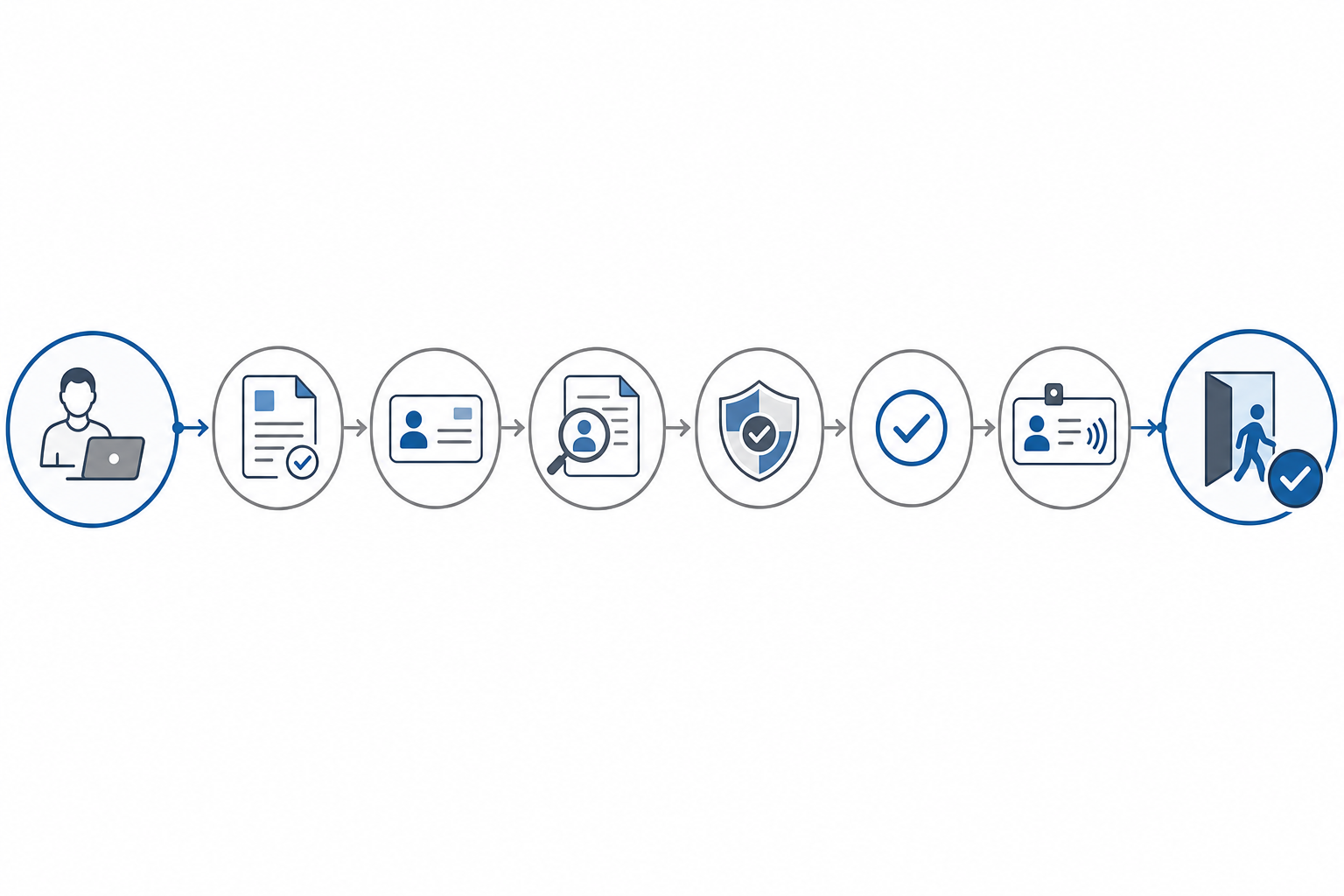
1. Define the access requirement before mobilisation
Role scope → access map → correct security route
Identify whether the consultant needs physical entry, IT access, EUCI access, or all three. For EUCI, determine the classification level actually required for the tasks. Need-to-know matters as much as clearance level: a PSC is not a reason to give broad access beyond the assignment’s requirements.
2. Separate the premises-and-IT track from the EUCI track
Site or system need → access-rights process → operational entry when approved
For Commission access in Belgium, published security appendices describe a clear dependency: individual consent supports the Belgian authority’s security-advice process, and positive security advice is a condition for access rights to Commission premises or IT assets. The same materials indicate that this can matter for both short- and long-term access periods.
That is the route most people mean when they refer to a site access badge European Commission contractor process. In practice, it is broader than the physical card: it concerns access rights to the site and, where relevant, IT assets. The badge is the visible outcome; the approvals behind it are what control readiness.
3. Start the PSC route where classified access is required
EUCI need identified → national security investigation → PSC at the required level
Where the assignment requires access to CONFIDENTIEL UE/EU CONFIDENTIAL or SECRET UE/EU SECRET, the personnel security clearance EU contractor route must be built into the plan. The competent national authority issues the PSC after the relevant security investigation. A completed site-access process does not replace this requirement.
External contractors, experts, and consultants who are shown EU classified information must also be briefed on their security responsibilities. Treat this as part of readiness, not an optional induction detail left until after classified material is already in view.
4. Run both tracks in parallel when the role needs both
Premises and IT approval + PSC approval → access aligned to the assignment
Parallel processing is the sensible approach where both controls apply. It does not shorten a formal investigation by itself, but it prevents an unnecessary serial delay in which the PSC is addressed only after the badge process has finished, or vice versa.
5. Confirm access against the actual first-day work
Approved controls → role-specific access check → realistic first-day plan
Before scheduling substantive work, compare the approvals completed with the tasks planned for the consultant’s first day. This avoids a common mismatch: the person is present, the offer is signed, and a manager has allocated work that requires a system or information-access right still pending.
A common delay timeline, without promising dates
What the rules do not provide is one guaranteed timetable for every badge, security opinion, additional screening step, or PSC. Timing depends on the contract, the location, the authority involved, the consultant’s nationality route, and whether classified access is in scope. So the useful way to think about delay is by phase, not by promised days or weeks.
- Before offer signature: delays start when the role has not been mapped properly and nobody can say whether the consultant needs only site access or also classified-information access.
- After the role is confirmed: delays appear when the candidate’s identity, nationality, or consent information is requested late or supplied inconsistently.
- During the access-rights phase: any premises or IT process that depends on identity validation, Belgian security advice, or local administration can hold up effective start even where the contract itself is already in force.
- During the clearance phase: if a PSC is required, the security investigation must run its course under the relevant national procedures. EU rules allow for extra time to obtain a clearance where the contract notice explicitly provides for it, but they do not create one universal deadline.
- Just before day one: managers often discover that badge status, account status, equipment collection, and classified-information authorisation have not all matured at the same speed.
The planning lesson is simple: do not ask for a fixed security-processing promise where the rules do not support one. Instead, track the dependencies openly and keep the effective start aligned to the approvals the role actually needs.
What delays a consultant’s start in practice
Security checks are not delayed only by complex cases. The more common problem is a late or incomplete hand-off between candidate, supplier, delivery manager, site-access contact, and security authority. The following failure points deserve active management.
- Consent is requested late or is not completed. For the Belgian security-advice route, individual consent is an explicit part of the process.
- Nationality is identified too late. Non-EU nationality personnel can require additional Commission screening before access is granted in the Belgium-specific tender context.
- Information for the security investigation is incomplete. A PSC depends on a security investigation under competent national-authority procedures.
- The assignment’s information classification is unclear. If the delivery team cannot say whether the consultant needs access to CONFIDENTIEL UE/EU CONFIDENTIAL or SECRET UE/EU SECRET, it cannot set the correct PSC requirement.
- Belgium-specific rules are treated as universal. The cited positive-security-advice requirement is specific to the Commission tender context described for Belgium and should not be projected onto every institution or location.
- A badge is treated as proof of clearance. This remains the central misunderstanding.
Do not promise a guaranteed security-processing timeline. The applicable material does not provide one universal timeframe for badges, security advice, additional Commission screening, or PSC issuance. A responsible delivery plan makes the required approvals visible and keeps the effective start contingent on the route that the role actually requires.
Troubleshooting the real access gaps
The consultant has a signed offer but cannot begin the planned work
Check the task-to-access map, not the contract status. Establish whether the blocked work requires premises access, IT access, EUCI access, or a combination. A signed offer can precede completed access approvals; it does not answer which operational control is still pending.
The consultant has badge paperwork but the team says a clearance is still needed
Verify whether the role requires access to EUCI and, if so, at which level. If the work involves CONFIDENTIEL UE/EU CONFIDENTIAL or SECRET UE/EU SECRET, a PSC issued by the competent national authority is required. Treat the badge process and clearance process as separate workstreams from that point.
The document request changes after the candidate has already supplied information
Do not assume the original request was wrong. The assignment may have moved from a simple access-rights route to a classified-information route, the relevant location may have been clarified, or the competent authority may require further information for its investigation. Reconfirm the specific access requirement and submit the requested material through the stated channel.
The consultant is a non-EU national and the start date is approaching
Escalate the access-planning question early, with accurate nationality information already available. The additional Commission screening described for non-EU nationality personnel in the Belgium-specific requirements is not something to discover at badge collection. The delivery plan should recognise that this is a separate layer in the access route.
The advanced move: manage access as a role-readiness matrix
The strongest delivery teams do not manage security through a single “cleared/not cleared” label. They maintain a simple readiness matrix that separates each required approval. This is the practical discipline that prevents security administration from becoming a last-minute surprise.
- Role requirement: premises, IT assets, EUCI, or a combination.
- Location: identify whether the Belgium-specific access route is relevant.
- Nationality routing: identify early whether additional Commission screening applies.
- Consent status: record whether individual consent has been requested and completed where required.
- PSC requirement: record whether the assignment requires classified-information access and the relevant level.
- Operational status: distinguish between building-ready, IT-ready, and EUCI-ready.
This is not bureaucracy for its own sake. It gives the consultant clear instructions, lets the delivery manager plan work honestly, and stops a physical badge from being mistaken for full role readiness. The matrix should track the required controls, not collect unnecessary personal information.
Key moves before day one
- Separate site and IT access from access to EU classified information from the beginning.
- Use Commission Decision (EU, Euratom) 2015/444 as the reference point for why EUCI access is classification- and need-to-know-based.
- For Commission-related work in Belgium, prepare for individual consent and positive Belgian security advice where that access route applies.
- Flag non-EU nationality early because the relevant tender material adds an extra Commission screening layer before access is granted.
- Where work requires CONFIDENTIEL UE/EU CONFIDENTIAL or SECRET UE/EU SECRET access, build the PSC route into the mobilisation plan.
- Never treat a signed offer, a badge application, or a completed PSC as proof that every other required access control is complete.
The right outcome is not simply that a consultant arrives on site. It is that the consultant arrives with access aligned to the work they have been assigned: the right premises and IT rights, the required personnel security clearance where EUCI is involved, and a clear understanding of the security responsibilities attached to that access.
In other words, the cleanest starts come from separating the visible badge process from the less visible clearance question early enough to plan both. When managers and candidates map the role first, scope the Belgium-specific rules correctly, and avoid promising dates that the formal process does not guarantee, most preventable delays stop being surprises.