How EU Framework Contracts Turn Into Consultant Assignments

EU framework contracts are not consultant jobs
The most common mistake is treating a framework contract award as though it has already placed a consultant. It has not. A framework contract establishes the supplier pool, rules, lots, and call-off methods for future work. The actual consulting opportunity comes later, when the contracting authority has a defined requirement and issues an assignment under that framework.
That distinction matters because it changes how staffing firms and consultants should prepare. Winning or joining a framework gives a supplier access to future opportunities; it does not guarantee work. Winning an individual assignment depends on the relevant lot, the call-off mechanism, the speed of the supplier response, the fit of the proposed CV, and the consultant’s ability to clear the practical onboarding requirements.
The right way to approach a framework assignment is to work backwards from the assignment scorecard. Do not start with a broad CV and hope it will be persuasive. Start with the lot, the terms of reference, the mandatory requirements, and the evidence the evaluator needs to see. That is how a framework position becomes a real assignment rather than another tender alert that goes nowhere.
Framework award → lot call-off → supplier shortlist → CV scoring → task order → onboarding → first day
What must exist before a consultant can be assigned
The process moves quickly once a request is issued, but only after several procurement conditions are already in place. If one of these foundations is missing, there is no valid route to the assignment.
- A framework contract has been awarded and signed with one or more suppliers.
- The framework documentation sets out the call-off method: cascade, mini-competition, direct award, or a hybrid arrangement.
- The relevant lot exists. Lots may separate work by discipline, geography, seniority, or service type.
- The supplier is admitted to both the framework and the relevant lot.
- The contracting authority has a defined requirement, including scope, duration, location, language needs, and any security or clearance conditions.
- The assignment has a scoring model or selection method, normally set out in the procurement documents or request for services.
The practical judgment here is simple: eligibility is decided before quality is judged. A highly capable consultant cannot be proposed through a supplier that is outside the relevant lot. Likewise, strong technical experience does not overcome a mandatory language, availability, or clearance requirement.
Step 1: Separate the framework award from the work order
Step 1 → Confirm the framework and lot → Establish whether a real route to the assignment exists
A framework award creates a controlled purchasing environment. The contracting authority has already selected the suppliers eligible to compete for, or receive, future work under that agreement. It has not necessarily selected the person who will deliver a particular task.
When a relevant lot is opened or reopened, including through notices on TED, it signals that the authority may be purchasing a defined piece of expertise under the existing framework rather than running a full open tender from scratch. This is where contractors often lose the plot: they see the framework notice, assume the opportunity is already closed, or assume it is already a job offer. Neither assumption is useful.
The correct reading is that the framework is the container and the call-off assignment is the work. The first operational question is always: which lot covers this requirement, and which framework holders can respond?

Step 2: Identify how the assignment will be called off
Step 2 → Read the framework call-off rules → Match the response to the mechanism
The framework documents determine how the authority turns a requirement into an individual assignment. This is not administrative fine print. The call-off method decides who gets invited, how quickly a response is needed, and whether the supplier is competing on the specific assignment or being approached because of a pre-established ranking.
Cascade: ranking and response speed decide the path
In a cascade system, suppliers are ranked in order of preference. The authority approaches the first-ranked supplier first. If that supplier cannot meet the need, cannot deliver within the timetable, or fails a minimum requirement, the authority moves down the ranking.
- The cascade is not a free-for-all; the ranking fixed in the framework documents governs the order.
- The authority must document why it moved to a lower-ranked supplier.
- A top-ranked supplier can still lose the assignment by failing to provide a suitable, available consultant quickly enough.
- Internal supplier screening often happens before the client sees any candidate profile.
For a staffing firm, cascade mechanisms reward bench depth and preparation. Do not wait for the request to begin assembling a candidate pool. The supplier that can submit a compliant, immediately available profile has a material advantage over one that needs days to locate and qualify a consultant.
Mini-competition: the assignment is competed again
A mini-competition reopens competition among the suppliers admitted to the framework and relevant lot. The authority issues a request for the particular task, and several or all eligible framework holders compete on the requirement now in front of them.
This is usually the route where people confuse framework status with assignment selection. The framework holder has already passed the prequalification stage. The consultant still needs to win the individual requirement.
- A statement of work or terms of reference.
- A deadline for questions and clarifications.
- Instructions for submitting CVs, methodology notes, pricing, or availability confirmations.
- An evaluation grid and award criteria.
- Rules for interviews where interviews are included.
Do not submit a recycled proposal because the supplier is already on the framework. The whole point of the mini-competition is to decide who best fits this task, at this time, under this scoring model.

Direct awards and hybrid mechanisms also depend on the rules written into the framework. The disciplined approach is the same: follow the framework documentation, confirm the relevant lot, and check the assignment-specific requirements before proposing anyone.
Step 3: Run supplier-side selection before the deadline controls you
Step 3 → Check eligibility, availability, and evidence → Submit a candidate the client can score quickly
The client does not normally review every possible consultant in the market. The framework holder performs an internal preselection first. This is where a technically excellent consultant can be lost before the external evaluation begins.
- The supplier receives the invitation or request for services.
- Recruitment or account management confirms lot eligibility and the scope of the requirement.
- The supplier searches its bench, consultant network, and subcontractor pool.
- Availability and compliance are checked before submission.
- The CV and supporting material are tailored to the assignment.
- The supplier submits the candidate profile, and any required technical or commercial material.
- If shortlisted, the consultant may be prepared for an interview or clarification stage.
- If selected, the supplier confirms mobilisation and engagement terms.
The shortcut that fails is submitting the first broadly relevant CV. A profile needs to be both eligible and scoreable. If the consultant cannot start when required, lacks a mandatory language capability, or has no clear evidence against the terms of reference, the supplier has created work for the evaluator rather than made a convincing case.
Step 4: Treat CV scoring as evidence mapping, not résumé writing
Step 4 → Mirror the criteria in the CV → Make relevant evidence impossible to miss
CV scoring is usually more structured than consultants expect. Evaluators score against the assignment criteria, not against an abstract idea of who has the most impressive career. General seniority helps only if it is translated into direct evidence for the work required.
- Relevant years of experience in the stated field.
- Direct experience with comparable EU, public-sector, or donor-funded assignments where required.
- Technical expertise in the exact subject matter.
- Experience in similar geographic, institutional, or policy settings.
- Required language ability.
- Availability and ability to start on time.
- Education or certifications where they are explicitly required.
- Evidence of delivering comparable outputs rather than simply holding similar job titles.
What works is precise, recent, named evidence. Put the most relevant assignment first, even when it is not the most recent one. Use the terminology from the terms of reference where it truthfully describes the consultant’s work. State the outputs delivered: reports, systems, stakeholder training, managed budgets, or other comparable results.
What fails is generic consultancy language, a lengthy career history that buries the relevant experience, or a vague claim of fluency where the assignment requires a working language. A panel should not have to infer the match. Make it explicit.
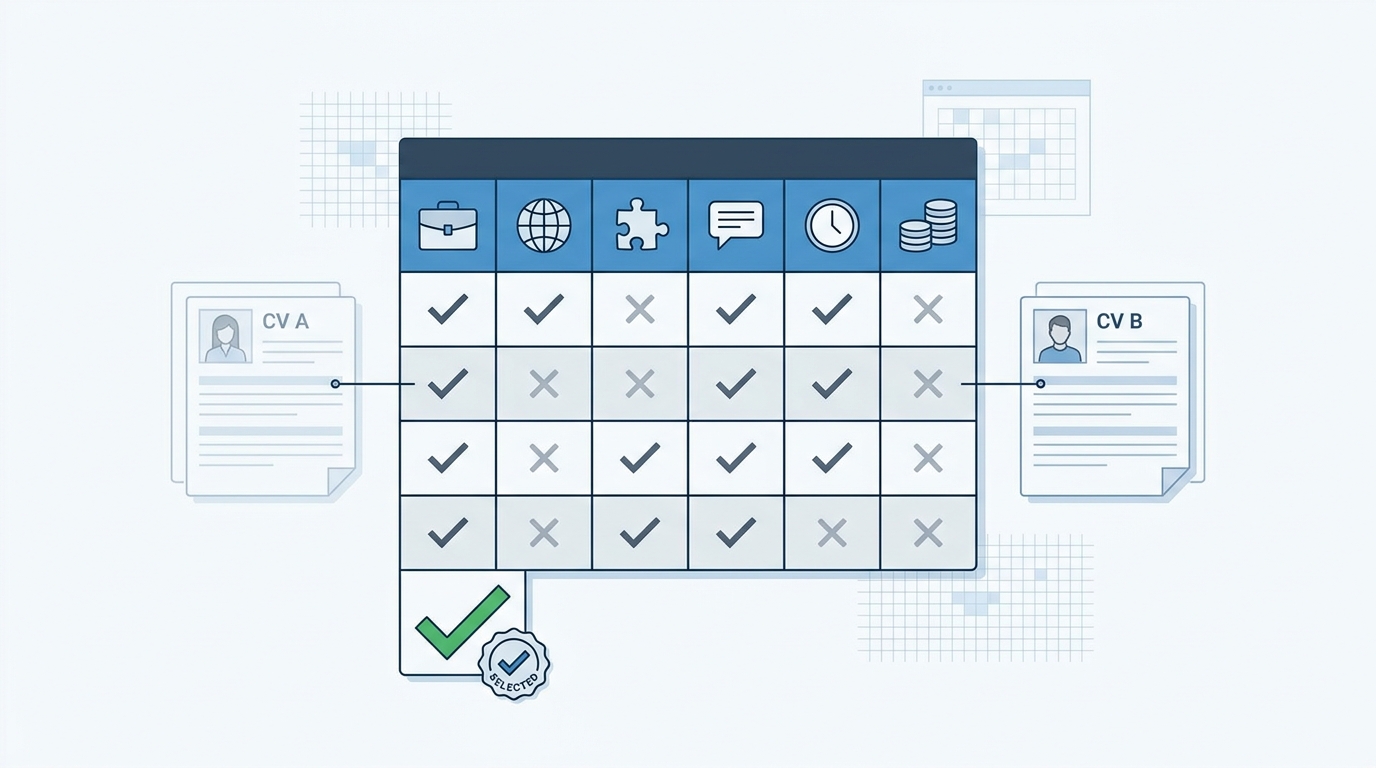
Advanced move: maintain a tender-ready CV library with modular achievement statements, current availability, language evidence, and assignment references mapped to common lot families. A consultant who can adapt a credible framework-ready CV in under an hour is far more usable to a framework holder than one who needs a complete rewrite for every request. For the CV mechanics of each mechanism in detail, see mini-competition vs cascade: tailoring your CV for each call-off.
Step 5: Understand what happens after selection
Step 5 → Receive the task order → Complete onboarding requirements → Start on the agreed date
Once the preferred supplier is selected, the competitive phase is largely over. The authority issues the contract or task-order documents, and the work shifts from selection to mobilisation. This is not the time to relax. Assignments can still stall if the paperwork and access requirements are treated as an afterthought.
- The supplier confirms acceptance of the order or task assignment.
- The consultant signs the relevant engagement documents.
- Identity, tax, and compliance documents are collected.
- Travel, accommodation, and access logistics are arranged where needed.
- IT accounts, badges, or security clearances are requested where applicable.
- The project lead provides the onboarding pack and deliverables calendar.
- The consultant starts on site or remotely on the agreed date.
The usual reasons for delay are unprepared compliance documents, unresolved rate approvals, travel issues, and access approvals. The better practice is to treat mobilisation information as part of the candidate’s readiness, not as something to resolve after award.
Timeframes: fast procurement does not always mean fast mobilisation
Framework call-offs can move faster than an open tender, but the real timetable depends on the assignment and its practical constraints. Framework award to operational use may take days to months. A lot may be opened and invitations issued on the same day or within a few days. Invitation-to-submission windows commonly run from 5 to 15 working days, though complex missions can allow longer.
Evaluation may take from a few days to several weeks. Award and contract issue can take days to a couple of weeks. Onboarding can then take days to several weeks, particularly where travel, visas, badges, or security clearance are required. The shortest route is a consultant already known to the framework holder, available immediately, with documentation ready and no relocation barriers.
Troubleshooting the failure points that cost assignments
- The deadline is missed: A late submission can be rejected regardless of candidate quality. Build internal cut-off times before the formal deadline, especially where signatures, declarations, or supplier approvals are needed.
- The consultant fits the work but not the lot: General relevance is not enough. Confirm that the supplier is admitted to the correct lot and that the requirement falls inside its scope.
- A mandatory language requirement is vague or unsupported: Put clear language evidence in the profile. Do not rely on an unsupported claim buried in a CV.
- Availability is incomplete: Confirm start date, duration, and potential conflicts before submission. A strong candidate who cannot mobilise in time is not a strong candidate for that assignment.
- The CV is generic: Reorder and tailor it around the evaluation criteria. The relevant evidence belongs at the top, not on page four.
- Compliance documents are missing: Keep conflict-of-interest declarations, signatures, eligibility statements, identity documents, and other required material current and accessible.
How to know the process is being handled well
A well-run framework assignment process is not measured by how many CVs are held in a database. It is measured by whether the right consultant can be proposed quickly, compliantly, and with evidence that maps directly to the assignment scorecard.
Done right, the supplier knows the relevant lots, understands the call-off mechanism, has verified availability before submission, and presents a CV that makes the evaluator’s job easy. The consultant reaches day one with commercial terms, compliance documents, access requirements, and deliverables already understood.
TL;DR: the key moves
- A framework award creates access to future work; it does not itself appoint a consultant.
- The relevant lot and call-off mechanism determine how an individual assignment is awarded.
- Cascade systems reward ranking, speed, and immediate delivery capability.
- Mini-competitions require framework holders to compete again on the specific requirement.
- CVs should mirror the assignment criteria and show direct evidence of comparable delivery.
- Mandatory requirements such as language, availability, and compliance can eliminate an otherwise strong profile.
- Onboarding is part of mobilisation, not an administrative detail to leave until after award.