Mini-Competition vs Cascade: Tailor Your CV for Each Call-Off
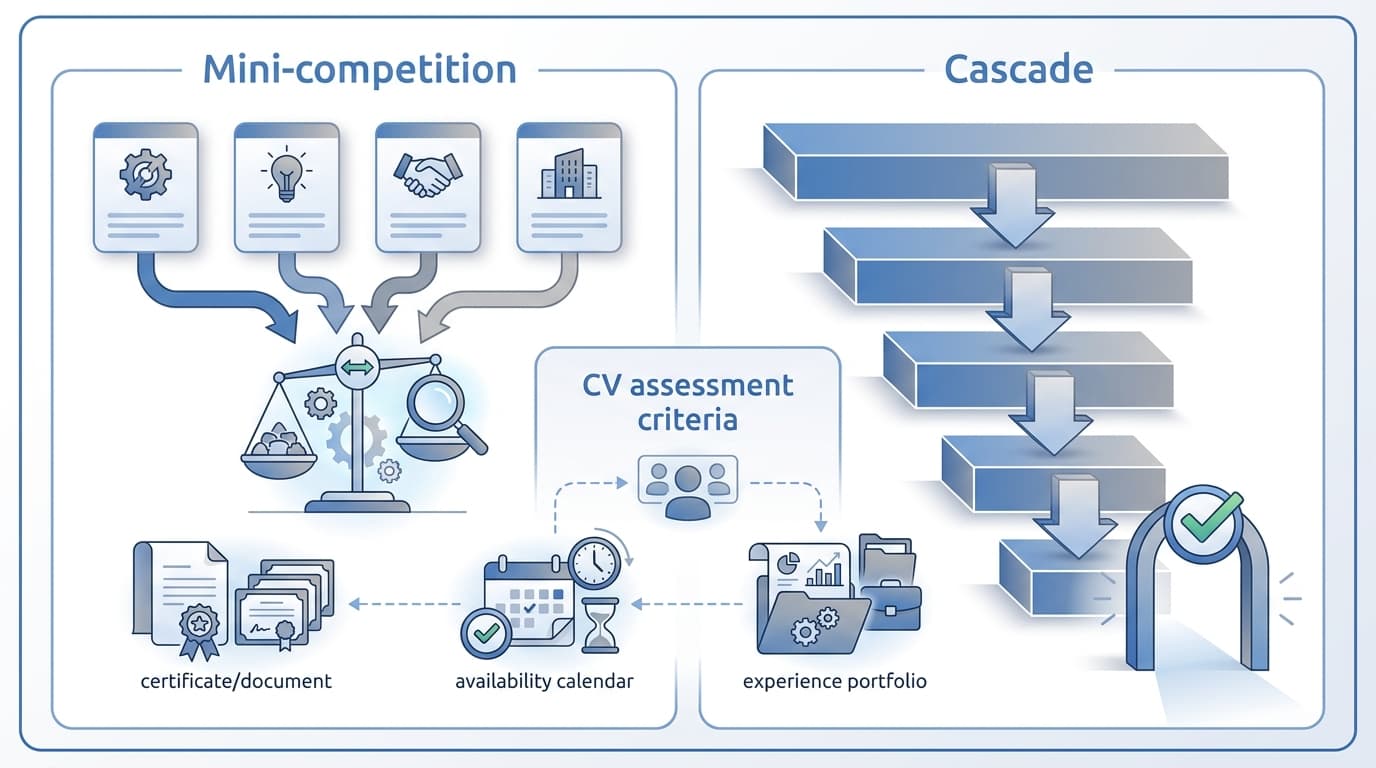
One framework contract, two very different CV tests
In EU framework-contract staffing, a strong consultant can still lose an assignment because their CV was written for the wrong call-off mechanism. That is the most common mistake: treating every request as a standard recruitment exercise and submitting the same broad, polished profile every time.
That approach fails because mini-competition and cascade call-offs answer different buyer questions. A mini-competition asks whether your consultant is stronger than the other profiles submitted for one defined task. A cascade asks whether the consultant supplied by the highest-ranked contractor meets the requirement clearly enough to award without moving to the next supplier.
The practical rule is simple: write to win the comparison in a mini-competition; write to pass the suitability test quickly in a cascade. The underlying experience may be the same, but the evidence, order and emphasis in the CV should change. If the overall call-off chain is new to you, start with how EU framework contracts turn into consultant assignments.
The recommended approach: identify the mechanism before touching the CV
Do not start by updating job titles, adding generic skills or compressing your whole career into a shorter document. Start with the call-off language. The wording in the framework documents or request for service tells you how the evaluator will read the profile.
Call-off wording -> Evaluation logic -> CV structure -> Stronger submission
This is the efficient way to work because it stops you from making the CV impressive in the abstract and instead makes it useful to the evaluator making this decision.
What to have ready before tailoring a profile
A well-targeted submission depends on evidence, not confident wording. Before preparing the CV, bring together the assignment requirements and the consultant’s verifiable experience.
- The request for service, assignment notice or terms of reference.
- The stated role title, scope, deliverables and required expertise.
- Any minimum requirements and award criteria.
- The consultant’s employment history, project dates, roles, deliverables and qualifications.
- Confirmed language ability, availability, notice period and relevant practical delivery capacity where requested.
Do not rely on memory. If a required skill, project or qualification is real but cannot be found easily in the CV, it may as well not exist for evaluation purposes. Tender evaluators assess the evidence in front of them, not the experience they suspect a consultant may have.
Step 1: Read the tender language for the call-off signal
The first task is to establish whether the institution is running a competitive comparison or following an existing supplier ranking.
Mini-competition wording commonly states that the contracting authority will invite framework contractors to submit offers for each specific task. It may say that the award will be made to the economically most advantageous tender, or that consultants will be evaluated against the minimum requirements and award criteria in the request for service.
Cascade wording is different. Look for language such as the framework being ranked in cascade order, call-offs being made from the highest-ranked contractor, or the contracting authority approaching contractors in descending order until it obtains a suitable offer.
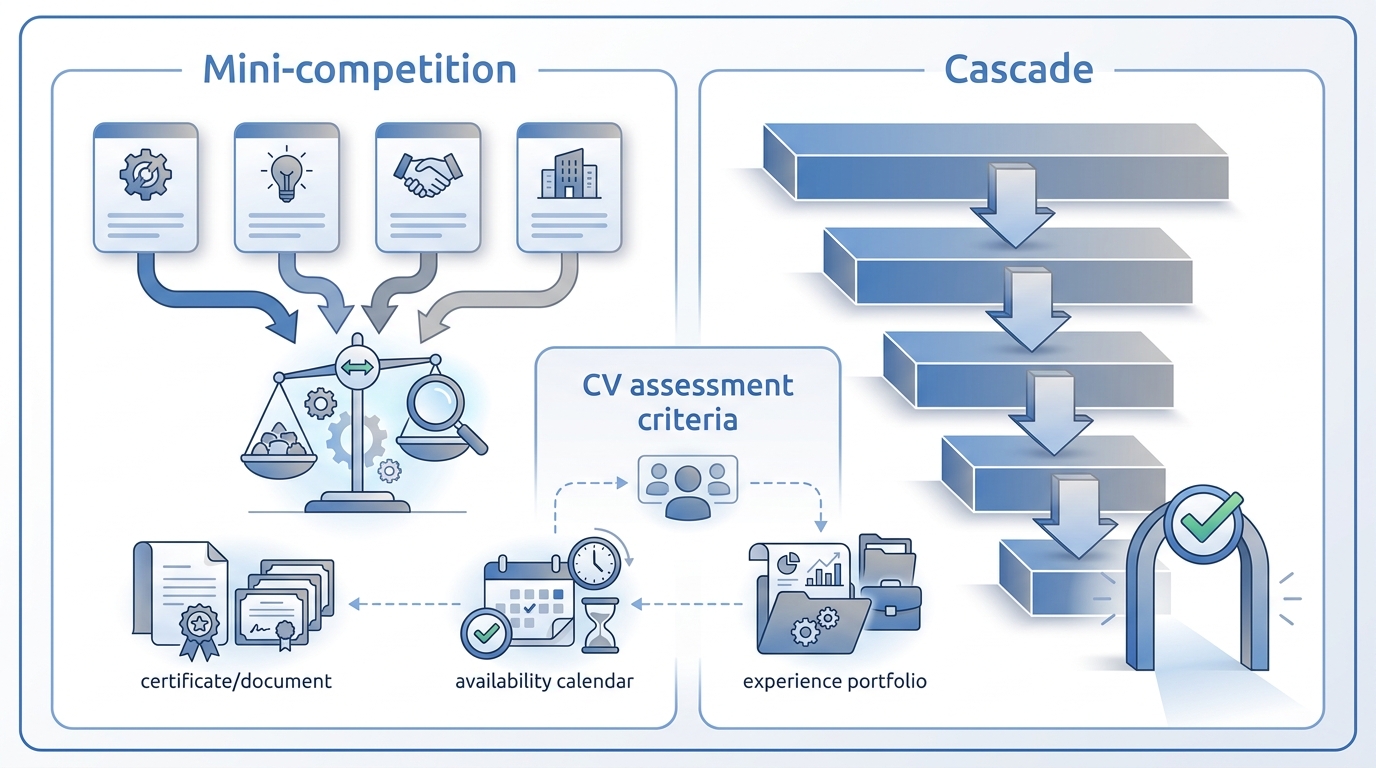
The distinction is not procedural jargon. It tells you what the evaluator is comparing:
- Mini-competition: the consultant profile is compared with other submitted profiles.
- Cascade: the profile is compared with the specification. The next supplier is approached only if the higher-ranked supplier cannot provide a suitable consultant or declines the assignment.
The judgment call: if the request contains both minimum requirements and award criteria, do not assume it is a cascade just because compliance is mentioned. Mini-competitions also have minimum thresholds. The decisive signal is whether multiple contractors are invited to compete for the individual task.
Step 2: For a mini-competition, build a CV that wins the comparison
In a mini-competition, meeting the minimum requirement is necessary but rarely enough. The evaluator is looking across several proposed consultants and deciding which profile is the closest, strongest and most credible match for that assignment.
Common scoring dimensions include directly relevant experience, similar projects, sector knowledge, specific tools, policy or methodology experience, languages, availability, and sometimes an interview or written justification. This makes the CV a competitive document: it must show not merely that the consultant can do the work, but why their experience is more relevant than that of other candidates.
Assignment criteria -> Direct evidence -> Relative advantage
Put relevance before completeness
The best mini-competition CV is sharply tailored. Put the most comparable assignment first in the experience section, even if it is not the oldest or broadest role. Lead with the work that most closely resembles the requested deliverables, institutional setting, methods and scope.
- Use the assignment’s terminology for the role, scope and deliverables.
- Highlight repeated work of the same type, not general seniority alone.
- Show comparable institutional or public-sector environments where relevant.
- State tangible outputs and project scale when those facts are available.
- Bring forward distinctive niche expertise that competing profiles may not match.
- Include a clear one-line availability statement near the top.
Strong evidence sounds specific: “Led the redesign of a procurement evaluation framework for an EU-funded programme” says far more than “Experienced procurement expert.” Likewise, a statement such as “Managed multiple framework call-offs across policy and technical workstreams” gives the evaluator a relevant delivery signal rather than a vague capability claim.
What goes wrong: submitting a “generalist excellent consultant” CV. A long list of unrelated achievements may demonstrate a successful career, but it performs badly when evaluators are comparing profiles against one narrow task. In a mini-competition, broadness can hide the very evidence that should win points.

Step 3: For a cascade, build a CV that passes the test fast
In a cascade, the major competition happened earlier, when contractors were ranked for the framework or through a later ranking exercise. For the individual call-off, the first-ranked supplier is approached first. The buyer needs to establish whether that supplier can provide a consultant who fits the requested profile.
That makes the CV a compliance document before it becomes a marketing document. The profile needs to be easy to check, easy to trace and explicit about every essential requirement.
Mandatory requirement -> Explicit proof -> Fast suitability decision
Make the mandatory match impossible to miss
Start with a factual profile summary that directly answers the requisition. Use the requested role title. State the relevant seniority or qualification level, required languages, availability and location flexibility where those points are required. If permitted, add a short Match to Requirements section so that the evaluator does not have to search the document for core evidence.
- State mandatory qualifications clearly and early.
- Use the exact terminology used in the request for service.
- Make dates, employer names, project titles and responsibilities easy to verify.
- Show clear chronology and avoid unexplained employment gaps.
- State the real availability date and notice period.
- Include requested credentials, language certificates or other formal evidence.
- Document practical delivery capacity, such as travel readiness, onsite availability or security-clearance information, when requested.
For cascade submissions, direct factual phrasing works best: “Meets the required seniority level with documented relevant experience,” “Available to start within the stated timeframe,” and “Completed assignments matching the requested technical scope.” These statements should be supported by the chronology and project descriptions below them.
What goes wrong: ambiguity. If the CV implies a qualification rather than stating it, the evaluator may not infer the missing connection. A beautiful profile with unclear dates, unspecified languages or buried credentials creates unnecessary risk. In a cascade, clarity is not a cosmetic improvement; it is what keeps the buyer from moving to the next supplier.
How the same factor is judged differently
| Evaluation factor | Mini-competition | Cascade |
|---|---|---|
| Main evaluator question | Why is this consultant stronger than the other submitted profiles? | Does this consultant meet the requirement now? |
| Primary filter | Relative merit against competing candidates | Minimum compliance and precise fit |
| Best CV style | Targeted, competitive and evidence-rich | Explicit, structured and easy to verify |
| Most valuable content | Deep relevance to the task and comparable delivery | Clear proof of mandatory criteria and availability |
| Common failure | Being generic, broad or poorly prioritised | Being unclear, incomplete or difficult to check |
A practical top-of-CV structure for each mechanism
The top third of the CV matters disproportionately because it shapes how the evaluator reads everything that follows. Do not make them work to discover the match.
For a mini-competition
- A tailored profile summary linked to the assignment scope.
- Three to five points of directly relevant expertise.
- The most comparable achievements, deliverables or assignments.
- Relevant sectors, methods, tools or policy areas.
- A concise availability statement.
For a cascade
- The role title used in the tender.
- Mandatory qualifications and required seniority.
- Required languages and relevant formal credentials.
- Availability, location and delivery-readiness information where requested.
- A short, factual statement showing compliance with essential criteria.
The rest of the CV should then support that opening with reverse-chronological employment history and assignment-by-assignment project descriptions. For each relevant project, make the client or institution type, dates, role, deliverables, methods and outputs clear.
Troubleshooting the failure points that cost good profiles
The CV is strong, but it still feels generic
Why it happens: the document describes capabilities at a high level rather than proving direct relevance. Terms such as “strategic,” “senior” and “experienced” do not distinguish a profile when every supplier uses them.
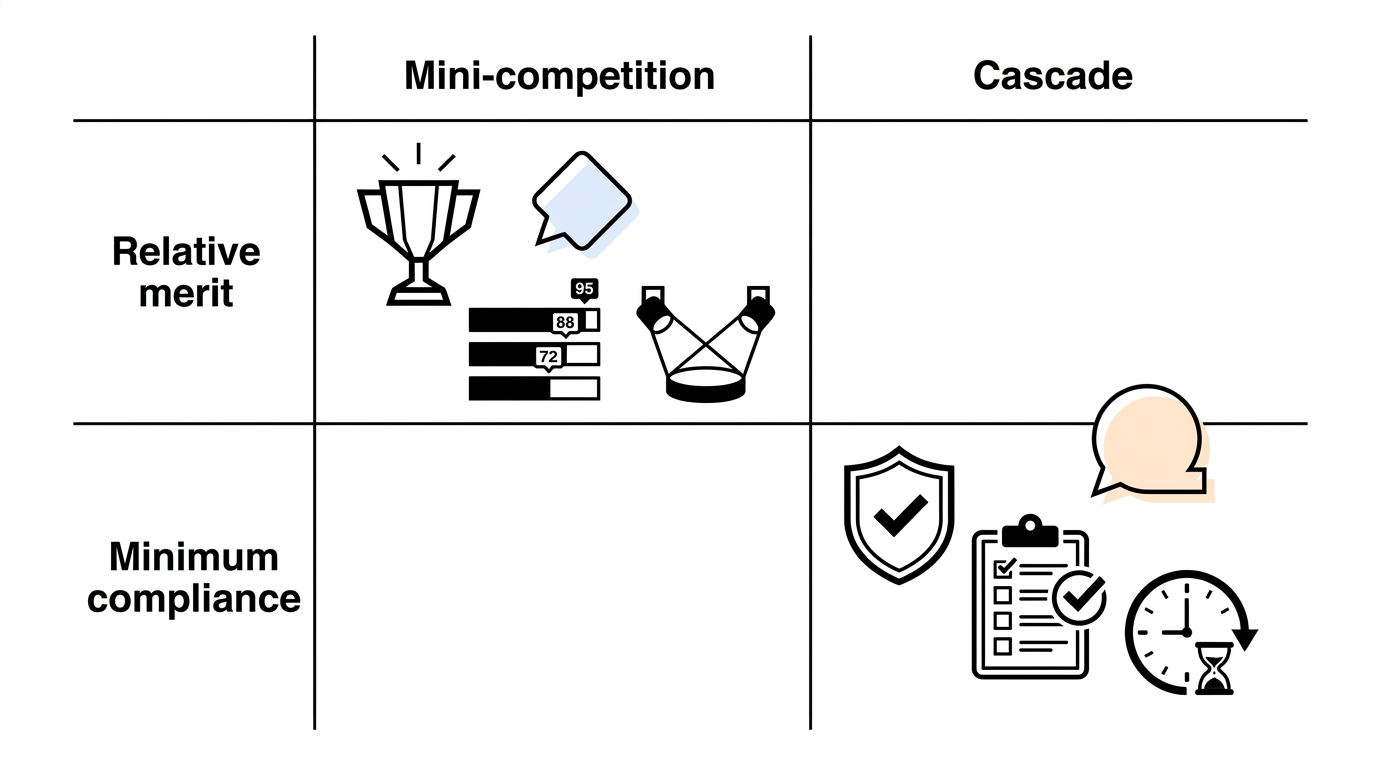
Fix: replace broad claims with assignment-specific evidence. Bring forward projects with matching deliverables, institutional context, sector knowledge and methodologies. In a mini-competition, this is how you create a visible advantage.
The consultant meets the criteria, but the proof is scattered
Why it happens: the CV was written as a career narrative rather than an evaluation document. The reviewer has to connect dates, projects, qualifications and skills themselves.
Fix: state essential facts early, then repeat the supporting evidence in the relevant employment and project sections. This is especially important in cascade call-offs, where the buyer needs a fast, confident suitability decision.
The role title does not match the request
Why it happens: consultants often use their preferred market title rather than the terminology in the request. That can make a close match look weaker than it is.
Fix: use the assignment’s role title in the tailored profile summary, while keeping the underlying employment title accurate in the chronology. This gives the evaluator a direct line between the request and the proposed consultant.
The better way: keep the evidence factual, then change the emphasis
The advanced move is not to invent two different professional identities. It is to use the same verified experience with two different evaluator lenses.
- For a mini-competition, make the strongest relevant experience prominent and show why it is superior for this task.
- For a cascade, make every mandatory requirement explicit and make the document simple to validate.
In both cases, avoid inflated claims, long narrative paragraphs and one-size-fits-all formatting. The winning CV is specific, structured and directly mapped to the tender criteria. The difference is whether it needs to demonstrate relative strength or unambiguous suitability.
TL;DR: the key moves
- Identify the call-off mechanism from the tender language before tailoring the CV.
- In a mini-competition, competing profiles are assessed side by side; in a cascade, one profile is checked against the specification.
- In a mini-competition, lead with exact task relevance, comparable assignments, distinctive expertise and evidence-rich achievements.
- In a cascade, lead with mandatory criteria, qualifications, languages, chronology and confirmed availability.
- Do not submit the same general CV for both mechanisms.
- Write to win the comparison in mini-competition and to pass the test fast in cascade.